Royal Liverpool University Hospital by Sasha Ward

This was a commission that I thought would never get finished. A new Liverpool Hospital has been built next to the old one which is due for demolition. During the course of its construction, the main building contractor, Carillion, went bust, faults were discovered in the building and with the cladding that had been used causing further costs and delays which were added to by the pandemic. The selected artists, who had been contracted to Carillion, stored their work and waited to see what would happen next. Understandably, my enthusiasm for the project started draining away as the seven oval glass panels I had made were stored behind my kiln for five years.

Drawing for glass and wall design at Ward 7A, 2015.

The selected artists had each been asked to design work for walls next to the four ward entrances on their allocated level, mine was the seventh with bright green accents. Hospitals often ask for artwork that is organic and curvy, definitely not geometric, a look that I have struggled with over the years of doing commissions for health care settings. On this occasion I decided to go for no straight lines or interlocking patterns, taking inspiration from the natural world rather than the urban environment. For each location I designed a swirly drawing that would be printed on vinyl wallpaper with shaped pieces of glass mounted on top of a pool of pale colour.

The wall next to Ward 7A (above and below) changed shape and colour during the course of the years, with a piece of glass that is the biggest and I think the best. It was hard to photograph on installation day with reflections from a screen opposite and equipment stored up against it (below).

Ward 7A during installation, left wallpaper, right with glass on top.

Ward 7D, from drawing to glass, 2015 & 2022.

Ward 7D is similar, and for this one my first drawing (above left) shows the initial concept where lines and circles spiral into the pool of overlapping colours. However, the blank wall had been too much for someone to resist, and when I visited just before installation I saw that a square access hatch had been cut into it so I moved the glass up and some white lines around on the design. This wall is opposite a window which provides some great reflections of the the new building (below right) which is white and grey and spiky in design.

Details of wall and glass at Ward 7D.

Drawing for Ward 7C, 2016.

The wall leading up to Ward 7C had room for two glass panels above the crash rail. My watercolour drawing for this one (above) is closest in feel and colour to the work installed. The changes I made to the shape of the lines and the positioning of the panels happened because of a fire alarm that I had to keep well away from. The detail (lower right) shows how the ceiling lights are effective in picking up the lines sandblasted on the edge of the glass and mixing them with fine white lines printed onto the background vinyl.

Entrance to Ward 7C

Details of the glass at Ward 7C

Drawing for Ward 7B

The wall leading up to Ward 7B, six metres long, is the one that didn’t change so neither did the lines on my watercolour drawing (above). It’s a piece of wall between bays of windows - wouldn’t it be lovely and simple to be able to go back to doing windows again! This series of three looks the simplest and cleanest with an unfortunate resemblance to a row of washing machines.

Wallpaper and glass for Ward 7C
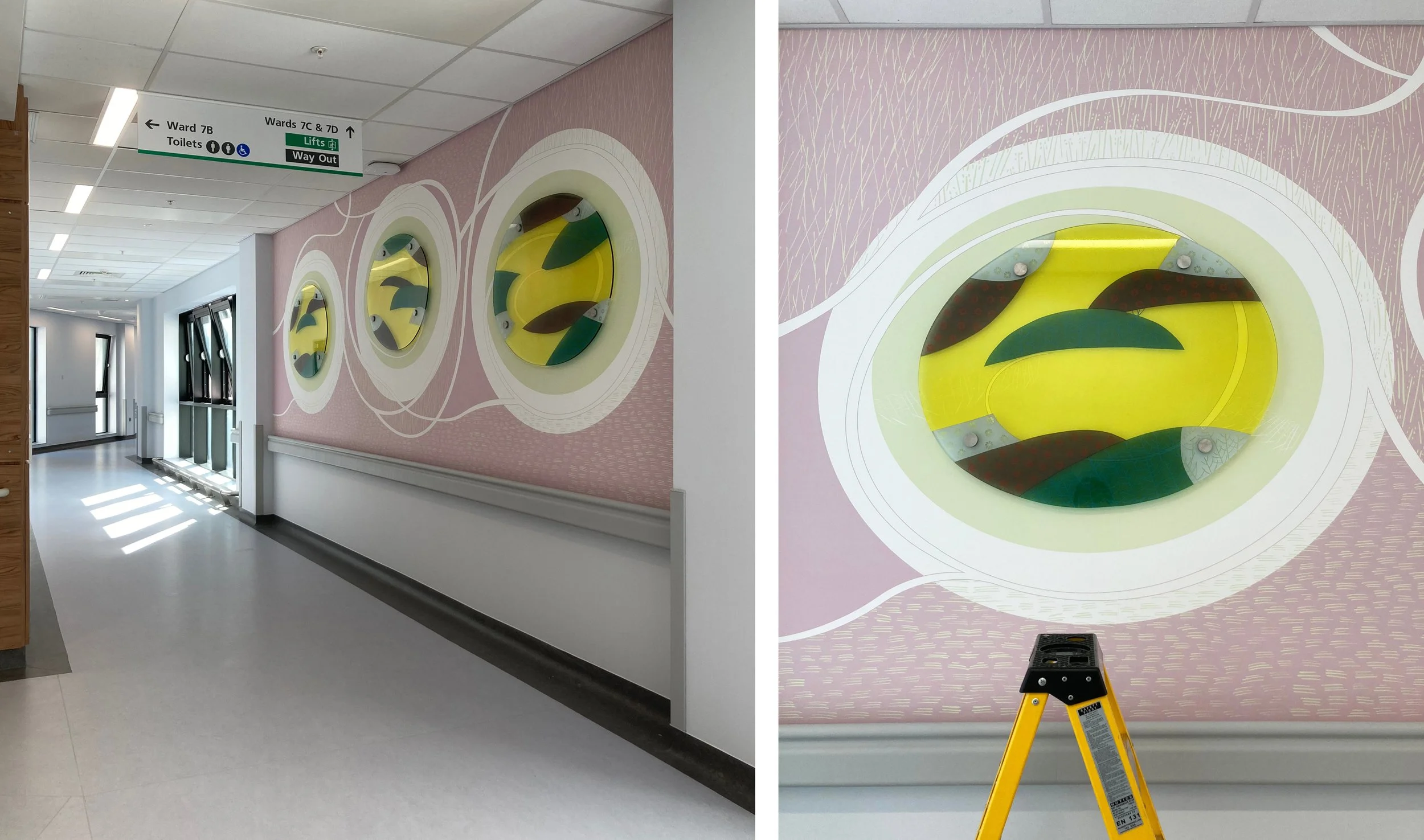
Corridor at Ward 7C and detail of glass panel during installation.

Overall, I am delighted with my last hospital commission. The no straight lines design looks effortless and was very easy to alter over the years and to install. Above all the colours look great, the transparent enamels on the glass are strong against the pastel coloured wallpaper and complement the tricky green on level 7. It’s hard to find your way around this building, hopefully this commission will help you remember the way and give you a boost of energy as you watch the patterns swirling around.

vinyl patchwork by Sasha Ward

Scraps of sample adhesive vinyl.

The long term plan for blocking the view through the bay window and into the sitting room (below) is to make a stained glass window. The short term plan was to use scraps of printed adhesive vinyl, otherwise know as window film, to make a patchwork in the window so we could get rid of the hated lace curtain. The before and after photos show the transformation of the room (mostly by painting it) and the surprising way that the coloured vinyl works. It blocks the view more but lets light through, with none of the droopiness you got from the lace curtain.

Levenshulme window - before and after.

Levenshulme window - inside and outside.

The easy part was the design, kept simple with repeated, accurately cut shapes that could be moved around later. The hard part was the installation, some of the vinyl was too old or bent to stick properly and some of it looked too pale against the opaque colours (which have a white backing that you can see on the photo of the window from the outside) and had to be discarded.

Hexagons are always good, they make the design feel open and slightly curvy, but the three ‘flowers’ we planned, each with a red centre, don’t stand out because of the different properties of the different types of vinyl - it’s like mixing cotton and silk and thinking you wouldn’t notice. This vinyl project is a useful step towards designing the future stained glass window which will be a collaborative effort (this is my daughter’s house). I’ll be advocating that some red stays in.

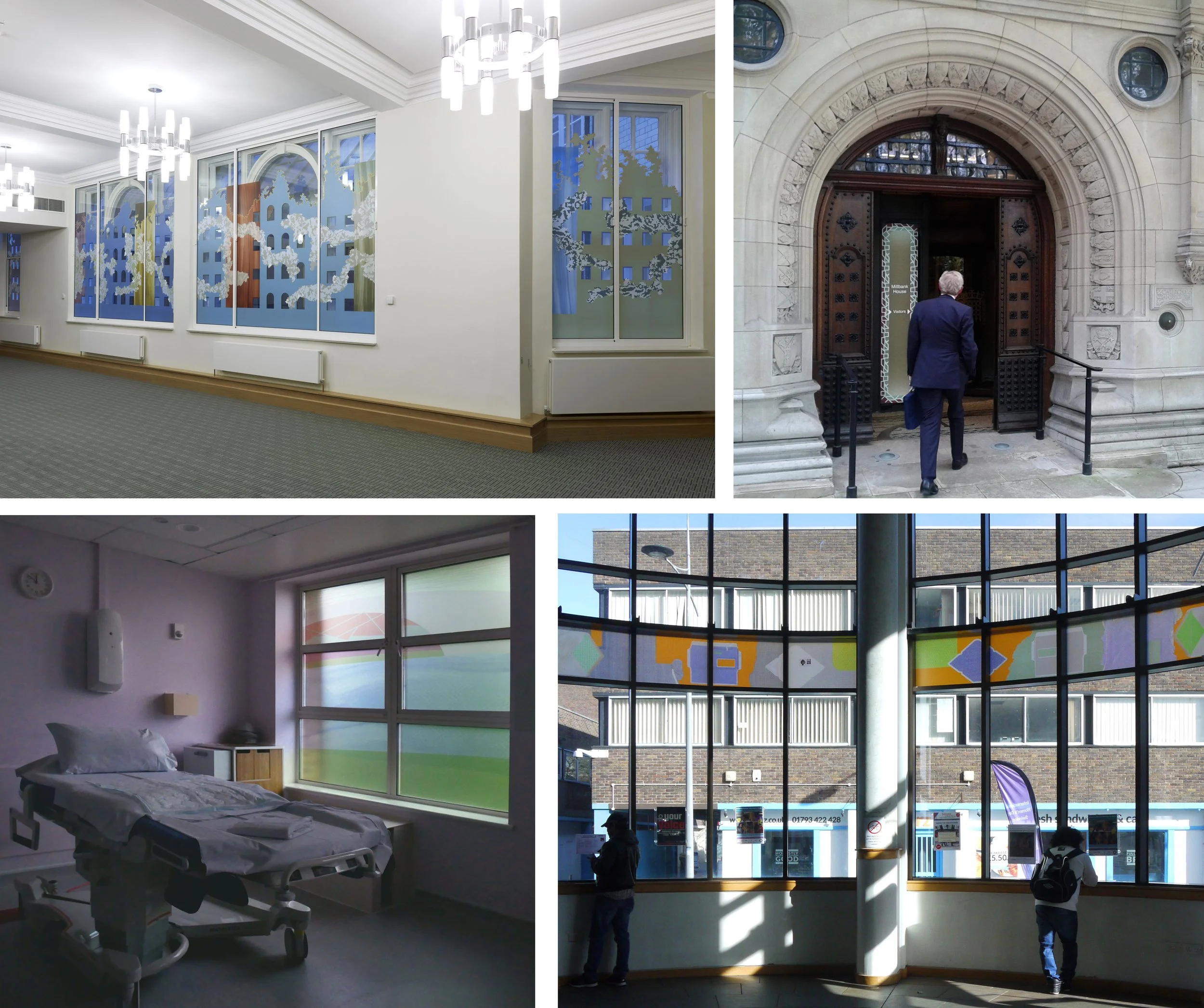
The red vinyl stands out because it’s the only sample that I didn’t design. The other pieces we used are samples from four projects shown below. One at Millbank House where the aim was to block a building right outside the windows with peepholes remaining, two at the entrance to the same building to cover an over bright lightbox, three next to a maternity bed at Dorchester Hospital where privacy was vital, and four from was a design I always really liked installed as part of an exhibition about public art at Swindon library.

Origins of the vinyl leftovers - temporary commissions for The House of Lords Library at Millbank House (2011), The entrance to Millbank House (2012), Dorchester Hospital Maternity Suite (2019) and Swindon Library (2017).

Even northern french light by Sasha Ward

Above and below: Church of St Martin, Romilly-sur-Seine. Windows by Joël Mône.

For our last day of stained glass sight seeing in France we chose, from another excellent tourist leaflet complete with map, two churches with windows made in the twenty first century. The large church of St. Martin in Romilly-sur-Seine has a series of windows by Joël Mône above what looks like a huge layer of bird netting. There is a very effective white, textured one above the west door, and a spectrum of coloured windows from yellow to red (in the south transept) through pink and purple to blue (in the north transept) and finally to turquoise and green. The colour sequence is interrupted by nineteenth century stained glass windows around the apse and, as you can see in the photos where similar glass can be seen in the lower windows of the church, the new windows sit well with the old ones by not imitating them in any way.

St. Martin, Romilly-sur-Seine, with blue window representing the baptism of Christ in the centre.

Initially I found the new windows, installed in 2013, uninteresting and the concept of the rainbow colours clichéd. In the church was a diagram that explained the sequence in terms of water and light at the green and yellow ends (cliché upon cliché) with each window linked to a bible story in the traditional way, starting with the old testament at the west and ending with the new testament either side of the altar. Now that I look at the window designs in more detail next to the verses that inspired them, I am more appreciative of the scheme and the attempt to interpret the words of the bible in an abstract manner.

Church of St Peter and St Paul, Villenauxe-la-Grande. Windows on the south side by David Tremlett.

Our last stop was Villenauxe-la-Grande, and a scheme of windows - all the glazing in the church of St Peter and St Paul - by the British artist David Tremlett that I’ve wanted to see since I read an article about them in 2005 when they were installed. 200 square metres of glass over 25 windows makes this the most significant church commission in France for twenty years, according to the leaflet. David Tremlett had not designed much for stained glass before he won this commission which was executed by the studio of Simon Marq in Reims, but this typically French stained glass system, where an artist is paired with a master stained glass maker, works perfectly here, as indeed it does in many of the churches we’ve visited on this trip.

Villenauxe-la-Grande. Windows on the north side by David Tremlett.

I think of these windows as giant watercolours, they are opalescent rather than transparent, with white lines bordering colours that remind you of the edge of a piece of paper. There is a bewildering variety of design but a consistency of scale and technique, Tremlett says that he wants each window to relate to the next one, but also to stand on its own. I imagine how satisfied the artist would have felt on seeing the commission completed - daring, original and seeming to add light to the interior with a wonderful range of light, bright colours.

Villenauxe-la-Grande. Left: Window 2 (Christ). Right: Windows 4 (Christ), windows 6 & 8 (the vine).

I chose as my favourite window no 2 in the scheme (above left), which with its pair, represents Christ. I had to keep blocking the next two windows out of my vision (above right) their spottiness represents to me the worst aspects of decorativeness - what was he thinking of? The diagram of the windows, spookily similar to the one in the church at Romilly-sur-Seine, says they represent the vine. The subject matter for the other windows goes from earth, through fire, ceramic (for the benefactor of the windows) to the virgin Mary, the paschal mystery, Christ, air and water.

Villenauxe-la-Grande. Left: Window 9 (fire), windows 7 & 5 (ceramic). Right: Windows 3 & 1 (The Virgin Mary).

Villenauxe-la-Grande. Left: Window 12 (air), windows 14 & 16 (water). Right: Windows 20 & 22 at the south west corner.

This was my favourite stained glass interior of all the ones we visited on this trip - see my last four blog posts for comparisons. I knew I would like the designs and the differences between the windows, but the success of stained glass windows, their luminosity, colour and detail, depend on their manufacture and in this case they were made by the best there is. I thought a view of the outside of the windows would give a clue as to how they’re made (below), it’s also interesting to see the wire mesh over them all that is hardly visible from the inside and to see the colour of the sky - the even northern french light that is perfect for the viewing of stained glass.

Villenauxe-la-Grande, windows 7 and 3 from the outside.

Stained Glass City by Sasha Ward

Troyes Cathedral. Left and centre, three tiers of windows around the nave. Right, rose window in south transept.

Troyes, capital of the Aube département, calls itself the stained glass city. ‘The saying goes that France is home to 80% of the world’s stained glass windows, that 80% of French stained glass windows are located north of the Loire, that 80% of the stained glass windows north of the Loire are in the Champagne region, and that 80% of the stained glass windows in the Champagne region are in the Aube département ‘ - this from the city’s tourist web site. The opening of Troyes’ stained glass museum is imminent, meanwhile a wonderful map and series of leaflets leads you from cathedral to basilica to church after church, some of them (mercifully) locked as you begin to overdose on the best medieval and renaissance stained glass you could hope for.

After all the modern stained glass we’d been seeing, the windows in the Cathedral of St Peter and St Paul in Troyes were a reminder of another side of stained glass - the one where you stand in wonder at the intricacy of the pattern making and then stay for hours finding the stories, the characters and the landscapes in the windows.

Troyes Cathedral. Left, the south side of the nave. Right, windows in the chapels on the south side of the nave.

Forgetting to take my proper camera (apologies for mentioning this again!) gave me more time to stand and stare and to focus on pattern rather than on finding favourite details. I loved looking at the rows of striped leading filled with stories and parables high up on the south side of the nave (above left) and then looking down to the chapels at ground level with a whole variety of rich styles and colours in windows made from the 13th to 19th centuries. The most useful leaflet imaginable tells you the date, the makers’ names when known and the date of restoration of each window. Best of all was a window in the chapel of the Immaculate Conception made in 1524 in the workshop of Jean Soudain (below right).

Troyes Cathedral. Left and centre, C13th glass in chapels around the apse. Right, window of the Immaculate Conception.

St Urban Basilica, Troyes.

You get a more concise stained glass experience inside the Basilica of St Urban, a massive but delicate gothic church a short walk away from the cathedral. This church was begun in 1262 at the expense of Pope Urban IV, a native of Troyes. The stained glass windows are from the late thirteenth century, they soar above the alter, creating a luminous area that shines right out of the church (above). This effect comes not only from the height of the bands of windows, but also from the large amount of pale grisaille glass that is used around the strip of bright figures. The ornaments in the borders are simple and heraldic, with flashes of rainbow chevrons that contrast with foliage patterns on the white glass ground. Another set of windows (below right) has an all over circular pattern, stronger than the little figurative scenes they encircle. All these windows with their jazzy details are seen through an interior screen of empty stone windows that contribute to the effect of a delicate cage.

The windows of St Urban Basilica.

Church of St Madeleine, Troyes. Centre and right, creation window (c.1500).

The map took us through medieval streets to St Madeleine, a church with a claim to being the oldest and most beautiful in the city. The atmosphere is quite different, intimate and rich with an astonishing carved stone rood screen right across the centre of the space and a series of incredibly fine windows in the apse. It’s great to be able to get close to these and to read the stories, strip cartoon style, of the creation (above right), the lives of Saints Eloi and Louis, The Passion of Christ (below right), and a wonderfully composed and painted Jesse’s Tree (below) in a design that scrolls across the mullions and leading stripes. Seeing this series side by side shows up the stylistic differences, some with captions under each picture and some with words floating on banners. The designs are organised around elaborate top tracery, different in each one and daringly complicated with figures using up every scrap of glass as they tell the story right to the top of each window.

Windows in the church of St Madeleine, Troyes. Centre, Jesse’s Tree (c.1500). Right, The Passion of Christ (c.1490).

Fashions in Stained glass by Sasha Ward

Cathedral of St Mary of the Assumption, Vaison-La-Romaine

In this account of our road trip we are now on the way home, travelling from the south of France back to Calais. First stop Vaison-La-Romaine where, at the top of the medieval town with a view over Mont Ventoux, is the recently restored Cathedral of St Mary of the Assumption. All the windows are the work of the artist and Dominican preacher Kim En Joong, who has been making stained glass for French cathedrals and churches since 1989. These are the first I have seen in reality and the semi restored state of the cathedral seemed the perfect setting for his floating calligraphic style.

Vaison-La-Romaine, all windows by Kim En Joong, 2018-19 (above and below).

Kim En Joong travelled from South Korea, where he studied traditional taoist calligraphy and fine art, to Switzerland where he studied art history, theology and metaphysics before entering the Dominican order. For this commission of nineteen windows, Kim painted the designs on canvas, using mixed materials, tools and layers. These paintings were then interpreted by the German glass studio Derix, with air brushing, hand painting and some layering of the glass to get a perfect imitation of the paintings. The windows are abstract with no overt story telling, they seem both ancient and modern and I think, very safe.

Abbey St Philibert, Tournus.

Our next visit took us further back in time, with exquisite stained glass from the 1960s in the romanesque Abbey of St Philibert, Tournus, built from the eleventh century onwards. Most of the windows are by Brigitte Simon, an artist from a famous stained glass family in Reims and, with her husband Charles Marq, the maker of many of Chagall’s windows. Here, she said her goal had been ‘to extend the impression of the stones and to preserve in this mother-of-pearl space the full melody of its true colour, rose.’

Tournus, all windows by Brigitte Simon, 1964-7 (above and below).

As well as rose, there are glowing golden windows around the apse (top) and very subtle grey ones high up in the nave (above left). The most beautiful one is in a gothic transept windows, with a combination of pink, lilac and neutral coloured glass in wandering lead lines that match the cobwebs (below).

An account of the windows in the abbey tells us a lot about changes in stained glass fashions, some of them due to the course of history. The original alabaster windows from the 11th century were replaced by 12th century stained glass ones. These were destroyed in the 16th century Wars of Religion and another set was installed in the 19th century then blown out during the Second World War. When new windows were installed in the 1950s, they were the work of Pierre Choutet and Max Ingrand. Three of these have been retained, but the rest proved so controversial that they were removed and replaced by Brigitte Simon’s series which take a purely architectural even decorative approach. The controversial windows, at least the ones I’ve seen, are figurative with angular typically 1950s figures in muted colours (below left). The sort of thing we are so used to seeing in european churches that they fade into the background with no chance of offending anyone.

Tournus, Left, chapel window by Choutet or Ingrand. Centre and right, windows by Brigitte Simon.