Two more stories by Sasha Ward

Just Another Story Two black and white drawings by Ray Ward, the second one shows the same scene from inside the room.

Just Another Story Two black and white drawings by Ray Ward, the second one shows the same scene from inside the room.

Just Another Story is an old drawing of Ray’s that he had a copy of on his studio wall with the intention of using it as inspiration for a painting, however I managed to grab it first. In my glass interpretation of the drawing (below) I focused on the architectural setting of the scene, using a white sandblasted line on dark red glass for the exterior and the opposite, a dark red line on white opalescent glass, for the interior. I didn’t want to confuse the lovely simplicity of the lines by introducing lead lines into the picture and I couldn’t quite decide which glass to use for the thickness of the wall between the hopeless man and the sagging woman. I tried the muranese glass (below left) which makes every composition sparkle and which I’ve been overusing, but finally settled on an olive green strip (below right).

Just Another Story Stained glass panel in progress

Just Another Story Stained glass panel in progress

As soon as I put those three colours together, I saw that I could extend the piece by making a leaded border to suggest the extension of the cross section through the house using glass of different tones and textures in the same colour combination. This gave the figures more space and also provided a place to write the title, something I’d intended to do on one of these pieces before but never found the right place.

Just Another Story Final version 385 x 300 mm and detail showing glass textures in natural light.

Just Another Story Final version 385 x 300 mm and detail showing glass textures in natural light.

MememememeME Egg tempera on gesso 375 x 530   Bad Shadow Ink on Paper 420 x 596 mm, both by Ray Ward

MememememeME Egg tempera on gesso 375 x 530 Bad Shadow Ink on Paper 420 x 596 mm, both by Ray Ward

The other drawing of Ray’s that I chose to work from at the same time was one of several versions of a bathroom scene viewed through a window. The most recent version (above left) looks exactly like our old house on Five Stiles Road, but as it’s too hard for me to work from a coloured original I went back to an earlier drawing (above right) where the picture is more extreme, both emotionally and in its lines of perspective. In case you’re wondering what it’s all about this is a quote from Ray.

“For the record, he is seeing a reflection (shadow) of someone he dislikes, any sort of hate being self hate being the sub text. I should know.”

So is this “There is generally some idea behind them all but sometimes knowing that ruins the picture so not always worth knowing”, which is an attitude I adopt as I get on with choosing and cutting the glass.

Bad Shadow: Left, glass pieces cut & laid over copy of drawing. Right, first attempt at stained glass panel.

Bad Shadow: Left, glass pieces cut & laid over copy of drawing. Right, first attempt at stained glass panel.

This panel turned out to be tricky, I had an idea for the bricks which took two layers of sandblasting over a complicated stencil to match the sharp dots in the original drawing. The shading and painting on the bathroom pieces also took two goes, the first time I leaded up the panel (above right) there wasn’t enough sense of space so I added more dark lines and shading, then refired and releaded the pieces (below). This panel is one that looks much better and richer in the natural light of the window rather than on the even light of the lightbox, which to me is a sign of success.

Above, Bad Shadow, final version 325 x 385 mm. Below, detail of Bad Shadow.
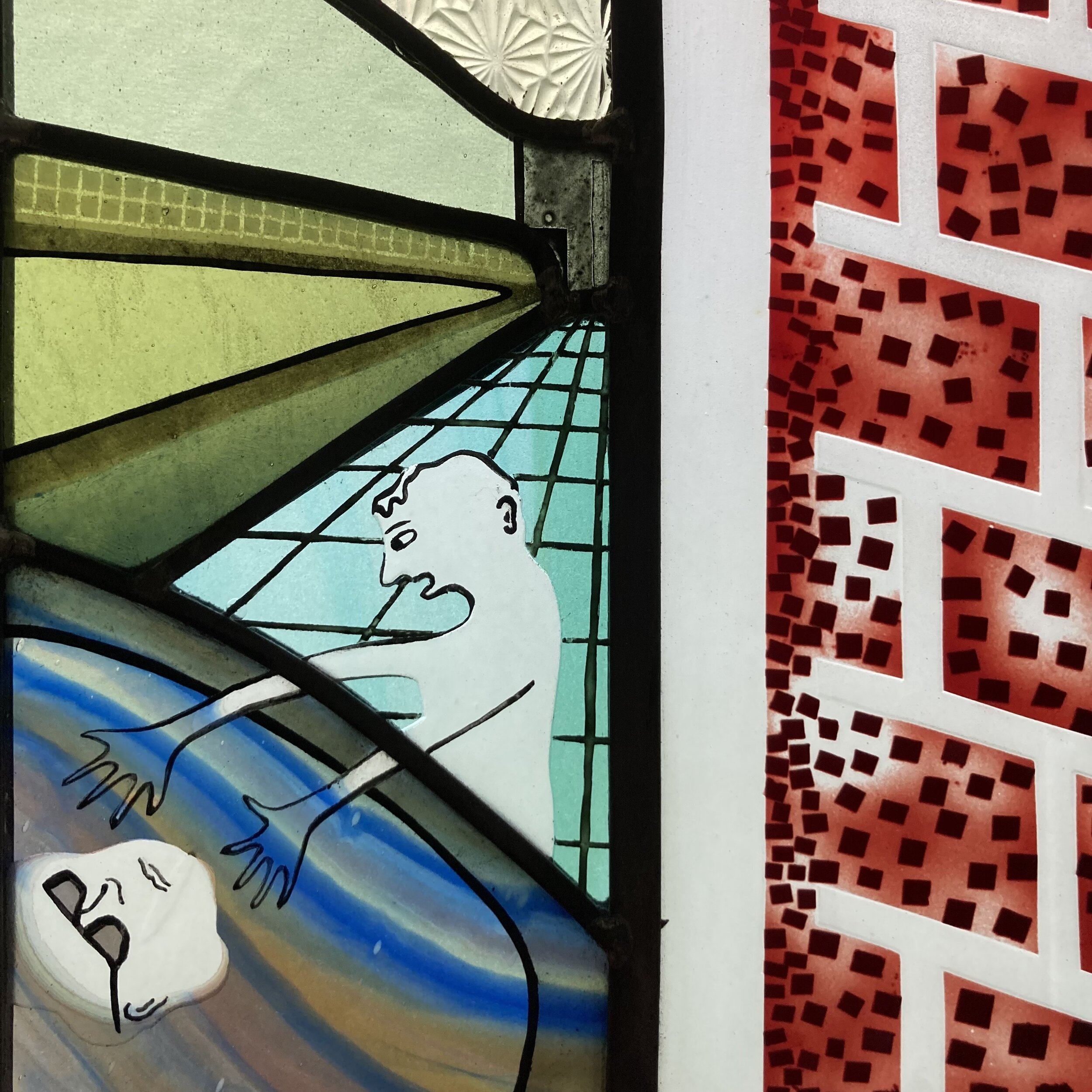
Above, Bad Shadow, final version 325 x 385 mm. Below, detail of Bad Shadow.

IMG_1914.jpg

East Wittering and Earnley churches by Sasha Ward

St Anne, East Wittering, West Sussex. Designed by Harry Sherwood, built in 1959. Detail shows south wall.

St Anne, East Wittering, West Sussex. Designed by Harry Sherwood, built in 1959. Detail shows south wall.

On a trip to West Sussex I went to find a Madonna and child window by Patience Hallward I’d seen on the screen (below). She’s got cartoonish eyes but also beautifully drawn hands with delicate painting on the figure and the surrounding glass pieces. It was a treat to discover how interesting the whole church, built to replace an older one still standing and currently for sale, in the village is.

St Anne, East Wittering. Chapel dedicated to St Mary built in 1986 with windows by Patience Hallward, made in 1951 for the church that this one replaced.

St Anne, East Wittering. Chapel dedicated to St Mary built in 1986 with windows by Patience Hallward, made in 1951 for the church that this one replaced.

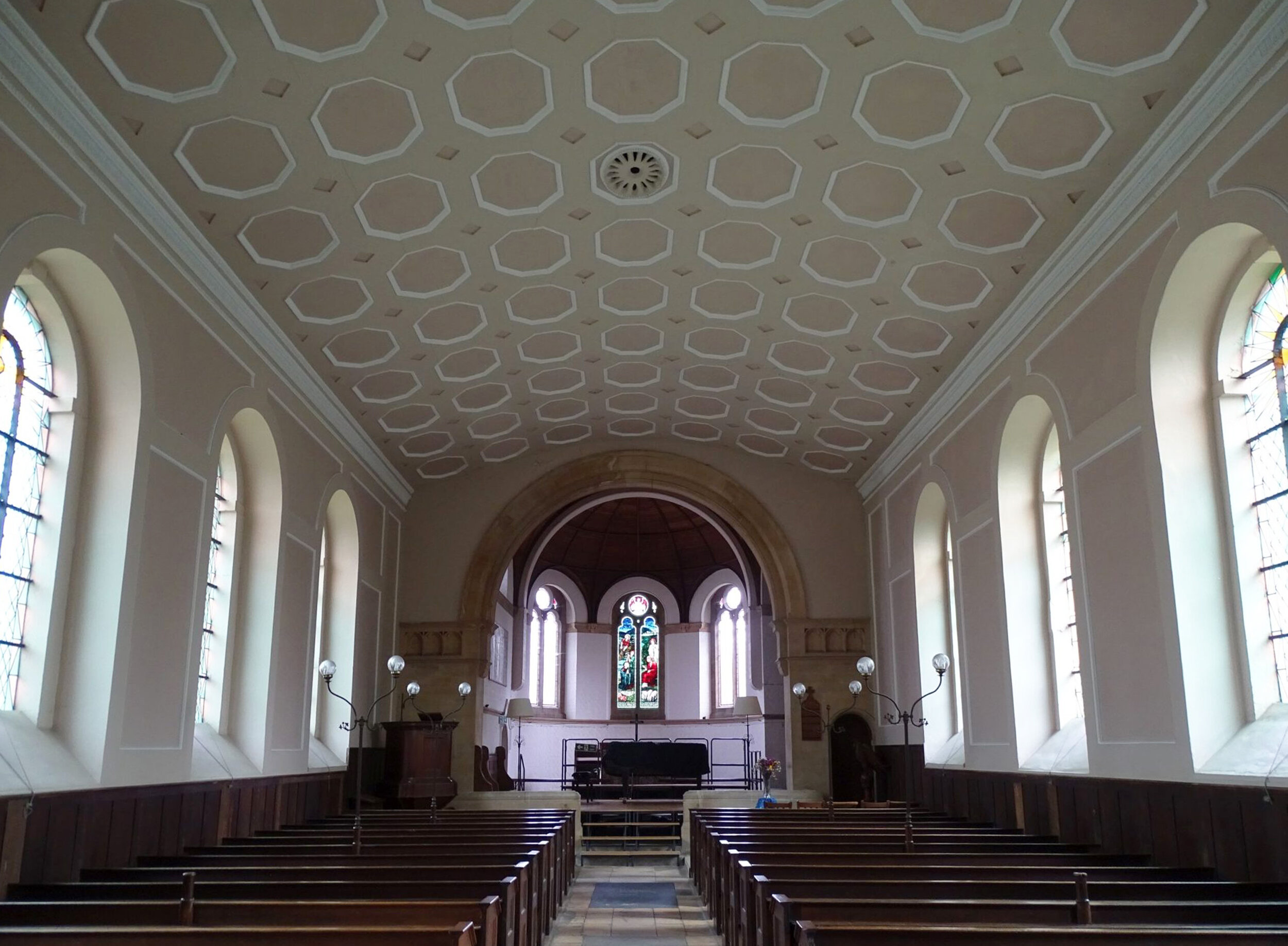
Everything in the church is considered and appropriate to the architecture, from the staircase to the kneelers to the original wall heaters. It has recently been painted blue, the very welcoming ladies in the church said ‘You can imagine how long it took for the colour to be agreed’ and they also said that they didn’t like all of the stained glass. The small lower windows throughout the church are filled with a complete set of stained glass windows, contemporary with the church, by John Baker. He was a teacher, maker and restorer of the stained glass at Canterbury Cathedral, well known also for English Stained Glass of the Medieval period, a Thames & Hudson book of colour plates that I’ve owned since 1978.

Interior of the church showing row of ten windows along the south wall.

Interior of the church showing row of ten windows along the south wall.

Windows 1 to 4 (5 is missing, being repaired). Also shown in photo above left.

Windows 1 to 4 (5 is missing, being repaired). Also shown in photo above left.

Windows 6 to 10. Also shown in photo above right.

Windows 6 to 10. Also shown in photo above right.

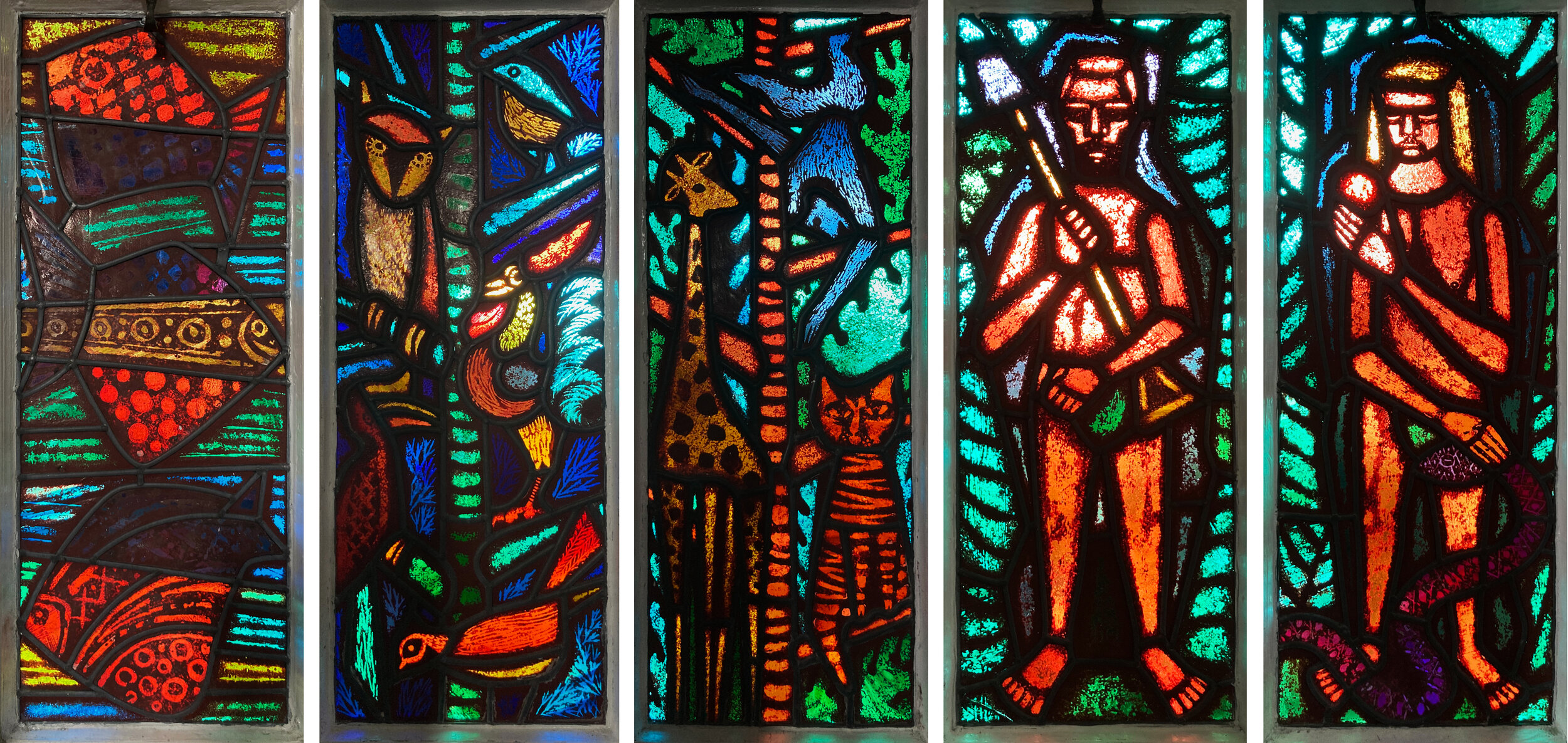
The windows have a huge impact in terms of colour, which you can see particularly well in the photo of the interior with coloured light illuminating the window reveals of the first three windows in the sequence. The use of strong colour with black iron oxide paint disguising the lead lines is particularly marked throughout, the only places where this doesn’t work are where the windows are positioned opposite one of the large clear upper windows which throw too much front light on the stained glass directly opposite. The first ten windows illustrate Creation, I think the missing one may show plant life. It turned out that the ones the church ladies weren’t keen on were the bird and animal windows (7 & 8 in my numbering) on the grounds that they don’t fit in with the sequence stylistically. I think they are right and the designs, although attractive, are too complicated unlike the Adam and Eve that follow in the sequence and are very strong.

Window 11 - St John the Baptist, Window 12 - Pentecost, Window 13 - Saul’s conversion.

Window 11 - St John the Baptist, Window 12 - Pentecost, Window 13 - Saul’s conversion.

The best three are at the west end of the church, with powerful figures, faces and colour combinations (above). There is another row of five in the chapel (below) which have much less impact, which I think is due to the complexity of the designs with their kaleidoscopic colour combinations.

New testament scenes in the Chapel.

New testament scenes in the Chapel.

Earnley Church exterior and interior showing the two stained glass windows.

Earnley Church exterior and interior showing the two stained glass windows.

Next stop was Earnley, just a mile and a half away, a church with no dedication to a saint and a 13th century nave. This church is also exceptionally well cared for and has been restored, redecorated and refurbished continuously since the 1970s, resulting in new stained glass and tile panels. These modern artworks are all small, discreet and of high quality.

East window, Dove by Mel Howse 2005. South window, Jonah made by Paul and Angela Soderberg to designs by Yvonne Rusbridge (Hudson) in 1987, details below.

East window, Dove by Mel Howse 2005. South window, Jonah made by Paul and Angela Soderberg to designs by Yvonne Rusbridge (Hudson) in 1987, details below.

The south window (above right) is particularly interesting, with a solar motif at the top and glazing pattern similar to John Baker’s creation windows. It is dedicated to the memory of Yvonne Rusbridge, an artist who worked in various media including tapestry, terracotta and embroidery and whose husband was churchwarden here. The makers combined some of her designs to create a window depicting Jonah praying as he sits inside the whale (below right), the whale just a lead line that cuts across the waves, its eye another simple circle. Yvonne Rusbridge designed and made two tile panels for the church (bottom) that are also lovely - they show the presentation in the temple and the meeting of the Virgin Mary and Elizabeth.

panel 7.jpg
Tile panels by Yvonne Rusbridge (Hudson)

Tile panels by Yvonne Rusbridge (Hudson)

These sister churches present a great opportunity to see twentieth and twenty first century glass close up, they are always open, with a very friendly and knowledgeable welcome.

Stained Glass Portraits by Sasha Ward

The interior of St. Peter’s Church, Wallingford, Oxfordshire.

The interior of St. Peter’s Church, Wallingford, Oxfordshire.

After more than a year of locked churches, most of them are opening up. The best doors are those that are fixed open, allowing a glimpse inside. Passing by St Peter’s in Wallingford I recognised the east window and went in to have a look. It’s a Morris & Co window from 1918 and shows Jesus’ charge to Peter (below left) and although I’d never seen one exactly like this before it’s the stripy sky and the colour combination that identified the makers to me. As is usual for a church looked after by the Churches Conservation Trust there is nothing ugly in the interior, the other windows are filled with pale coloured glass in an interesting and symbolic pattern (below right) that is suitable for the beautiful Georgian interior.

St Peter, Wallingford. East window and one of the windows in the nave.

St Peter, Wallingford. East window and one of the windows in the nave.

St Mary, Newnham Murren, Oxfordshire. East window and as viewed through horseshoe shaped squint.

St Mary, Newnham Murren, Oxfordshire. East window and as viewed through horseshoe shaped squint.

I went to find the next church, across the River Thames and hidden away along a footpath through fields. This is a small flint building with Norman origins also looked after by the Churches Conservation Trust. It is lit only by the light through the windows and the patches of bright colour in the stained glass really stand out - the 1849 restoration of the church provided these and removed much else. The patterned windows especially (example below right) provide just the right balance of colour and interest, with some yellow flour de lys wandering into the grid of floral ornamentation from a different composition, one of the joys of the patchwork nature of stained glass.

St Mary, Newnham Murren. West window and back of squint.

St Mary, Newnham Murren. West window and back of squint.

St Nicholas, North Bradley, Wiltshire. South and North nave windows by James Powell and Sons, 1929 & 1892.

St Nicholas, North Bradley, Wiltshire. South and North nave windows by James Powell and Sons, 1929 & 1892.

The next day and another open church, this time in the other direction from home at North Bradley in West Wiltshire. Here all the windows I like are by Powells with, in my opinion, a decline in quality of design from the earliest to the latest (above left) which is installed in the south aisle and was not easy to see in the blazing June sunshine.

There is a gorgeous pair of windows in the south wall of the sanctuary, made by Powells and designed by the painter T.R. Lamont. They show his two wives who died ten years apart, an unusual thing to see in a church and I’ve no idea why they are there. Mary is playing the organ and Bessie is holding a sketchbook in front of a background with a blue trellis, apples and daffodils. The borders, colour combinations and inscriptions are all lovely and Mary and Bessie look like two real (albeit rather similar and rather decorative) people. This chance discovery - just the sort of thing I was hoping for on my return to church visiting - has reminded me of what a great thing a stained glass portrait can be.

St Nicholas, North Bradley. Window designed by T.R. Lamont and made by Powells in 1881.

St Nicholas, North Bradley. Window designed by T.R. Lamont and made by Powells in 1881.

The two wives of T.R. Lamont, Mary and Bessie.

The two wives of T.R. Lamont, Mary and Bessie.

TV angel by Sasha Ward

Let The Light In. Painting in egg tempera on gesso by Ray Ward 435 x 300 mm.

Let The Light In. Painting in egg tempera on gesso by Ray Ward 435 x 300 mm.

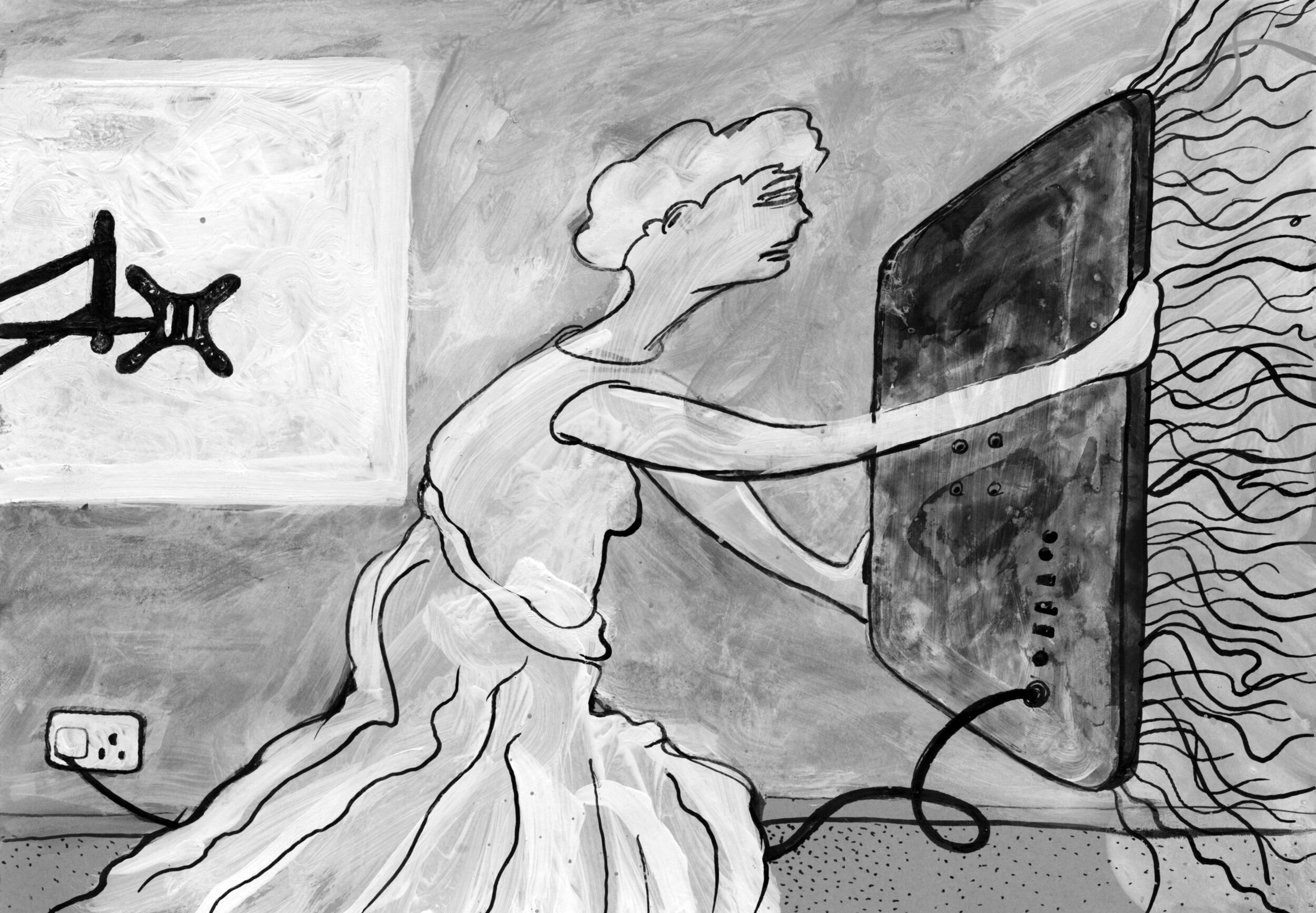
This recent painting of Ray’s (above) intrigued me, I couldn’t quite work out what the woman shielding herself behind the TV was up to. It is based on a black and white drawing, as they often are, which I thought made the situation clearer. In that version (below) the discarded wall bracket is more obvious and the composition more open, she is offering up the TV with her arms outstretched. This drawing, in its turn, was based on an annunciation angel in a carved relief that Ray photographed in St Martin of Tours Church, Chelsfield (bottom).

You Light Up My life. Drawing in indian ink and white acrylic on black card by Ray Ward

You Light Up My life. Drawing in indian ink and white acrylic on black card by Ray Ward

IMG_2537.jpg

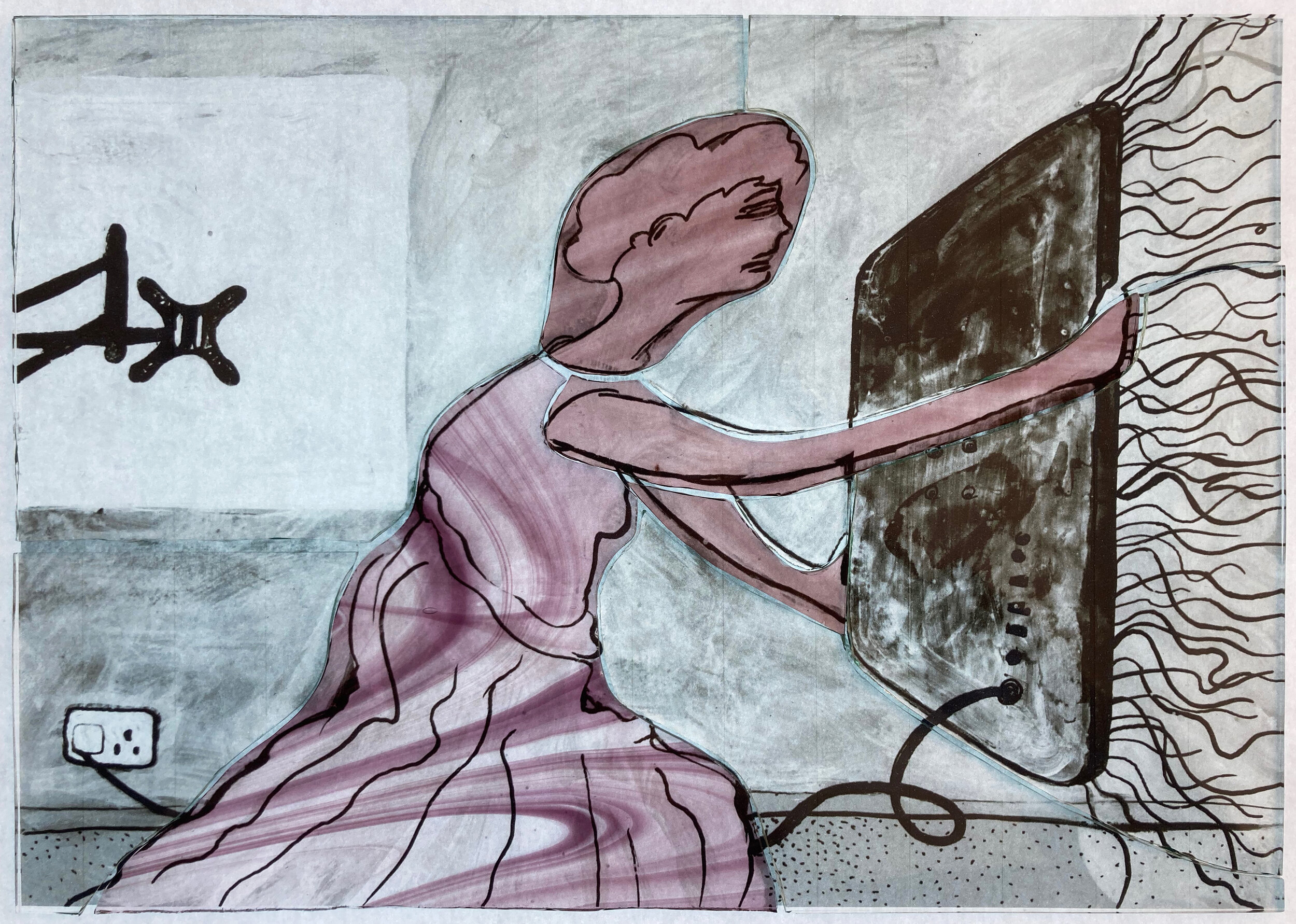
The interesting history of Ray’s painting made me want to add to the chain by making a stained glass version. I based this on the black and white drawing, only changing it by using a pink and yellow colour combination which is a classic in stained glass angelology. The glass pieces (below) show that the only pieces of coloured glass I used were two types of streaky pink on the angel, the yellow being a thin wash of silver stain fired on the back of the glass. As in all the panels I’ve made in this series most of the details are done with sandblasting and/or painting with black, brown and grey iron oxides.

Glass pieces cut and laid over an enlarged photocopy of Ray’s drawing

Glass pieces cut and laid over an enlarged photocopy of Ray’s drawing

Finished panel on the lightbox, 250 x 360mm.

Finished panel on the lightbox, 250 x 360mm.

The finished panel is shown above on the lightbox and below on my windowsill in the sunshine. Its title also has a history - Ray had called his painting ‘The Teacher, Look in Here and All Will be Revealed’ but then forgotten that fact. When I asked him for one he came up with two song titles, ‘You Light Up My Life’ which I used for the stained glass panel and alternatively ‘Let The Light In’ which he used as the new name for the painting. By then I’d been calling it TV Angel, so this little image actually has four names.

Finished panel in the sunshine

Finished panel in the sunshine

Douglas Strachan at Winchelsea by Sasha Ward

St Thomas the Martyr Church, Winchelsea, East Sussex.  Left: west elevation.  Right: east elevation.

St Thomas the Martyr Church, Winchelsea, East Sussex. Left: west elevation. Right: east elevation.

The restored Thomas the Martyr church sits in its own ruins in the middle of Winchelsea, high up inland after the original Winchelsea was flooded in the thirteenth century. Almost every window in the church was designed by Douglas Strachan between 1929 and 1933 and it’s remarkable to see the effect that they have on its interior. Simon Jenkins isn’t so keen: “They wholly dominate the church, which means that if one dislikes them they spoil it. The work is dramatic and perhaps a future generation will show more enthusiasm for it than I can muster”. In his ‘England’s Thousand Best Churches’, he does give the church 3 stars on account of the medieval tombs that line the walls of both aisles. These are good, but I hardly had time to look at them as I was so enraptured by the amazing stained glass - the rare sight in an english church of twentieth century windows that were actually designed to go together.

Left: windows in south east corner.  Right: (right hand) east window on the theme of death and resurrection..

Left: windows in south east corner. Right: (right hand) east window on the theme of death and resurrection..

On my visit, the sun was blazing through the six windows on the south and east walls and the colours in this set appeared quite pale. They make up the original 1929 commission from Robert Younger, Lord Blanesburgh in memory of his brothers and nephews. The first one to be completed, central on the south wall, commemorates the 1928 Mary Stanford lifeboat disaster.

The subjects of the three windows on the east wall are birth, praise (below) and death (above). These are all remarkable for their intense colour, not dimmed by the skilled glass painting. The praise window is entirely luminous, the colour combinations are riotous, but altogether the huge window gives a delicate, pastel glow. From the outside, the intricate web of expressive lead lines is so distinctive and so admirably rooted in its own period.

East window and details from the bottom of the window.

East window and details from the bottom of the window.

The third set of windows on the north wall (below) are, quite obviously, on the theme of earth, air and water in the context of a war memorial to the men whose operations were carried out on the land, sea and in the air. These last two and the birth window in the corner are the brightest blue, they drew me to that side of the church and complemented the beautiful tombs below.

Windows in the north east corner of the church.

Windows in the north east corner of the church.

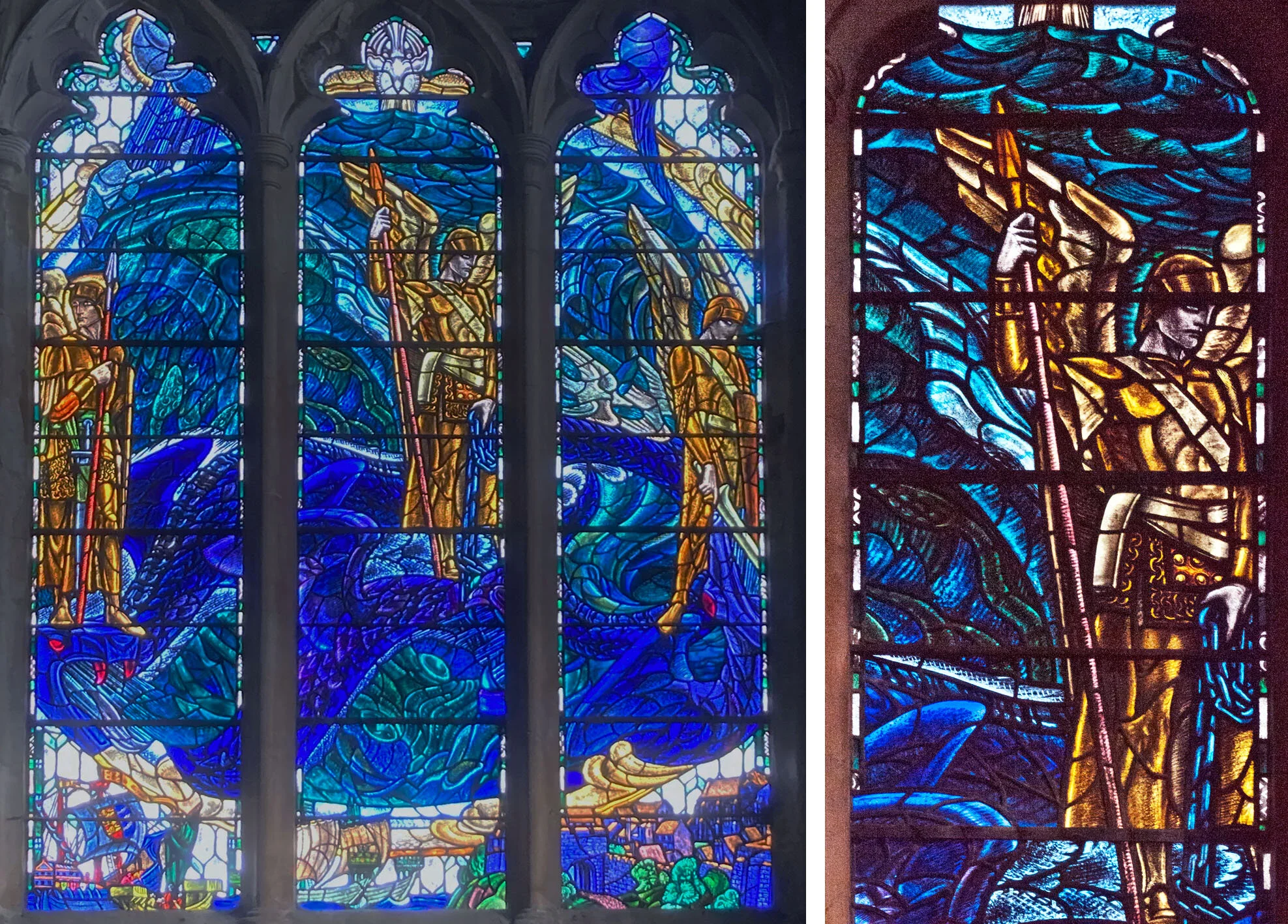
Lower section (& detail) of the left hand north window, on the them of the sea.

Lower section (& detail) of the left hand north window, on the them of the sea.

The one I really admire is the very 1930s sea window, with helmeted angels and sea monster. I particularly love the way that the little scenes in this series, here showing ships in Winchelsea harbour, are integrated into the picture, rather than placed in the usual boxy predella panels. Simon Jenkins’ future generations are finding this one totally to their taste.

The monster at the bottom of the sea window.

The monster at the bottom of the sea window.