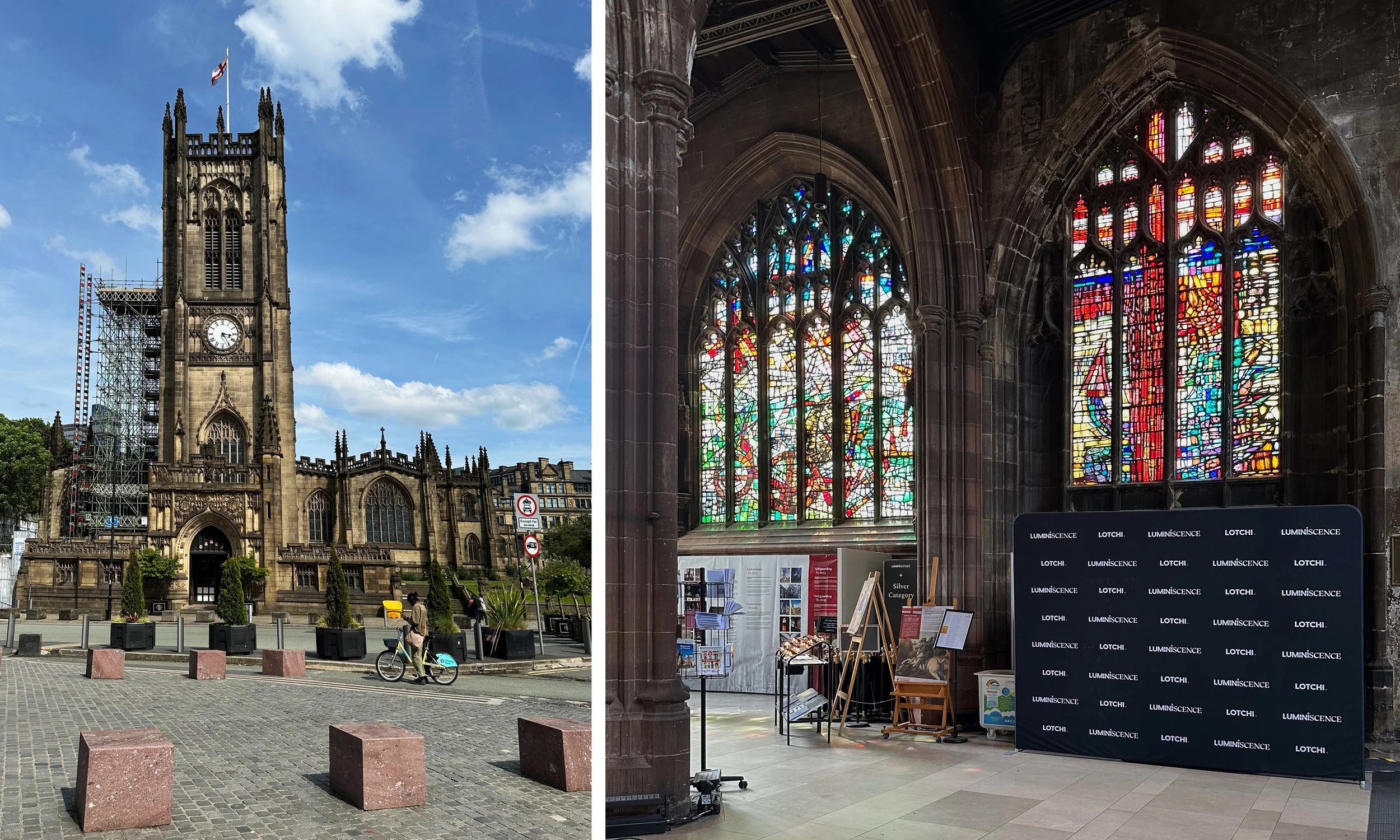
Left: View of Manchester Cathedral from the west. Right: Interior with windows by Antony Hollaway - Creation 1991 and St George 1973.
In the late medieval period Manchester Cathedral was a collegiate church dedicated to Saints Mary, George and Denys. The rebuilding of the tall west tower and the addition of chapels, galleries and a large annexe happened mostly after the building was given Cathedral status in 1847, then more changes came with destruction caused by the second world war and by the IRA bomb in 1996, so it is hard to identify anything from the medieval period. However all of the windows along the exceptionally wide east and west fronts were made between 1966 - 2016, chief among these being the five west windows designed and made by Antony Hollaway. I am writing ‘made’ with confidence as Tony Hollaway was head of three-dimensional design when I was a fine art student at Trent Polytechnic, and I went to his studio to see one of the windows being made on his workbench. So on my recent visit to Manchester I thought I would take another look, and make an assessment of these, his most celebrated works.
From left to right they are Creation 1991, St George 1973, St Mary 1980, St Denys 1976 and Revelation 1995. As you would expect from a series that spans 22 years, the styles are quite different with nothing obvious that links them all together other than the vision of one artist and his patron, the cathedral architect Harry M. Fairhurst.
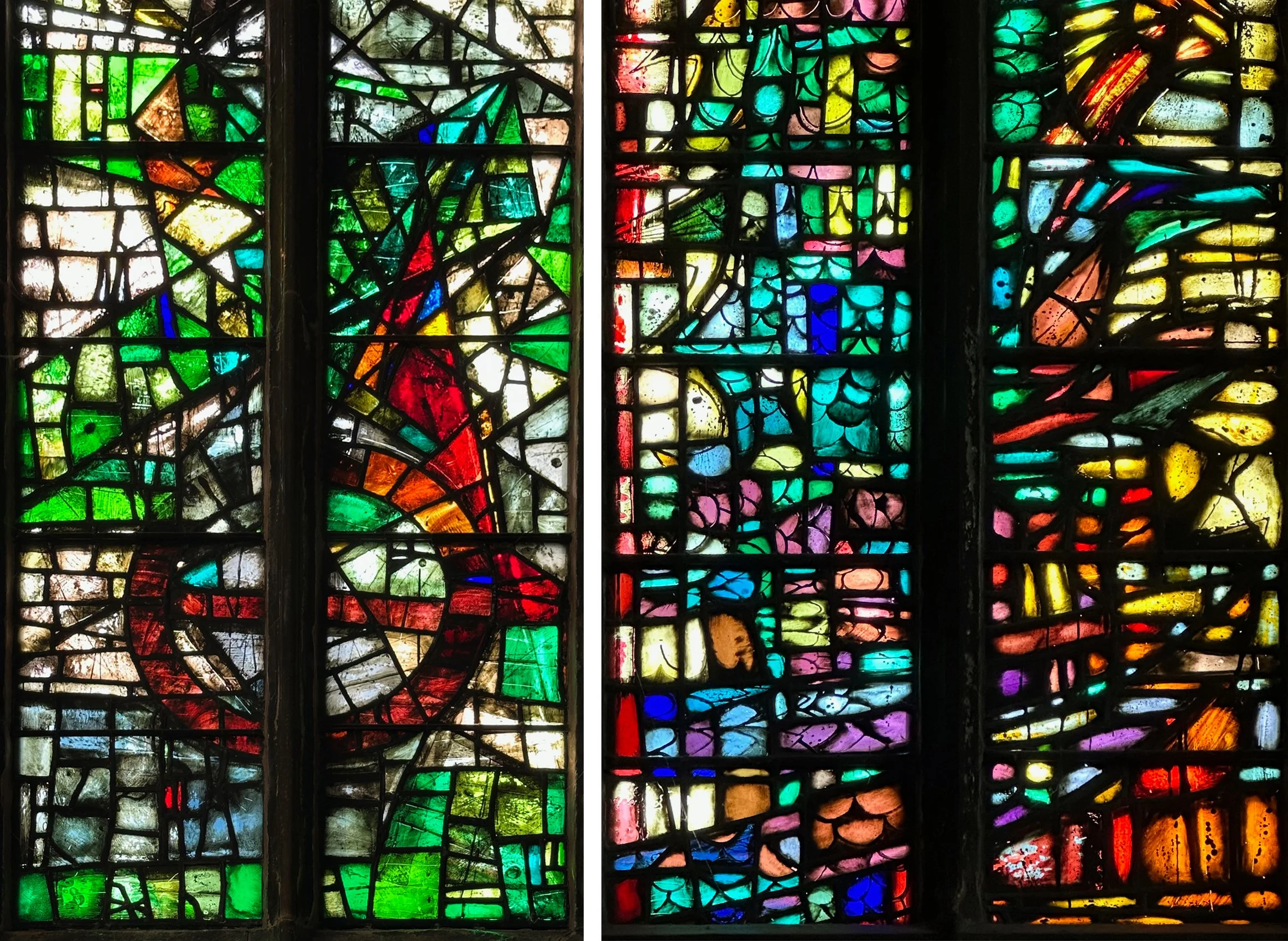
Left : detail from bottom left of Creation window 1991. Right : detail from bottom right of St George window 1973.
The Creation window which fittingly starts the sequence has an angular, complicated composition evoking landscape and skyscape, with versions of circular gender symbols at the bottom (above left). The next in line is the earliest window and is dedicated to St George, there is a deconstructed red cross that spans most of the window and lurking behind is a dragon, whose abstracted body appears in green on the right hand side (above right). While the Creation window is smothered in the sort of messy paintwork that I never liked, the details in St George are more curvy, with period looking scaley patterns in the rich colours that are often used for stained glass dragons.
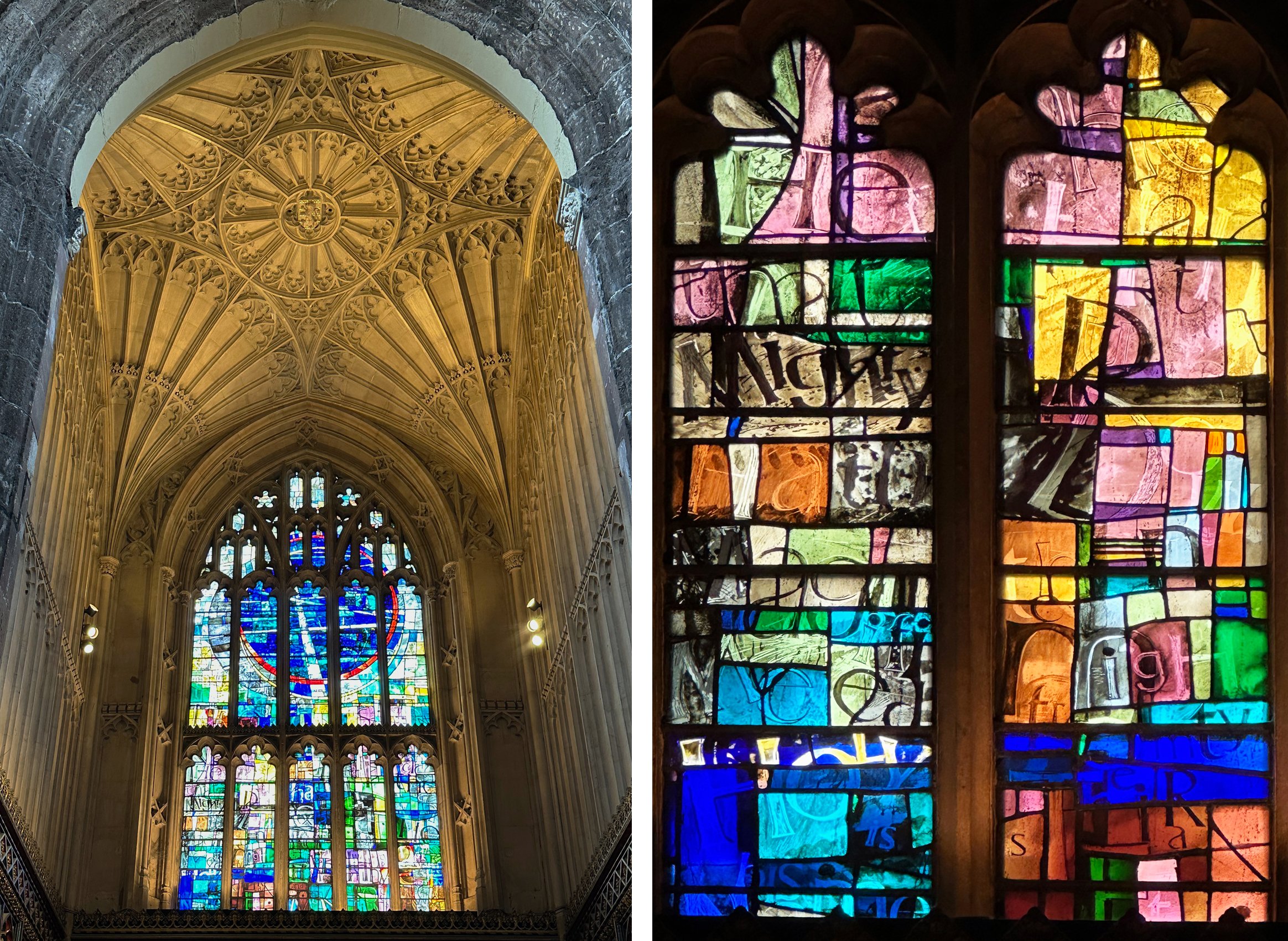
St Mary window 1980 and detail from bottom left.
The St Mary window is next and higher up as it’s in the tower. This is the one that you see on all the publicity for the cathedral, and it’s the one that I saw being made in 1979. I really remember the evening studio visit where I was allowed to join a group of not particularly interested 3D design students, glass wasn’t a material in favour at the college then. I remember the jumbled lettering - words from the Magnificat - letters being used for their look rather than their meaning as it seemed to me at the time, so another work with echoes from the past and a period of stained glass design that i was trying to get away from. I was never taught by Hollaway, but he was very rude about the work I was doing in the manner of a typical 1970s art school tutor.
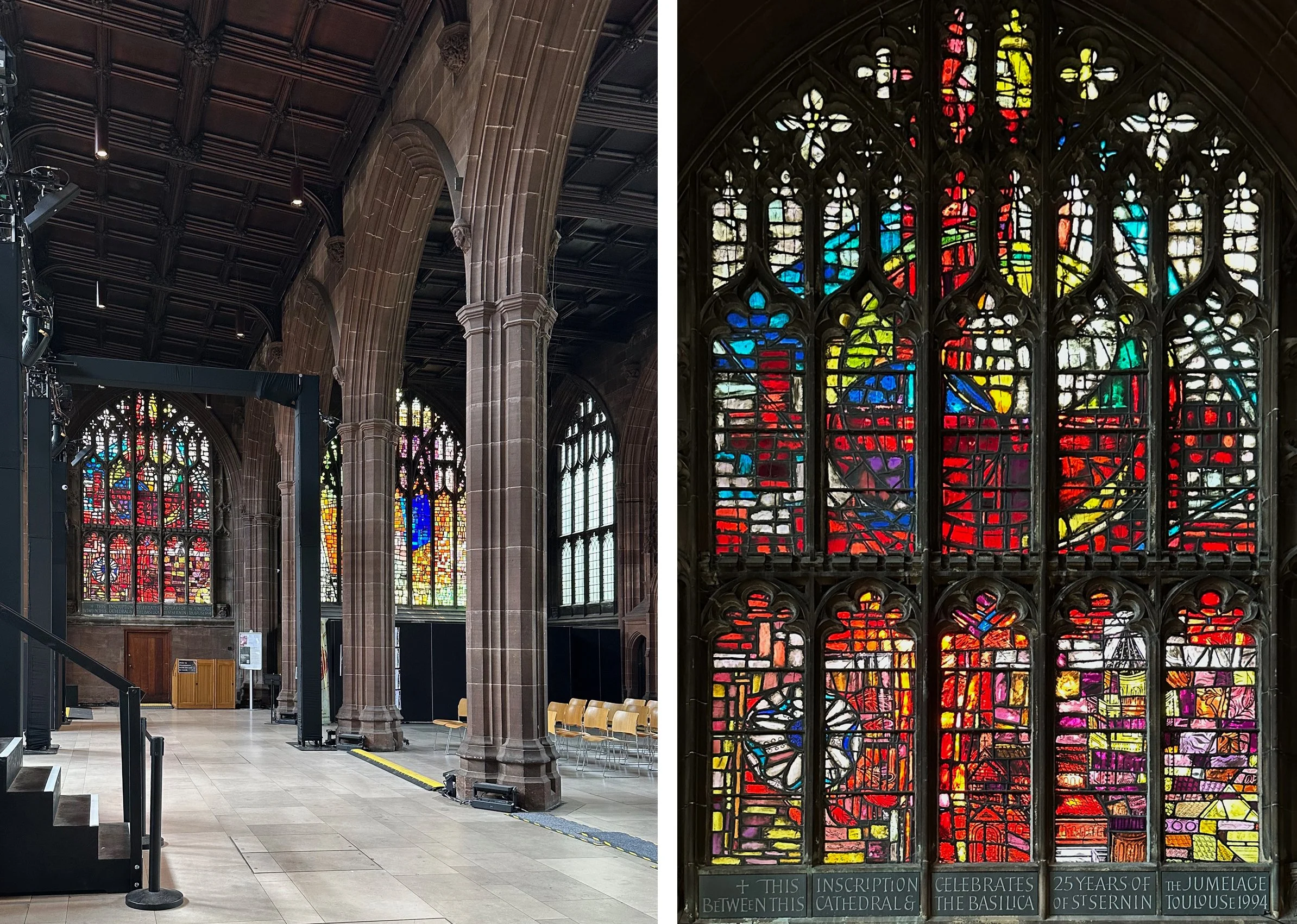
Left : Interior with windows by Antony Hollaway - St Denys 1976 and Revelation 1995. Right : St Denys window.
The glass in the St Denys window returns to the predominantly red palette of the St George window, and like the Mary window, uses a large off centre circle to symbolise the saint. In addition to the crosses there are elements of buildings and foliage (below left) with painting and colour drifting in bands across the 15th century tracery.
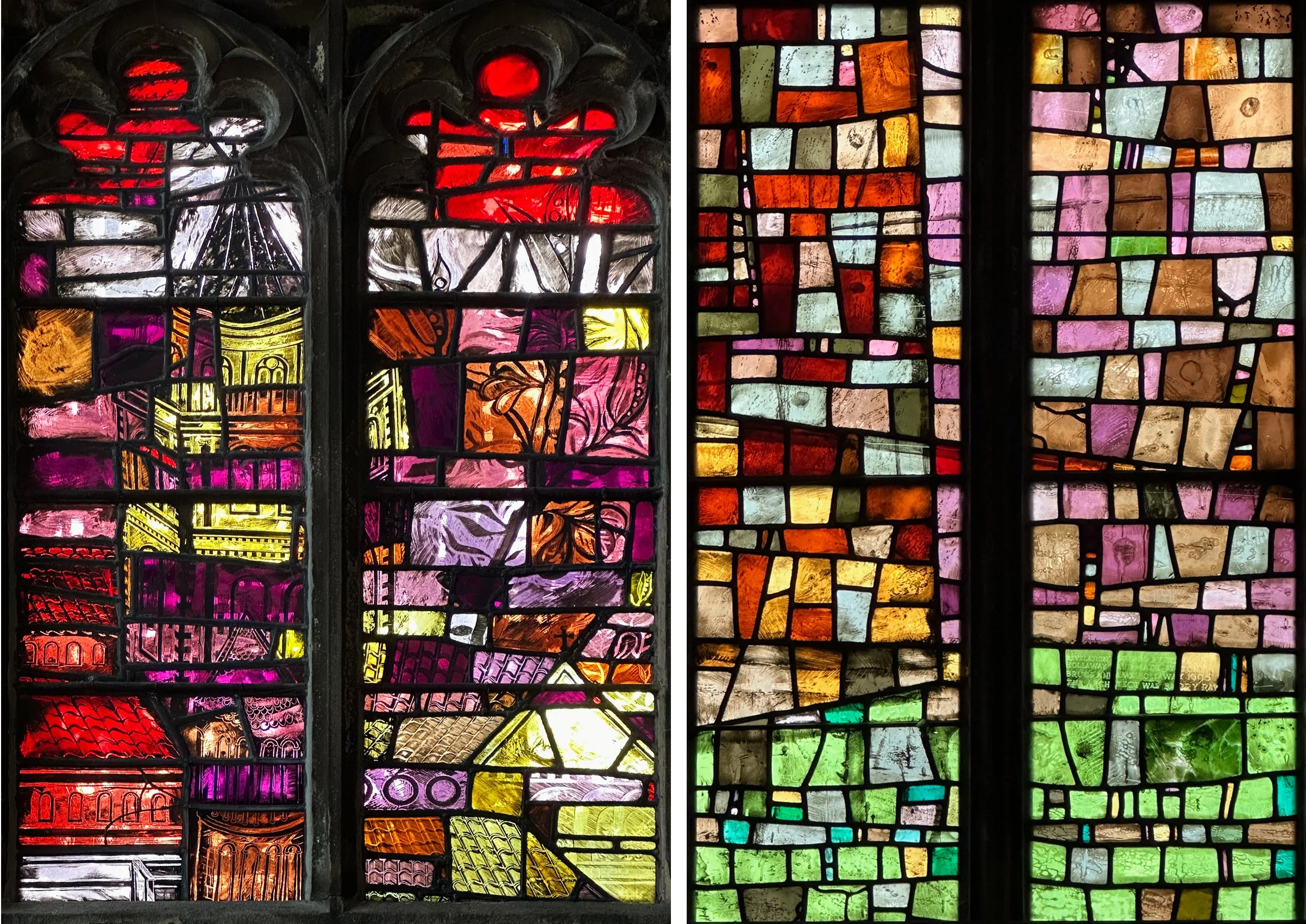
Left : detail from bottom right of St Denys window. Right : detail from bottom right of Revelation window.
Finally the latest window and for me, easily the best. No jarring red circles, just stones to symbolise the heavenly city in a divine range of colours and although the close up (above right) shows you that every piece is indeed painted, the black/grey pigment doesn’t dominate. This work reminds me of the windows of Brigitte Simon in Tournus Abbey, France, where her aim was to '‘extend the impression of the stones’ in an ancient building.
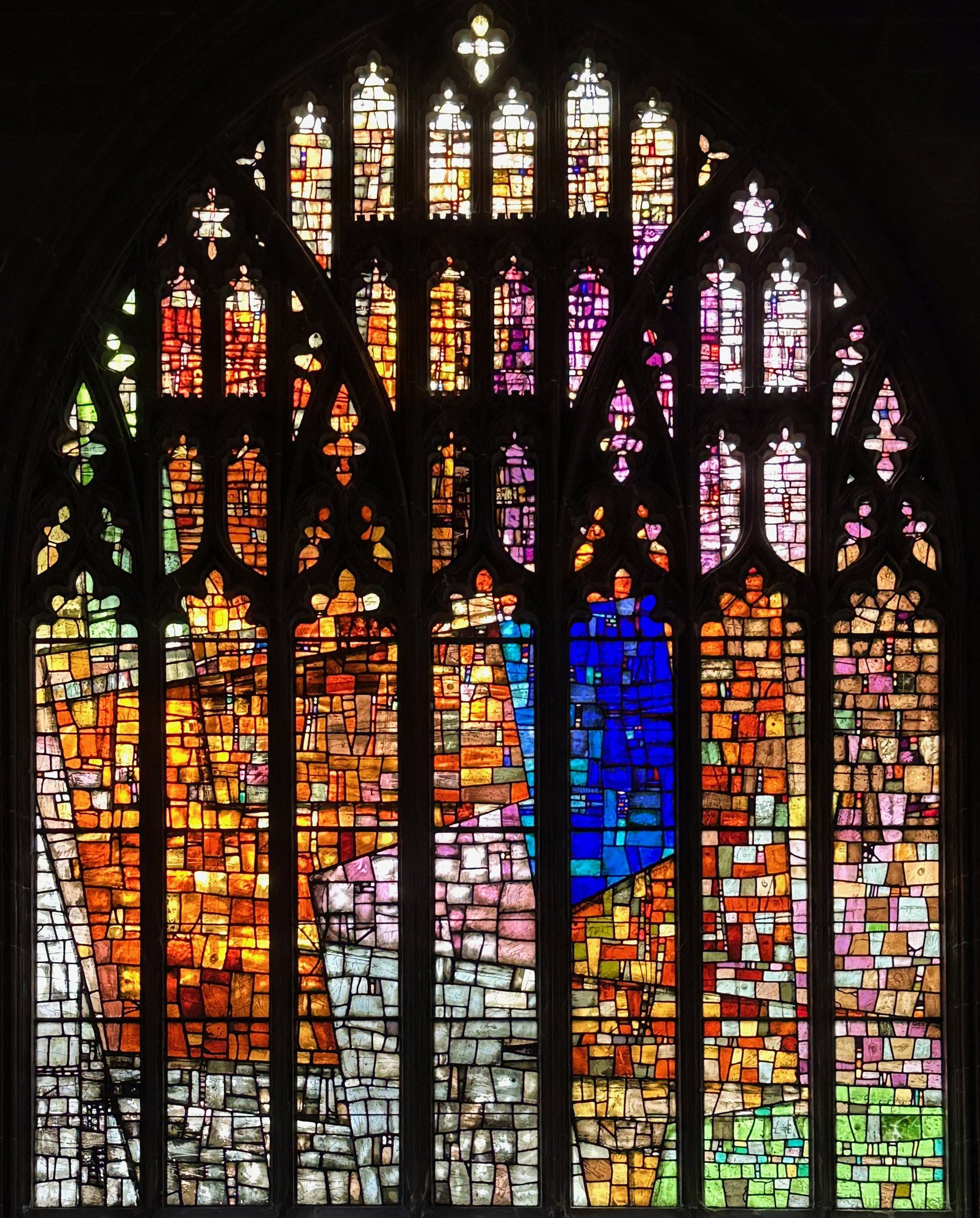
Revelation window 1995.
Opposite Revelation, across the length of the cathedral, is Margaret Traherne’s Fire window from 1966 (below). This also looks fantastic in the space, the regimental chapel, and is the most simple, literal interpretation of the theme that was originally commissioned to commemorate the rebuilding of the cathedral by the architect Hubert Worthington after the 1940 Manchester blitz. When the window was damaged by the 1996 Manchester bomb, Traherne supervised its restoration using superb streaky glass and an eccentric leading panel that closely matches the original - I checked on the pre 1996 postcard I have of the work.
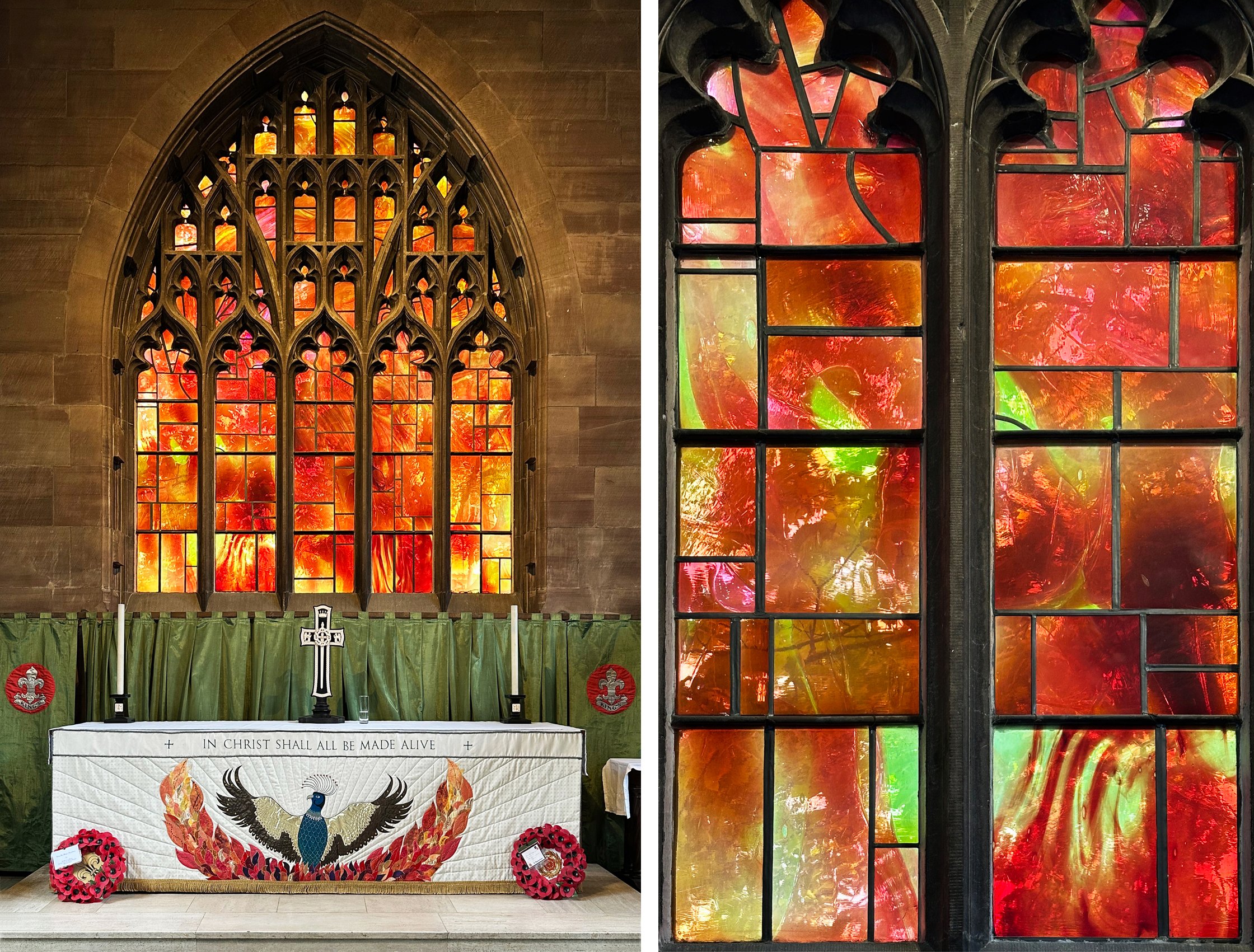
Regimental chapel at the north east end of the church with Fire window by Margaret Traherne 1966, remade in 1996.
And a quick mention for the paintings of Carel Weight in the recesses of the stonework above the entrance doors to the Chapter House. In the lower panels separate small paintings with titles of seven of the beatitudes (or blessings from Christ’s sermon on the mount), above them a painting that spreads across the compartments and shows Christ with the people in a rural, local setting. All are wonderful - it’s a pleasure to see the work of these distinguished twentieth century artists in such a magnificent setting.
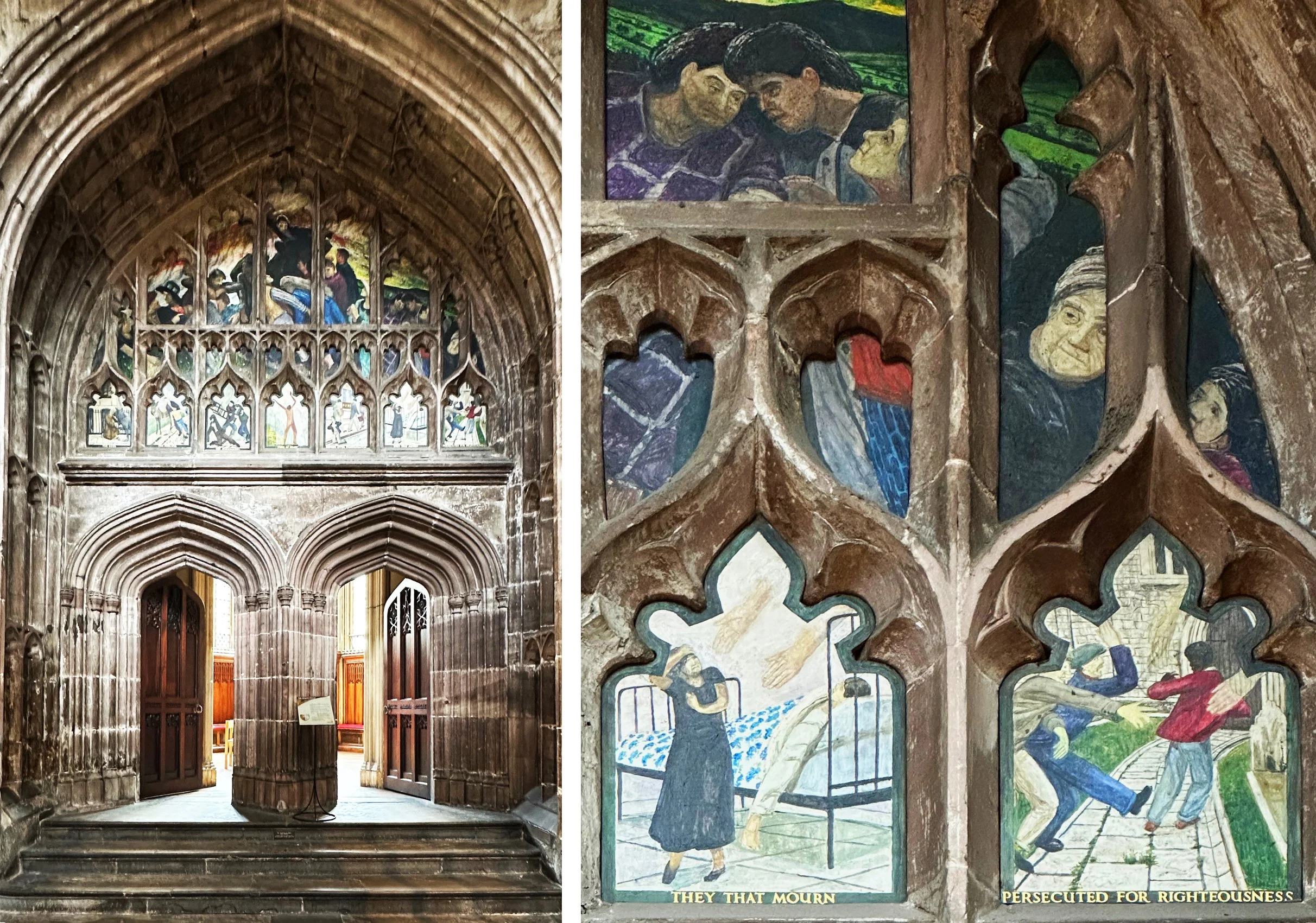
Entrance to The Chapter House, with paintings of The Beatitudes by Carel Weight 1963.