Adding without ruining by Sasha Ward

Windows made from scrap pieces of glass are a stained glass staple. In churches old pieces are leaded together in a different formation to make new windows, and in my own work I have always used offcuts, samples and broken pieces to make patterned windows, patchwork style. However, most of the samples I make for larger commissions are on thicker glass with large scale designs, not great for chopping up but ideal as the first layer in a new piece of work.

Experiment 1 with drawing and collage on top, 500 x 260 mm

Experiment 1 with drawing and collage on top, 500 x 260 mm

Experiment 1 (above and below) started with a leftover computer cut stencil from a large scale project which I stuck on an old piece of float glass to try out a coarse sandblasting grit. The first bit of enamelling, the red and purple on the left, was another leftover, this time from a bit of very runny spray painting. After firing the effect was so nice that I added another layer, or maybe two, of hand painted enamel enjoying the way that the grainy texture on the glass affected the colours. I spent a long time after these unphotographed stages drawing, collaging and photoshopping to find shapes that would add to the composition, hiding the muddled sections, keeping the best parts and not ruining what I already had.

I like the finished piece so much that it’s still in my studio window months later. The four narrow windows that I added to the design were sandblasted out, then each filled with a different enamel colour with a lot of flux in the mix to make them very pale. What was underneath slightly comes through and the new enamel colours perfectly compliment the ones that were already there.

Experiment 1 completed and detail.
Experiment 1 completed and detail.

Experiment 2 in the window and on the light box, 470 x 450 mm

Experiment 2 in the window and on the light box, 470 x 450 mm

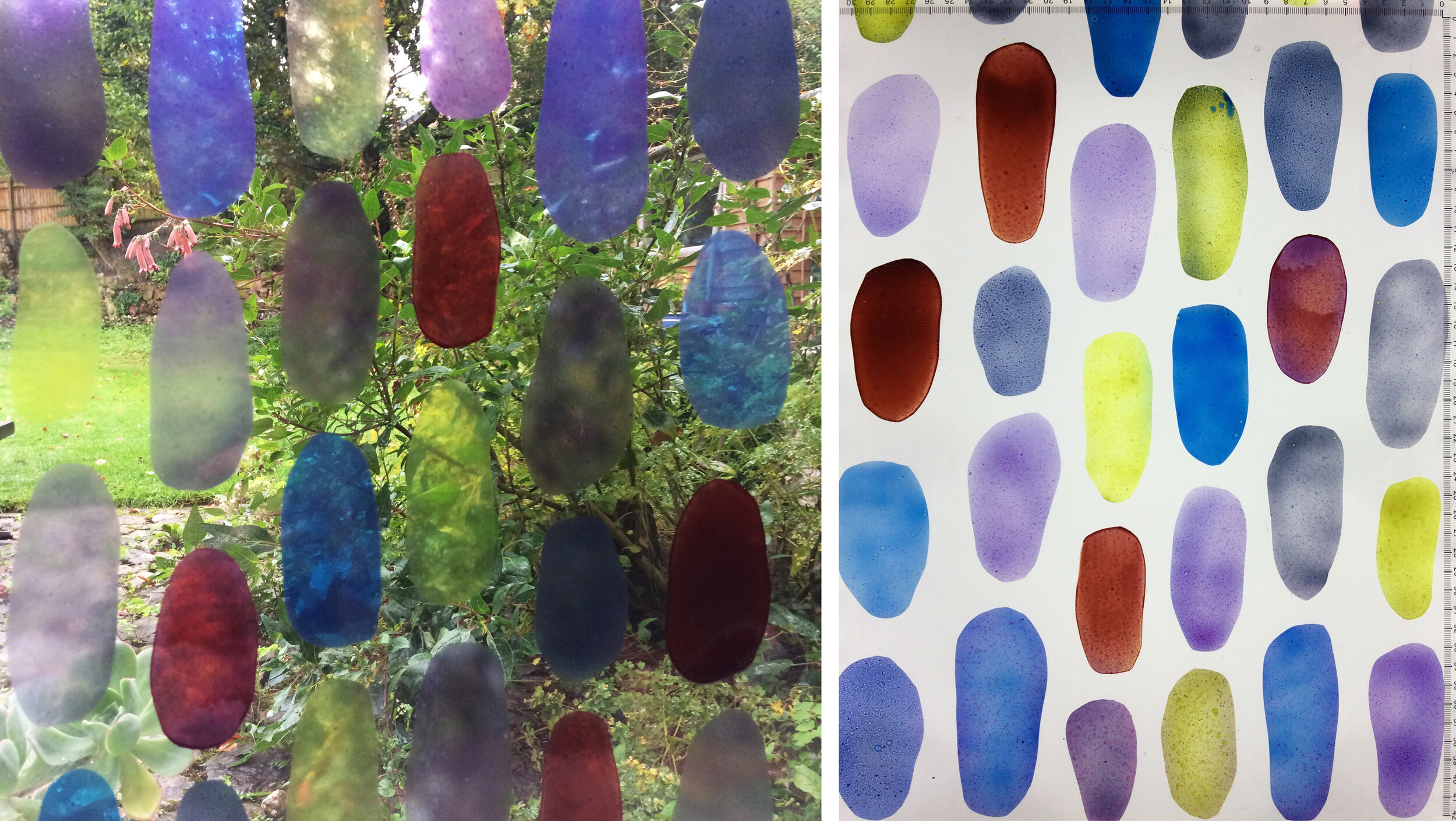
Experiment 2 (above and below) presented a different set of challenges. I had a large piece of glass where I’d tried out old glass enamels in rough ovals, there were some lovely qualities in the different enamel mixes but no overall shape to the composition. I decided to use it as the first layer of a new piece, 300 mm square, for the online exhibition of work by members (I’m a new one) of the British Society of Master Glass Painters as these marks and colours seemed to celebrate the joy of glass painting. I spent an even longer time on the next stage of this one, planning patterns around the shapes and additions to them inspired by the effect of the overlapping offcuts in my window (below left).

I know by now not to rush into things, I was very conscious that I mustn’t ruin the piece by interrupting the stillness at its centre. Instead I thought about the concept of tessellation and added more ovals where they were needed to make the tile roughly tessellate while creating just a few areas of overlapping colour. It looks much better on its own than when I did tesselate it as you can see below.
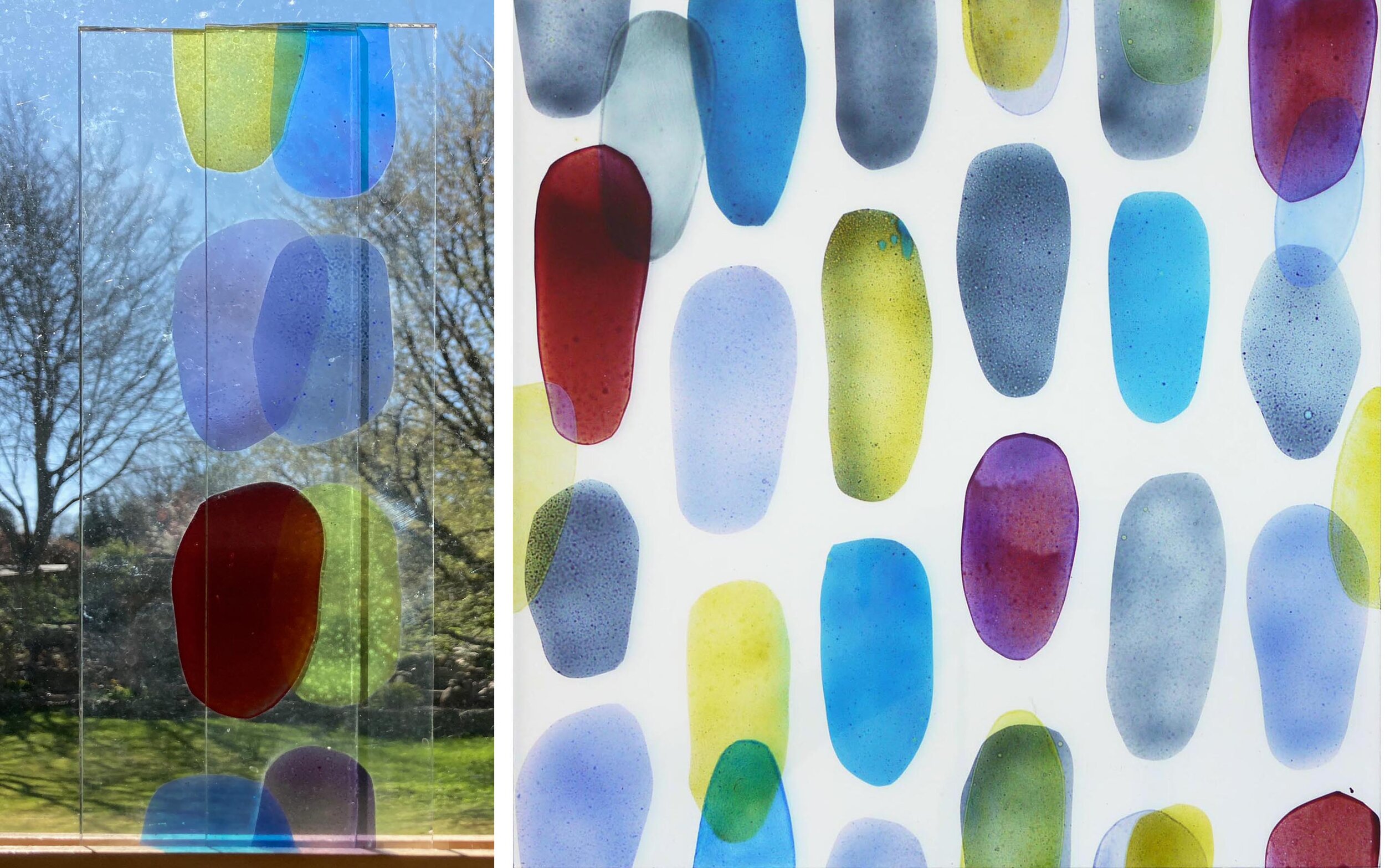
Experiment 2: Left, overlapping pieces.  Right and below, turned into a tessellating tile.

Experiment 2: Left, overlapping pieces. Right and below, turned into a tessellating tile.

blob 3.jpg

Here is a link to lots of great contemporary stained glass squares in the exhibition on the BSMGP website.

Passersby Passing By by Sasha Ward

Drawing 1 by Ray Ward, ink and acrylic on card.  236 x 320 mm

Drawing 1 by Ray Ward, ink and acrylic on card. 236 x 320 mm

It was time to choose which of Ray’s drawings I wanted to turn into stained glass. Nothing he had on the walls in his studio jumped out at me, so I looked through some of his boxes of old drawings - sorted by size and paper type - to find some that did. The last panel I made (that’s not really a question…) had featured a waterfall, so I thought the river scene (above) would make a good companion. However, I mostly make my choice by finding a figure I want to do in glass and the man looking at the river was a bit small and sketchy. The figure in another box of slightly coloured drawings (below) looked perfect for glass painting, once I’d got Ray to add a pattern to her coat, and I thought the two drawings would combine together perfectly setting up an interesting story between the two figures.

Drawing 2 by Ray Ward, ink and acrylic on card.  210 x 297 mm.

Drawing 2 by Ray Ward, ink and acrylic on card. 210 x 297 mm.

Painted and sandblasted glass pieces on the lightbox

Painted and sandblasted glass pieces on the lightbox

The resulting glass panel was quick to make. I saw her as a redhead and had the perfect piece of glass for that. The other colours, in the restricted palette that works best in these small pieces, followed from there. The completed panel (below) is practically opaque because of the heavy sandblasting combined with the types of glass I used and looks great photographed in my studio window, where normally too much green grass shows through.

‘Passersby Passing By’ Stained glass panel in daylight.  280 x 400 mm.

‘Passersby Passing By’ Stained glass panel in daylight. 280 x 400 mm.

Detail of the redheaded figure showing different types of glass, some heavily sandblasted.

Detail of the redheaded figure showing different types of glass, some heavily sandblasted.

In a continuation of this collaborative process Ray then did a new painting, with a new title, of the same scene (below). I had imagined the setting as the mouth of a river with a boat going out to the sea which their eyes are gazing at. But the new barges and the more elaborate balustrading place the figures on the embankment somewhere along the Thames, and she’s got a quite different look in her eye.

Painting by Ray Ward ‘The universe shall pass away as a scroll’  Egg tempera and Indian ink on gesso ground. 310 x 435 mm.

Painting by Ray Ward

‘The universe shall pass away as a scroll’ Egg tempera and Indian ink on gesso ground. 310 x 435 mm.

Bathroom Windows by Sasha Ward

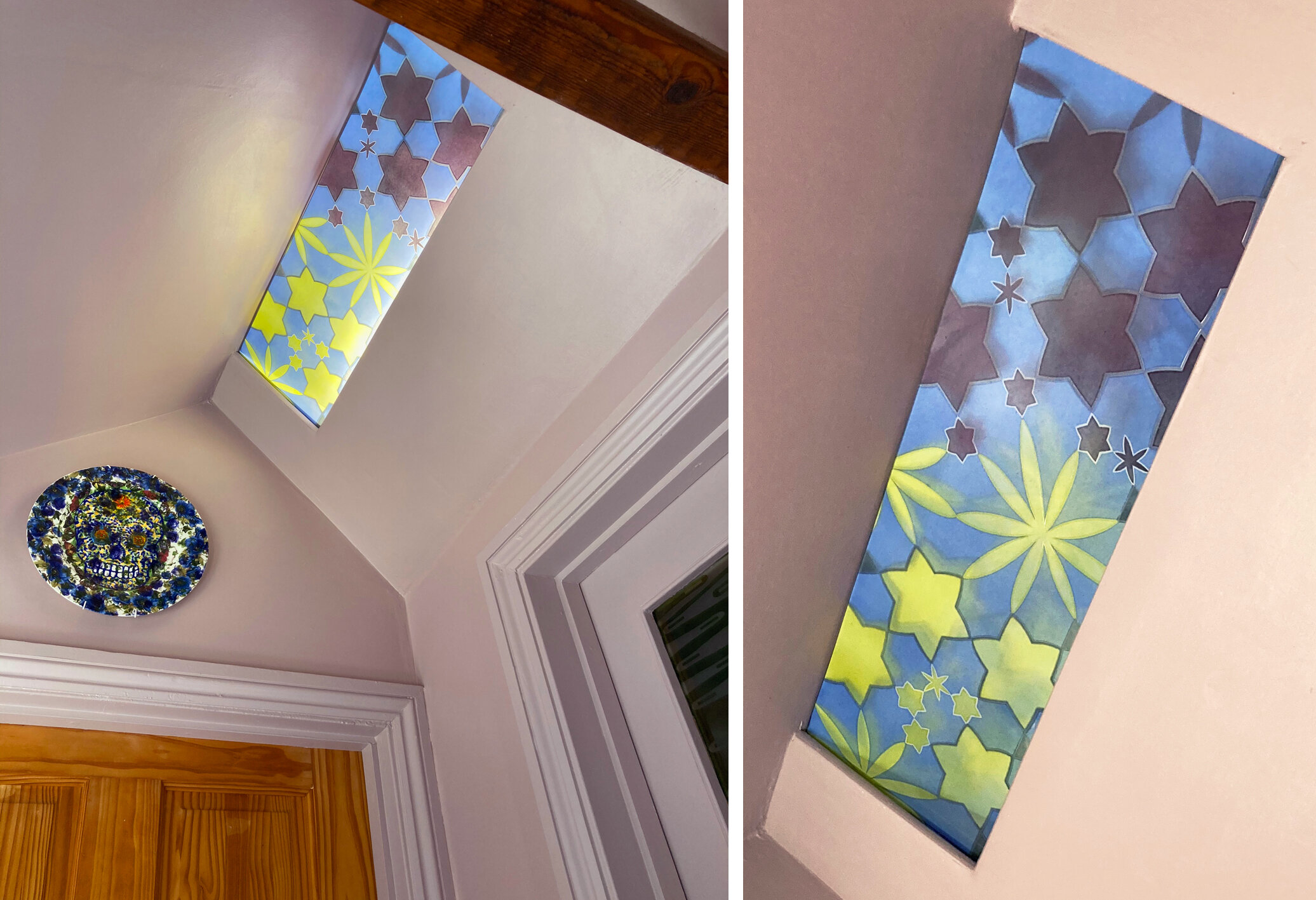
This winter we’ve painted our hall spaces pinky grey, a colour that we chose to compliment the greens and oranges we had in our interiors. The hall is lit by a concealed strip light and although it looked fine as it was I thought I could add something more to the space by making a glass panel to cover it. You can see it installed with the light on and off below.

Left: All three windows with the lights on.  Right: Ceiling and door window with the lights off.

Left: All three windows with the lights on. Right: Ceiling and door window with the lights off.

The new panel had to go with the windows I’d made in 2005 for the house, two of which you can see at the same time as the new one (above left). For our own windows I’ve used intricate, geometric patterns - I see these windows as an opportunity to use favourite designs that didn’t quite fit in to the schemes I was working on at the time. The bathroom window has a pink/green/gold repeating circle which looks great from a distance (below left) and the door panels have pale blue flower/stars floating across olive green horizontal bands on an etched background. You can see how good these colours look with the lovely brown quarry tiles and red brick of the bathroom walls below.

Inside the bathroom - Left: window.  Right: door.

Inside the bathroom - Left: window. Right: door.

So for the new design I plotted out a flower/star design on a hexagonal grid, thinking of the central flower as a burst of light from the centre. Each point meets another point, but the geometry is not organised into a regular pattern. I wanted the colour to change in the middle as this panel is at a meeting point with a door to the left and the right, and I also wanted it to go with the plate that greets visitors to the spare room on the left which we bought from Rob Turner (below left). As usual the colours, which are transparent fired enamels made of a mix of different pigments, aren’t exactly as I’d planned, the yellow is not quite olive enough and the pink is too dark. However the window sits very well in its place, it’s nice to look up and see a few unexpectedly twinkly stars inside the house.

Outside the bathroom - Left: light on. Right: light off.

Outside the bathroom - Left: light on. Right: light off.

New ceiling panel, 210 x 620 mm.

New ceiling panel, 210 x 620 mm.

Chaos out of Order by Sasha Ward

I found an old piece of work based on a drawing of a hut by a lake in the hills that gave me an idea for a new piece of work. The idea was to turn the picture into a sequence by repeating the shapes of road, hut, lake and hills and changing them slightly in each version. The sequence I followed to get to the final piece is described below - starting with stage one where I cut nine pieces of glass, some coloured, some flashed and some painted, into squares and sandblasted them with the basic design (below left). Stage two involved adding colour (below right), which never turns out quite how I imagine.

Stage one: Nine 90mm squares of glass, sandblasted.  Stage two: First layer of painting.

Stage one: Nine 90mm squares of glass, sandblasted. Stage two: First layer of painting.

It was at this point that I realised I’d made things too simple and too twee. So I dropped the squares down to add another colour between them (below left). This led me to join up the white paths and the black blobs (which were originally the lakes) to create a more disorderly pattern. The huts had served their purpose as pattern makers so they had to go (below right).

Stage three: Strips of coloured glass added.  Stage four: Sandblasting & painting to link pieces together.

Stage three: Strips of coloured glass added. Stage four: Sandblasting & painting to link pieces together.

After more painting and sandblasting to disguise the remnants of the huts, I thought the colours looked OK together and leaded up the piece (below left). Then I left it a while, knowing it wasn’t quite right. I liked the columns but not the rows, so I spaced a photograph of the panel out in photoshop and got rid of the cramped up look (below right). Then I ripped up the leading before I could change my mind and came up with a new plan.

Stage six: Leaded panel after more sandblasting & painting.  Stage seven: Moving the columns apart.

Stage six: Leaded panel after more sandblasting & painting. Stage seven: Moving the columns apart.

The new plan followed a pattern that I worked out on paper first. I added borders to give more space to the design, especially the blobby blacks which had been designed to cover the lead joints. I added horizontal colour strips between the columns which link visually to the geometry of the horizontal lead lines, with the white paths meandering across all the glass pieces. Another layer of sandblasting and painting meant that I changed some of the colour combinations I wasn’t happy with, before I leaded up the panel for the final time (below left). The sun projected version of the panel emphasised the blobby contrasted with the stripey that I was after (below right).

Stage ten: Panel with borders added.

Stage ten: Panel with borders added.

You can see the aspects of the panel that I like best below - sunlight through different types of glass and glass painting, and subtle colour combinations that flow across the lead lines.

Left: Sunlight through the panel.  Right: Detail shown on light box.

Left: Sunlight through the panel. Right: Detail shown on light box.

Christmas Cards - Year 6 by Sasha Ward

When I drew up the graph of the shapes of the christmas cards we were sent this year (below) I saw that we were into our sixth year of statistics. I realised a couple of years ago that most of the categories I’d ordered the cards into were overlapping or arbitrary - the only certainty is the shape and the rise of the square card. The homemade category was at a steady 37% this year, although due to the rise of self printing and the sale of home made cards the title of this category is now ‘card made by the person who sent it’.

IMG_0697.jpg

The overall number of cards we received was down about 10% and like last year, when we hung them up the display wasn’t very colourful. There were more birds than ever (a wapping 13%) and quite a few animal cards. Among them were two very similar hares, an amusing cat and a totally hilarious pig (below). This isn’t an art or homemade card, despite the real silver braid, but a charity card supporting the British Heart Foundation.

animals.jpg
IMG_0687.jpg

There were three nativity scenes (above), I must have needed cheering up as I particularly enjoyed the little funny one on the left. The best two this year, shown below, are both more 3 dimensional than your average card, and both suitably wintery. The tin star looked great on the mantlepiece reflecting the light from the christmas candles, and the one on the left is a delicate folded screen of a Japanese snow scene - thanks friends for continuing to make and send cards!

best.jpg