Three Squares by Sasha Ward

The small square glass panels I’ve made over the past fortnight were designed as wall panels - you can see them hanging high up on my studio wall (below left). I wanted to try out an invisible fixing which is glued to the back centre of the panel, that part of the glass has to be opaque to hide it.
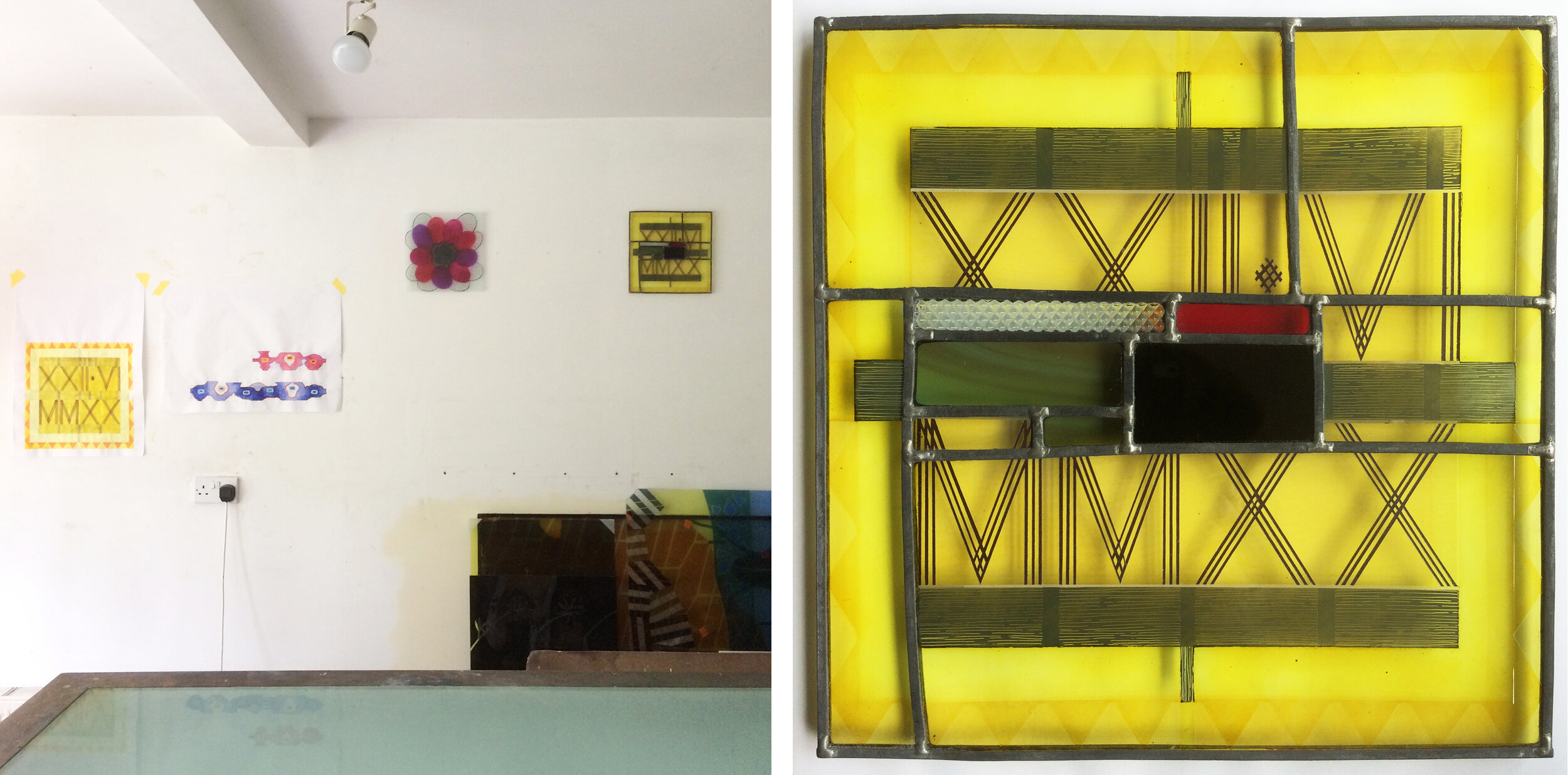
Left: studio wall with original date stamp design and two glass wall panels at the top. Right: Square One, 265mm sq.

Left: studio wall with original date stamp design and two glass wall panels at the top. Right: Square One, 265mm sq.

Square One (above right) is a leaded elaboration on the date stamp painted piece I made on XXII.VI.MMXX that looked a bit pointless as a stand alone piece of glass. I added patches of colour to compliment the yellow and remind me of midsummer in the local countryside, with an all important black piece in the middle and a scrap textured with triangles to match the XXs on the yellow ground.

Square Two (below) was designed as an opposite to that geometric piece with organic, slightly out of control shapes in lush sprayed enamel colours that I rarely use all together. I sandblasted the surround and the edges of the glass so they look as if they merge into the wall. The light, bright colours and the different textures achieved by applying the glass paints in a variety of ways show up really well against a white (rather than transparent) background in both of these pieces.
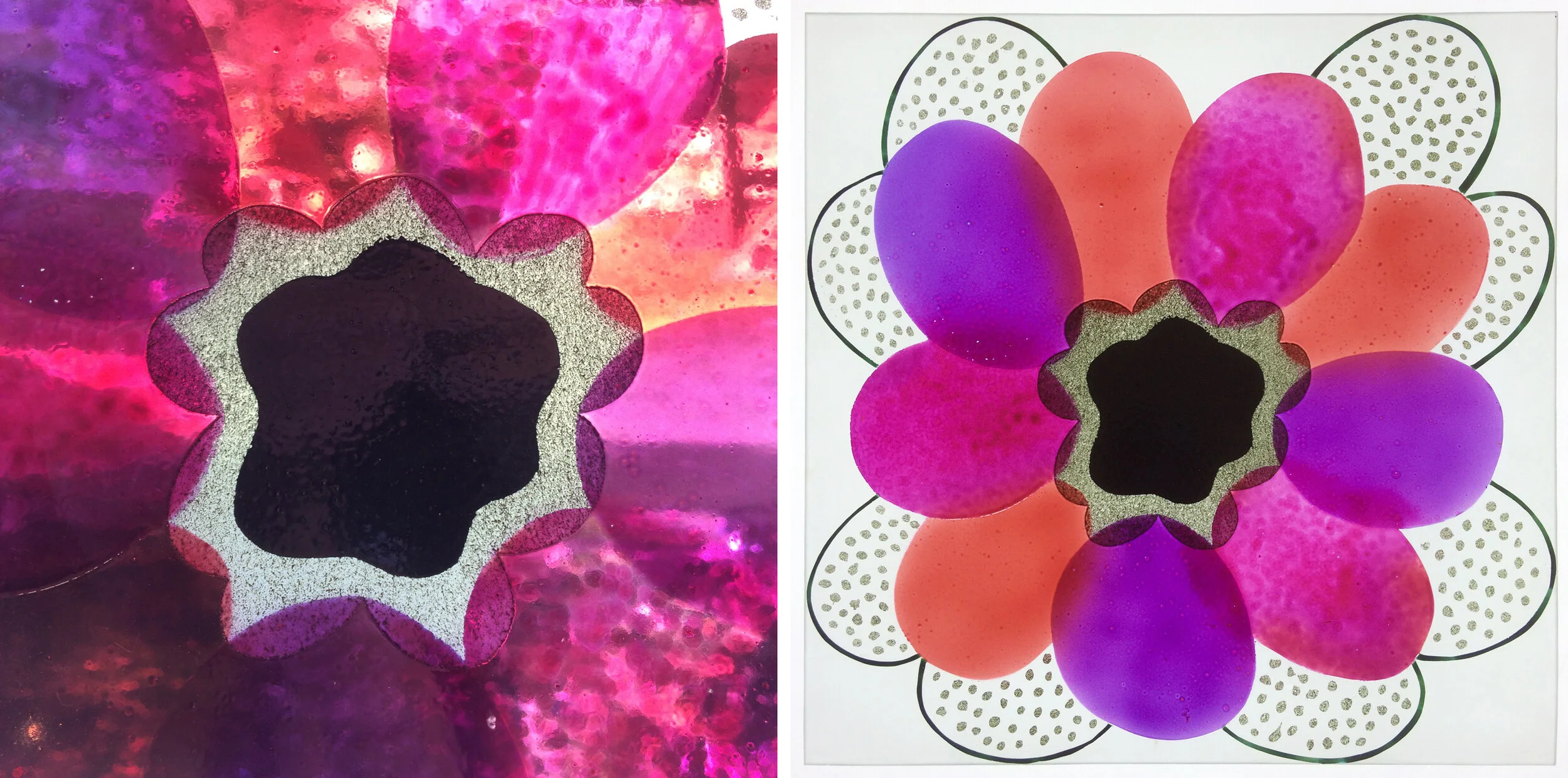
Square Two: detail and full piece on the wall, 260 mm sq.

Square Two: detail and full piece on the wall, 260 mm sq.

Left: ‘One Way Out’ ink drawing on plywood by Ray Ward. Right: ‘One Way Out’ glass enamels, 260 mm sq.

Left: ‘One Way Out’ ink drawing on plywood by Ray Ward. Right: ‘One Way Out’ glass enamels, 260 mm sq.

The third piece was a continuation of my project to turn Ray’s drawings into glass panels (see my previous posts for more examples). The drawings have been going so easily into stained glass versions, but I wanted to try one using my usual enamelling and sandblasting techniques. I intended to give the figure (above left) a solid centre to hide the fixing, but that was one of the things that didn’t really work out. I saw how unpredictable the enamel colours, used in layers, can be as my gold turned green and the hand painted streaks looked so watery that I resorted to sandblasting stripes across the whole background. The result - 6 firings later - is the panel (above right) displayed in the window not on the wall.

Left: panel before firing no. 5.  Right: reverse side of finished glass panel.

Left: panel before firing no. 5. Right: reverse side of finished glass panel.

Studio window by Sasha Ward

Winter 2020

Winter 2020

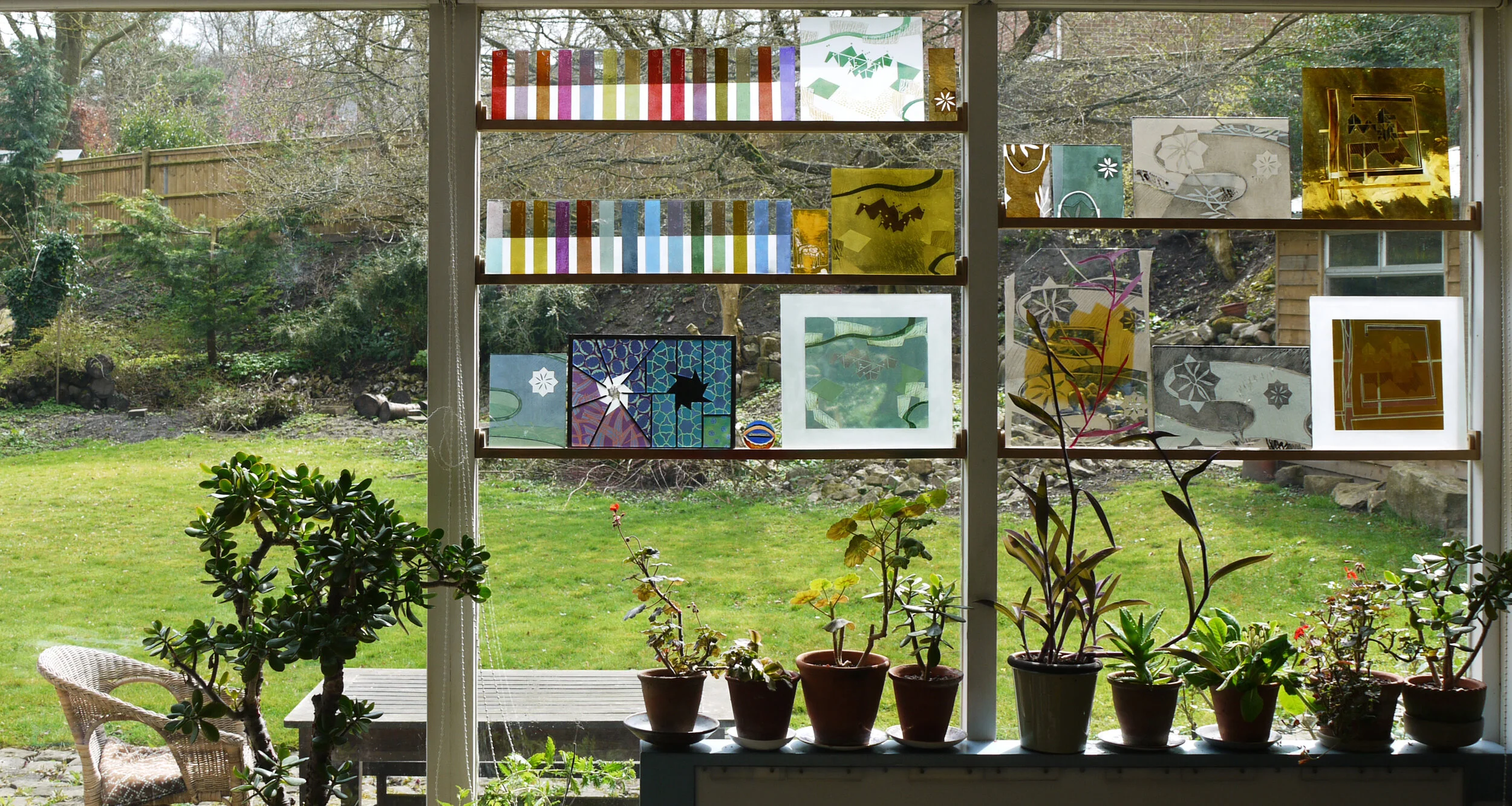
Do you ever get sick of the sight of your own work? In my case, samples and fragments of it are sitting on shelves in my window, blocking a view of our beautiful garden. The up side is that even in the gloom of a winter afternoon (above) there were interesting coloured reflections cast on the work I was doing on the lightbox. As this piece of work was a geometric composition, I ended up with a window full of striped colour samples and a more coordinated look in the studio (below). However, I was tired of that look and resolved, as we were going into lockdown, that I would end up with a completely different window at the end of it.

Winter 2020

Winter 2020

Autumn 2015

Autumn 2015

I found an autumnal photo with no coloured glass on the shelves from another year when I must have needed a change (above) and one from the following spring where I had painted the shape of one of the pink leafed plants on to a sample I was doing for a house in Italy (below).

Spring 2016

Spring 2016

Spring 2014

Spring 2014

Further back in time (above) I had the shelves in the same positions and a similar mix of geometric test strips and slightly organic patterns which were sample pieces for the commissions on the go. I recognise fragments from a wall panel for St James Hospital in Leeds, a plane propellor from Pegasus House in Bristol and colour variations for windows in Liverpool and Derbyshire. I only remember one occasion when I wanted to fill all four windows with samples (below). This was the last time we held an open studio event and the samples were labelled showing which commission they were made for. (Ten years ago I thought this was a terrible picture of me, now I can only see how much younger I look.)

Summer 2010

Summer 2010

Which brings me to the same window today and work that does look pretty different from anything I’ve put in front of it before (below). There are two main themes; self portraits which are on the bottom shelf and which I think I’ve done enough of for now, and stained glass panels from Ray Ward’s drawings which are on the top shelf and which I’ve described in previous blog posts. These have been a welcome return to making leaded panels and this is something I hope to continue doing both to commission and for exhibition.

Summer 2020

Summer 2020

Mash Up Self Portraits by Sasha Ward

Left: Self portrait aged fourteen.                                            Right: Self portrait years later.

Left: Self portrait aged fourteen. Right: Self portrait years later.

This is the self portrait (above left) when I was fourteen that made me want to revisit the self portrait theme. Unfortunately, none of the drawings I’ve done over the past few weeks, particularly the ones in pencil, have been anything like as good. So I decided to draw a new portrait (above right) using the 14 year old one as a template so the two drawings would fit on top of each other, and the two painted glass heads that followed would show my face in two different time periods. I didn’t labour over the glass painting too much and made a few versions before I got a pair of heads that matched up to good effect (below).

Left: Two layers of head encircled by painted scraps.        Right: Self portrait two 270 x 270mm.

Left: Two layers of head encircled by painted scraps. Right: Self portrait two 270 x 270mm.

In the finished square panel (above right) I had fun with the leading. A lead line loops out of the side of the head to form a background and shoulders made of glass scraps from two recent samples in my favourite colour, which has always been yellow. I put the youthful head on top of the older one so the hollows and wrinkles are less prominent, making me wonder whether I should get a fringe cut again.

Detail of self portrait two

Detail of self portrait two

Left: Four self portrait drawings on top of each other.            Right:  First version of self portrait three

Left: Four self portrait drawings on top of each other. Right: First version of self portrait three

The idea for self portrait three was to paint two quick heads and then combine the best parts into one by chopping them up. I had a pile of drawings of me in the same position (leaning anxiously into the mirror) to copy from (above left) and an idea for a background of wavy lines on top of a roughly painted section. This plan (above right) didn’t really work, the piece had a sombre, anxious appearance so I decided to do some more chopping and introduce coloured scraps to enliven the piece.

Self portrait three 265 x 475mm.

Self portrait three 265 x 475mm.

Detail of self portrait three

Detail of self portrait three

Self portrait number three was supposed to be the last one, but I still had half heads left from the last two portraits. So I shoved these bits together to make another head, combining it with an old vibrant green sample for the background to make a tiny mash up portrait. It felt as if I was finding a way to make the self portrait more light hearted, getting away from the intense stare of an artist looking at herself in the mirror.

Mash up self portrait 160 x 180mm

Mash up self portrait 160 x 180mm

Self Portrait Lockdown Challenge by Sasha Ward

As we went in to lockdown two months ago I had a few self motivated (as opposed to commissioned) projects I wanted to work on. One was to tackle the self portrait. The new drawings I did seemed less competent than the ones I’d done as a teenager, but still I thought I’d use one as the template for some glass painting - something I think I have got better at over the years. I worked away adding and scraping back the black iron oxide paint before putting the glass in the kiln overnight at least four evenings running. One (below left) was more painterly, the other (below right) was more scratchy and I looked horrendous in both of them - well I was recovering from illness at the time.

Glass self portraits, each approx 230mm square

Glass self portraits, each approx 230mm square

However, when I put one piece on top of the other, there was an amazing transformation as someone that looked a bit like me, which neither of the pieces did on their own, emerged. I kept it in the window for a while, as I checked that I really did like it.

One self portrait on top of the other

One self portrait on top of the other

I also knew that I wanted to do something with these pieces and that I would ruin some quality they had in the process. The panel I made (below) was my second attempt. In the first I had tried unsuccessfully to extend the painting beyond the head shape. Here I kept the extra painting to a neat hairstyle beyond the lead line round the head on fragments of grey painted glass, similar in tone to the face. I used coloured pieces of old samples for borders, all this in 6mm glass to match the thickness of the double head.

Glass Self Portrait I

Glass Self Portrait I

This self portrait only works from the front, with the scratchily painted glass on top. Viewed from the back (below right) with the more painterly glass portrait on top, the illusion that it looks a bit like me disappears and one eye dominates. Difficult, unsettling and surprisingly nerve-racking to make public, the glass self portrait is something I’ll continue doing.

Left: Head surrounded by (high heart) lead  Right: Head viewed from the back

Left: Head surrounded by (high heart) lead Right: Head viewed from the back

Clothes in stained glass by Sasha Ward

I said tell me the truth and I got a lie, ink drawing by Ray Ward, and my interpretation in stained glass.

I said tell me the truth and I got a lie, ink drawing by Ray Ward, and my interpretation in stained glass.

For my second attempt at interpreting one of Ray’s drawings in stained glass (above) I stuck to the original drawing much more closely. For the figure and the trees I painted with the glass pieces on top of a photocopy of the drawing, disguising the lead lines in the web of branches that pretty much follow his brush strokes. I had intended to stick to the original tones too, but when I swapped the dark green foreground I cut first to the piece of old pressed patterned white glass, it looked so much better.

The third piece (below) was from a smaller drawing of a figure surrounded by details that I thought would be interesting to copy. Again I put the cut glass pieces directly on top of the drawing for painting and again I was going to stick to the tones of the original. Then I found a piece of perfect table coloured flashed glass which contrasted well with all the blues. It’s the same piece I used for the sea (above) and the dressing gown (below), but look how different it appears against the other colours.

The Summons, ink drawing by Ray Ward and my interpretation in stained glass.

The Summons, ink drawing by Ray Ward and my interpretation in stained glass.

Details from the two panels.

Details from the two panels.

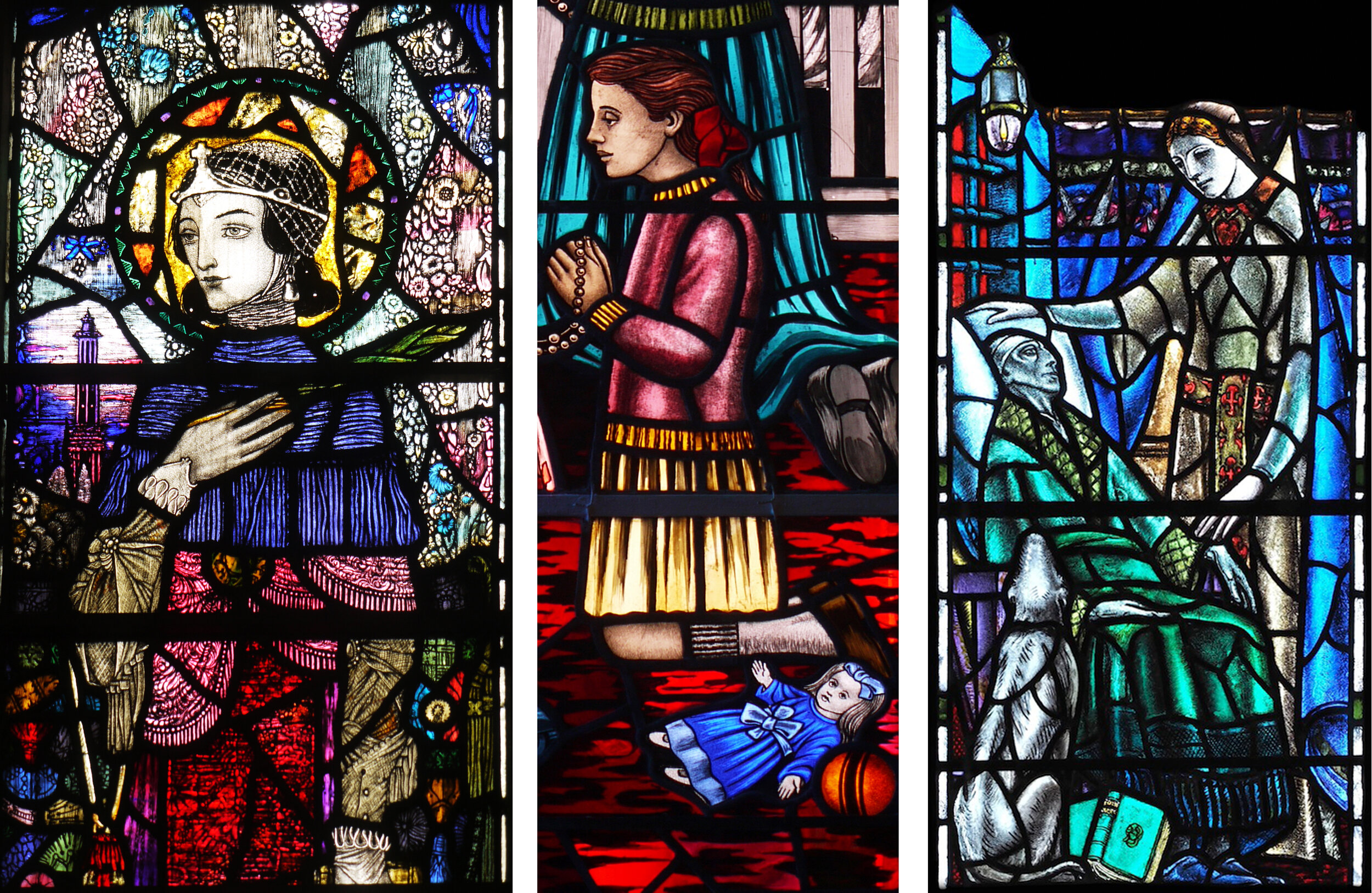
The powdery blue dressing gown drew my attention to the fact that what really worked was the clothes. This is also true of the first piece I made (see previous post) when what I was intending to concentrate on was figures in a setting. The details in Ray’s clothing reminded me of aspects of clothes in stained glass - specifically the weird neck coverings on Harry Clarke’s figures, the 1950s style skirts and jumpers in William Dowling work for Harry Clarke studios, and an even more fabulous dressing gown in Douglas Strachan’s 1944 Womanhood Window.

Harry Clarke at Sturminster Newton, William Dowling at Drimoleague, Douglas Strachan at All Saints, Cambridge

Harry Clarke at Sturminster Newton, William Dowling at Drimoleague, Douglas Strachan at All Saints, Cambridge