Clothes in stained glass by Sasha Ward

I said tell me the truth and I got a lie, ink drawing by Ray Ward, and my interpretation in stained glass.

I said tell me the truth and I got a lie, ink drawing by Ray Ward, and my interpretation in stained glass.

For my second attempt at interpreting one of Ray’s drawings in stained glass (above) I stuck to the original drawing much more closely. For the figure and the trees I painted with the glass pieces on top of a photocopy of the drawing, disguising the lead lines in the web of branches that pretty much follow his brush strokes. I had intended to stick to the original tones too, but when I swapped the dark green foreground I cut first to the piece of old pressed patterned white glass, it looked so much better.

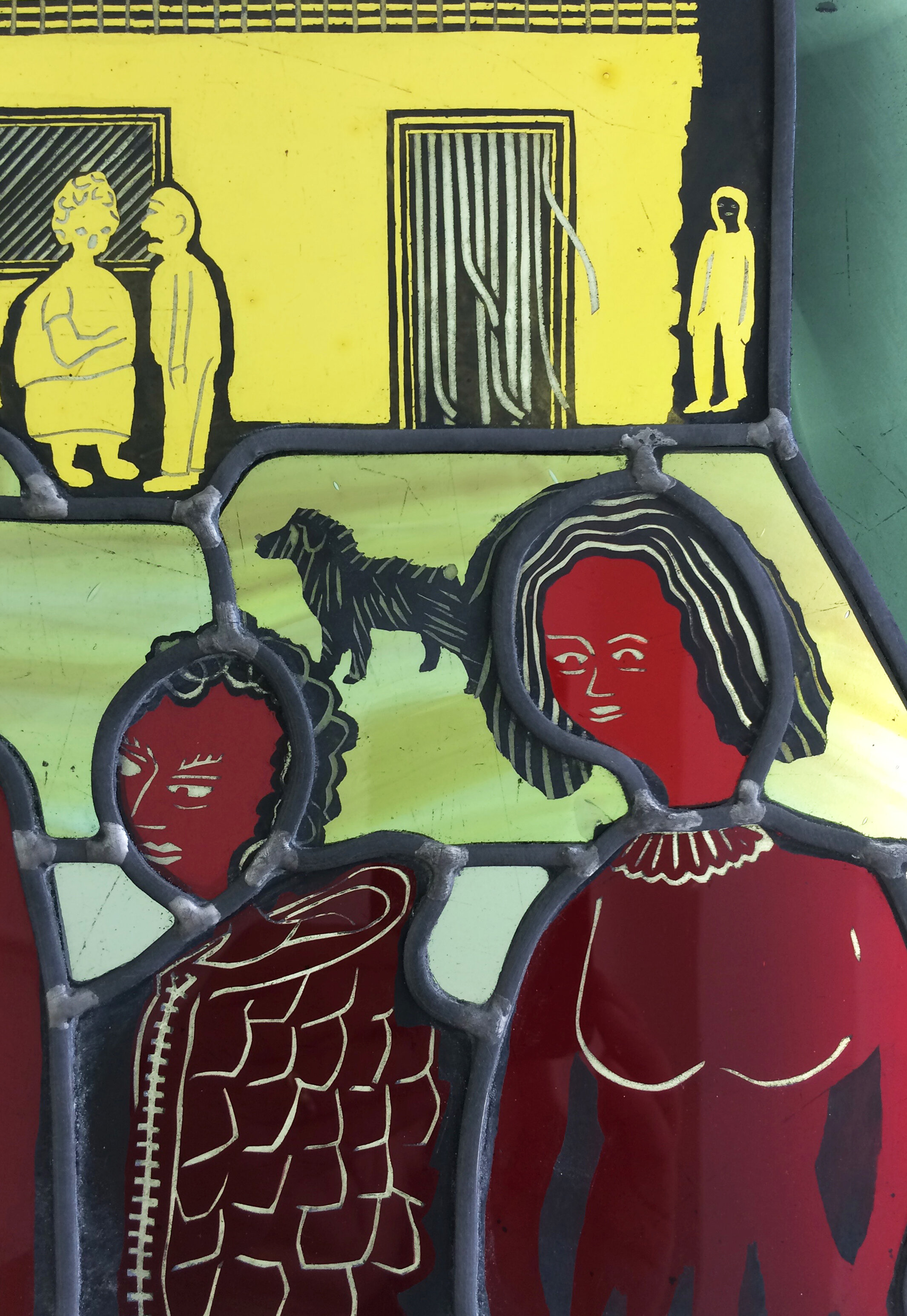
The third piece (below) was from a smaller drawing of a figure surrounded by details that I thought would be interesting to copy. Again I put the cut glass pieces directly on top of the drawing for painting and again I was going to stick to the tones of the original. Then I found a piece of perfect table coloured flashed glass which contrasted well with all the blues. It’s the same piece I used for the sea (above) and the dressing gown (below), but look how different it appears against the other colours.

The Summons, ink drawing by Ray Ward and my interpretation in stained glass.

The Summons, ink drawing by Ray Ward and my interpretation in stained glass.

Details from the two panels.

Details from the two panels.

The powdery blue dressing gown drew my attention to the fact that what really worked was the clothes. This is also true of the first piece I made (see previous post) when what I was intending to concentrate on was figures in a setting. The details in Ray’s clothing reminded me of aspects of clothes in stained glass - specifically the weird neck coverings on Harry Clarke’s figures, the 1950s style skirts and jumpers in William Dowling work for Harry Clarke studios, and an even more fabulous dressing gown in Douglas Strachan’s 1944 Womanhood Window.
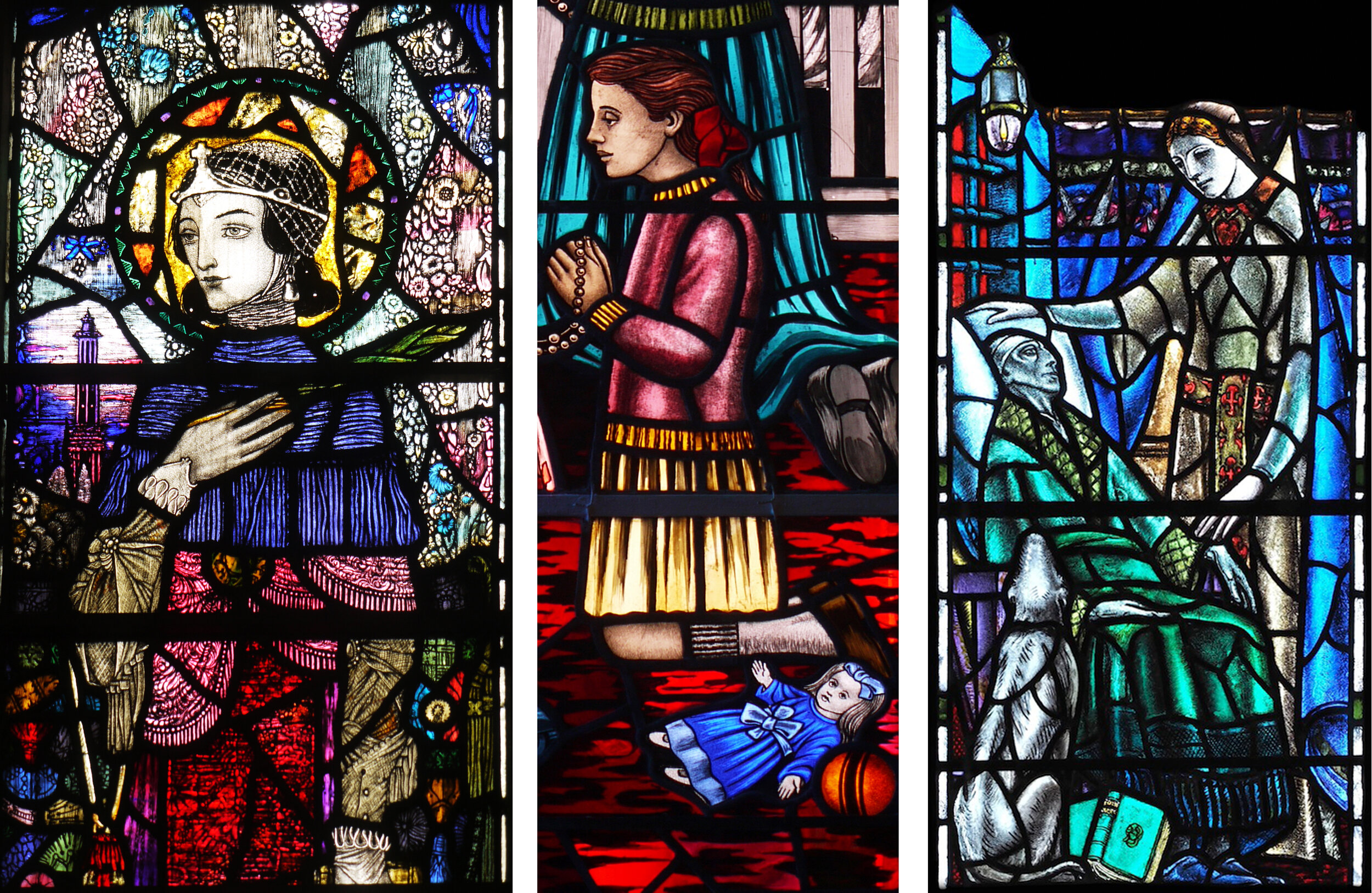
Harry Clarke at Sturminster Newton, William Dowling at Drimoleague, Douglas Strachan at All Saints, Cambridge

Harry Clarke at Sturminster Newton, William Dowling at Drimoleague, Douglas Strachan at All Saints, Cambridge

Interpretation by Sasha Ward

Drawing on grey card by Ray Ward 2019, 840 x 590 mm

Drawing on grey card by Ray Ward 2019, 840 x 590 mm

With projects put off during lockdown, I’ve turned to something I’ve been wanting to do for ages - that is the interpretation of one of Ray’s black and white drawings in stained glass. People have often suggested this would work, and the narratives in his recent series of large drawings do remind me of some of the things I really like about medieval stained glass. Thinking of those panels that tell a story, I chose the drawing above, where there’s a lot going on, for my first try.

Bottom section of Ray’s drawing with blacks and whites reversed.

Bottom section of Ray’s drawing with blacks and whites reversed.

I decided to make the glass panel square and quite small - about half size. I knew I wanted to do the three foreground figures in dark red flashed glass with the lines sandblasted out and the other colours followed from there (below left). I was pretty pleased as the first few pieces came through the painting and sandblasting processes (below right), but then things started getting over complicated.

Left, coloured glass pieces cut: Right, some of the pieces after firing and sandblasting

Left, coloured glass pieces cut: Right, some of the pieces after firing and sandblasting

Left, all the pieces after firing and sandblasting. Right, version 1 finished

Left, all the pieces after firing and sandblasting. Right, version 1 finished

I finished the panel (above). I’d removed all the shadows from the original drawing as well as the figure squished in between the front three and had put the seated figure on a little bit of pink glass. I also thought the trees would make a good decorative border. I finished the panel and thought I’d sleep on it before chucking it in the bin. The next morning, Ray agreed “It wasn’t up to my usual high standards”, so I took off all the bits I couldn’t stand and replaced them with nice bits of dark grey streaky glass.

Version 2 finished, 280 x 260 mm, shown in the window in natural light.

Version 2 finished, 280 x 260 mm, shown in the window in natural light.

Conclusions:

  1. If in doubt use dark grey glass

  2. Simplify even more than you think you need to

  3. It’s easy to do a good bit of detail, but getting the composition right is hard.

Detail of version 2 shown on the lightbox (which is very scratched).

Detail of version 2 shown on the lightbox (which is very scratched).

Inspirational students by Sasha Ward

Favourites from previous courses: left 2018 shown against the flint walls of the house, right 2019 (scale shown is on the lightbox).

Favourites from previous courses: left 2018 shown against the flint walls of the house, right 2019 (scale shown is on the lightbox).

The course I teach at West Dean College starts with an illustrated talk, of which the most popular section is the gallery of past students’ work. Although I aim to show a range of techniques and approaches to the craft, inevitably the panels I choose to show are the ones I like best. My two previous favourites are shown above, they are similar in their modular style which means the panels are fun to make as you can change your mind about which piece of glass goes where. On this year’s course, just completed, there were three students working in three different ways whose work I loved.

Six pieces of enamelled glass by Ursula Yeates.

Six pieces of enamelled glass by Ursula Yeates.

I’ve just inherited some glass enamels for students’ use - just as well as Ursula really lays it on thick! This time she painted at least thirty smallish glass pieces with opaque and transparent enamels, experimenting with spectacular results. She leaded some of these pieces together, but they are also good enough on their own - the top middle (above) at only fifteen cms tall, is amazing. All this painting inspired the group of students to use more paint in their stained glass panels than they usually do. Despite my talk with historical examples, I find it hard to convince people that the best stained glass windows are actually also painted.

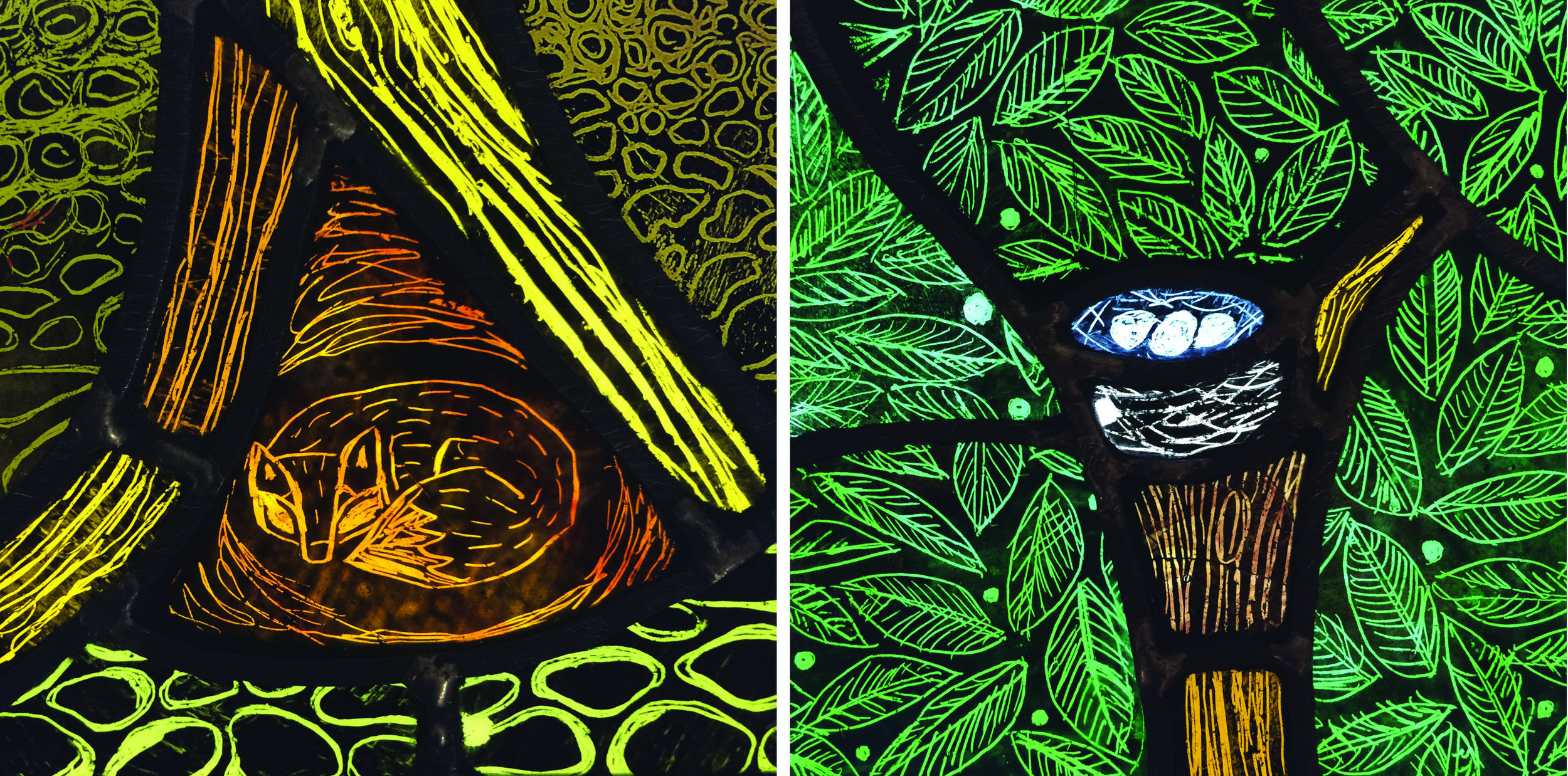
Angela covered her pieces of glass with black iron oxide and drew into it with a stick in the traditional way. At the bottom and top of her tree you find a fox and a bird’s nest which are both drawn so confidently, while for the leaves she drew on a large sheet of green glass and then cut it up. The whole panel is lovely, the details (below) show the freedom in her drawing.

Painted details from stained glass panel by Angela Ibbs.

Painted details from stained glass panel by Angela Ibbs.

The last set of panels, just some of the work that Katie did in five days, combine drawing in black iron oxide, enamel painting and pattern making. The sea urchin panel (below left) at about twenty cms. tall, was her sample piece and so good that I can imagine an enormous window like this, with shapes and patterns repeating. On her house plant panel (below left) she used some of this scratching off technique, but also sandblasting and painting with enamels on pieces of glass cut to a very satisfying plan. These last two students were absolute stained glass beginners. All of them have inspired me, now back in my own studio, with the joy of making.

Two panels by Katie Bebbington, left sea urchins, right house plants.

Two panels by Katie Bebbington, left sea urchins, right house plants.

Two Layers by Sasha Ward

Two layers installed, from the front, 960 x 790 mm.

Two layers installed, from the front, 960 x 790 mm.

This is a new commission for a house in London. The glass panel is in a place where there used to be a fishtank (with different dimensions); the client asked for geometry, textured colour, transparency and no flowers. I suggested two layers of glass to get interesting overlaps and a sense of movement and the project manager suggested edge lighting - we are are all pleased with the result which you can see in the photos above taken on installation day. The following pictures document the commission in progress, from first designs to final firing in my studio kiln.

Left: Original model made of acrylic. Centre: Half size watercolour design. Right: Sample on 2 sheets of glass

Left: Original model made of acrylic. Centre: Half size watercolour design. Right: Sample on 2 sheets of glass

First layer of enamel on the lightbox (left) and after firing in the kiln (right).

First layer of enamel on the lightbox (left) and after firing in the kiln (right).

Some handpainting on the second layer, trying (never succeeding) to match to the colour samples.

Some handpainting on the second layer, trying (never succeeding) to match to the colour samples.

The two panels in the kiln before their final firing.

The two panels in the kiln before their final firing.

Above: studio shot showing panels on lightbox Below: finished panels with tracing paper backing in the window

Above: studio shot showing panels on lightbox Below: finished panels with tracing paper backing in the window

panel 7.jpg

Painting enamel on the two layers of glass (shown separately above) and overlapping them in the window frame (below left) means the colours keep their own hue. Transparent glass enamels are very unpredictable when mixed and layering them often results in a lot of brown. The colours we ended up with are brighter than I had originally planned and they look absolutely great with the pinky decor and the concealed lighting which runs around the edges of both panels (below right).

Two layers installed, from the back with lights off (left) and on (right).

Two layers installed, from the back with lights off (left) and on (right).

The best details of the glass (below) are from the back, from the hallway behind the living room which is the darker side. As less light falls on this surface of the glass, the transparent colours are brought to life by the light through the living room window, even when the lights are off. The proportions of my design match those of the windows in the house, with a sandblasted off centre box where the two halves of the design come together and frame that window (below right).

Details of the glass from the back

Details of the glass from the back

My wallpapers by Sasha Ward

My designs for wallpapers are one offs - digitally printed for a specific place. This aspect of my practice has developed alongside the glass panels I make, sometimes the wallpapers are seen through a glass wall panel, sometimes they are a solid wall to contrast with a coloured window.

In my commission for the paediatric mortuary at the Royal Manchester Children's Hospital, the wallpapers played an important part in linking together a series of rooms that we decorated with new colours and artworks in glass and vinyl. The project was completed last year when I described the vinyl door vision panels here and the main glass artwork here. After a recent visit to check out the new furniture that completed the scheme I saw how well the wallpapers worked in the tricky spaces.

Model of the tricky spaces - five rooms with no external windows

Model of the tricky spaces - five rooms with no external windows

I designed the wallpapers to a brief that asked for abstract artworks, with little reference to the outside world. Because of the unique nature of the space and the sensitivities of the people who would use it, they needed to be nothing like you would have in your home, and nothing like you would ever see again. The designs followed a series of workshops with staff and bereaved families who gave their opinions forcefully. Back in my studio I made a series of watercolours and collages that drew on the workshops and formed the basis of my designs.

A favourite collage, I tried not to stray too far from this in the following designs for five wallpapers.

A favourite collage, I tried not to stray too far from this in the following designs for five wallpapers.

Design for Room 2. Waiting Corridor. 2.6 x 6.8 metres

Design for Room 2. Waiting Corridor. 2.6 x 6.8 metres

Photos of the trickiest narrowest space, the waiting corridor.

Photos of the trickiest narrowest space, the waiting corridor.

Design for Room 3. Children's Viewing. 2.6 x 2.6 metres

Design for Room 3. Children's Viewing. 2.6 x 2.6 metres

Photos through the viewing window to the viewing room wallpaper.

Photos through the viewing window to the viewing room wallpaper.

Design for Room 4. Children's Bedroom. 900mm x 6.4 metres

Design for Room 4. Children's Bedroom. 900mm x 6.4 metres

Photos from the viewing room to the Children’s Bedroom wallpaper and glass panel.

Photos from the viewing room to the Children’s Bedroom wallpaper and glass panel.

Design for Room 5. Babies’ Viewing. 2.6 x 1.8 metres

Design for Room 5. Babies’ Viewing. 2.6 x 1.8 metres

Photos into babies’ viewing room and through the viewing window.

Photos into babies’ viewing room and through the viewing window.

Design for Room 6. Babies’ Bedroom. 900mm x 6.4 metres

Design for Room 6. Babies’ Bedroom. 900mm x 6.4 metres

Photos through viewing window into the babies’ bedroom with wallpaper and glass panel.

Photos through viewing window into the babies’ bedroom with wallpaper and glass panel.