Disembodied head by Sasha Ward

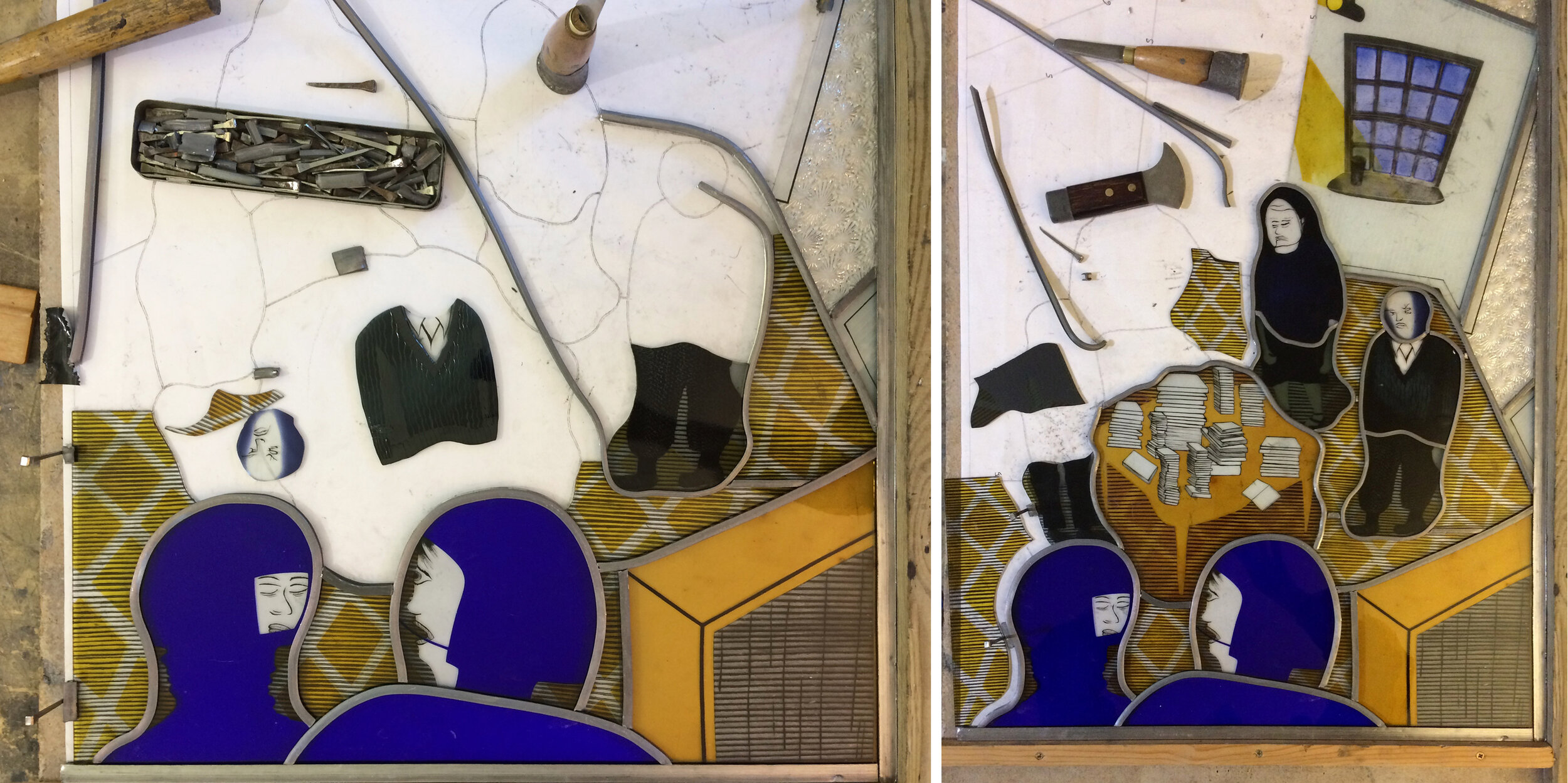
Purple man from ‘These People Are Intellectuals…’  Left, in progress.  Right, in the exhibition at Norwich Cathedral

Purple man from ‘These People Are Intellectuals…’ Left, in progress. Right, in the exhibition at Norwich Cathedral

Purple man’s disembodied head was an unplanned addition to our exhibition at The Hostry, Norwich Cathedral. When making the stained glass panel ‘These People are Intellectuals, They Live in Houses Full of Books and Have Nothing Worth Stealing’ (described in a previous blog post) purple man ended up with two alternative heads. I did a second one (on the left in the photos above) out of the same piece of flashed streaky purple glass because I thought I’d sandblasted too much of the purple layer off on the first head. However head number one turned out to be the best one, so head number two ended up on its own stand in the display case alongside an explanation of how the window was made.
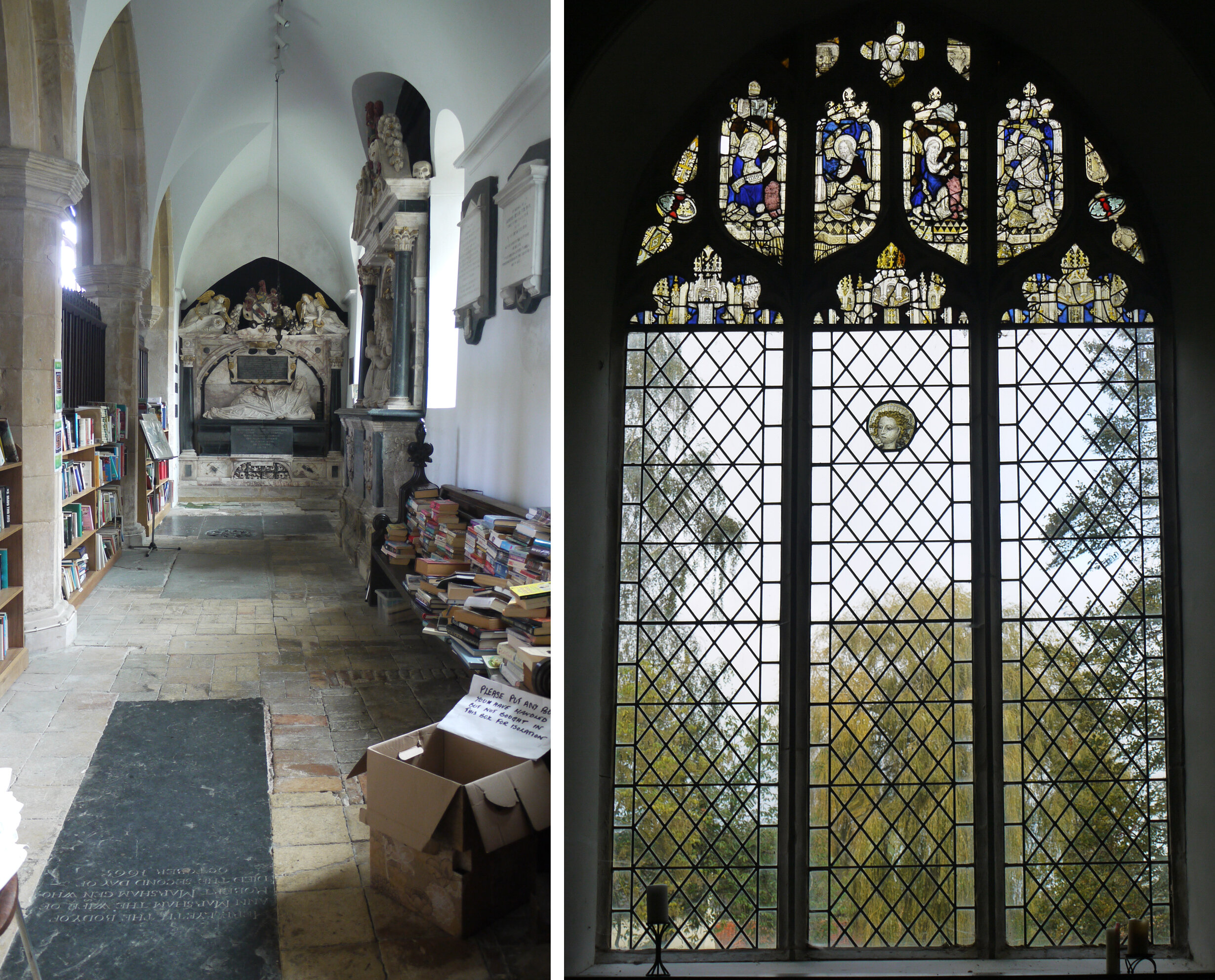
St Margaret, Stratton Strawless  Left, the south aisle. Right, north window containing medieval glass.

St Margaret, Stratton Strawless Left, the south aisle. Right, north window containing medieval glass.

When you start looking at old stained glass in churches you get used to seeing disembodied heads. These are pieces of medieval stained glass that have survived breakages or the releading of windows and find themselves either part of another picture or out on their own. We made a trip to the village of Stratton Strawless, just north of Norwich, to see a perfect example of fifteenth century Norwich glass painting in the angel head which has been set into a clear glass window (above and below). Miraculously the church was not locked and it is full of stupendous monuments and second hand books as well as the angel head which seems so beautifully done now that I’ve started painting heads myself.
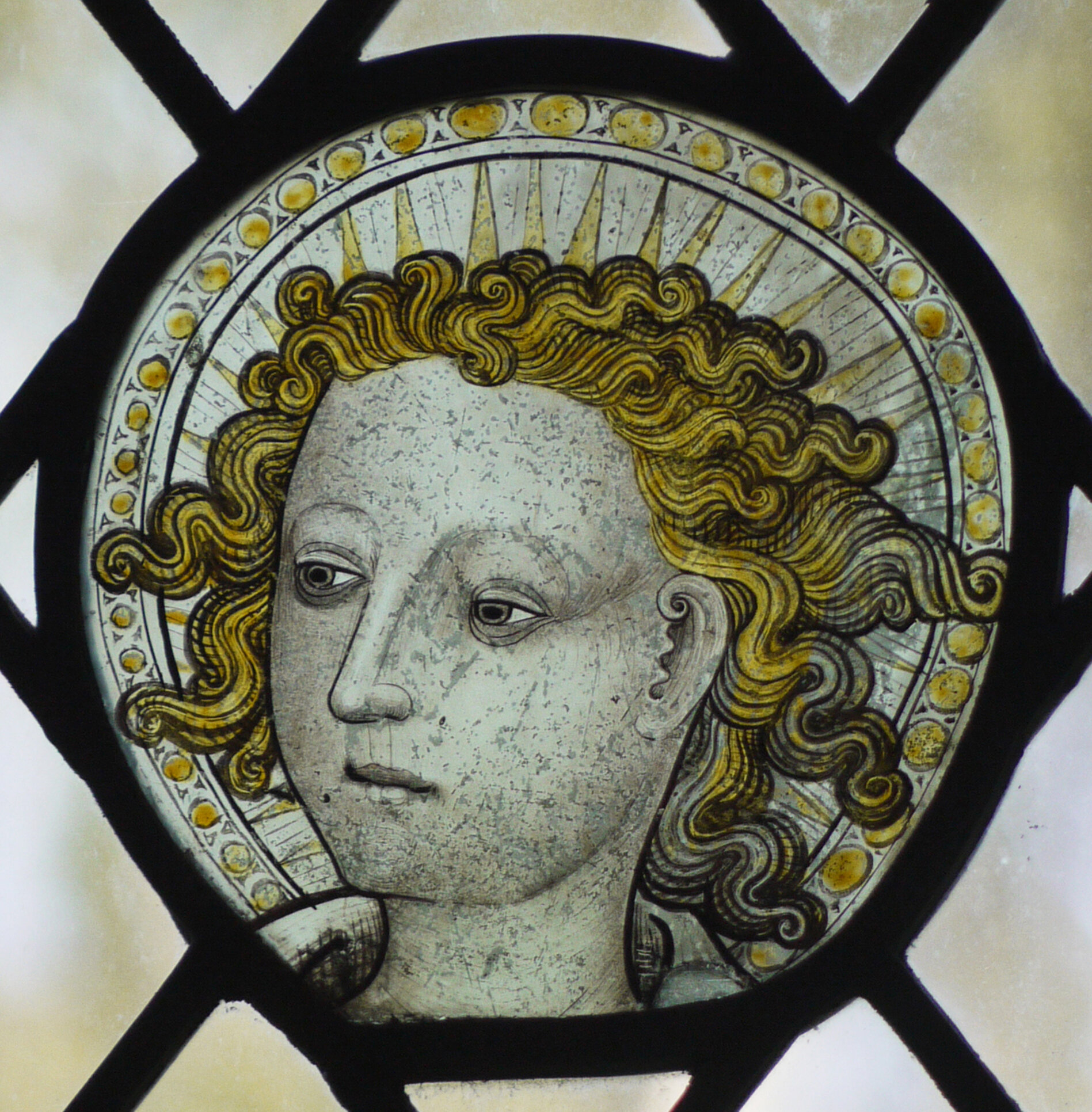
Stratton Strawless, the C15th angel head.

Stratton Strawless, the C15th angel head.

Stratton Strawless, glass in the windows of the south aisle.

Stratton Strawless, glass in the windows of the south aisle.

Set into the windows of the south aisle are a collection of other glass fragments, including the heads of a bishop, a king with a fascinating web of lead lines where he has broken and a strange head which is all beard and no hair (above right). All of the other churches we drove to were locked, so thank goodness for a visit to Castle Acre Priory. Here were windows and arches, carved patterns and lines and among them just a few carved heads (below).

Stone heads from Castle Acre Priory.

Stone heads from Castle Acre Priory.

Arches by Sasha Ward

Left, Version 4, glass panel 270mm square. Right, Norwich Castle Museum and Art Gallery - currently closed.

Left, Version 4, glass panel 270mm square. Right, Norwich Castle Museum and Art Gallery - currently closed.

I was working on a series of painted glass panels called Theme and Variations while planning our exhibition at Norwich Cathedral. It was only when I looked back at this photo of the castle (above right) that I saw the connection to the rows of arches in my series, even down to the inverted concrete arch of the horrendous glass lift exit in front of it. So I added the castellations to the top of the last in the series (above left) in the hope that a local visitor to the exhibition may notice the link.

Left, Norwich - from Castle Meadow to the Royal Arcade. Right, Stained glass inside the arcade.

Left, Norwich - from Castle Meadow to the Royal Arcade. Right, Stained glass inside the arcade.

Most of the buildings in Norwich I’d earmarked to visit to see the best examples of old stained glass were closed. With covid restrictions in place, the city felt like a half empty stage set so I wandered around and found interesting architectural details everywhere. The rounded arch, filled with fresh floral stained glass, made another appearance in the Royal Arcade (above).

Left, King’s Lynn - the locked doors of St Nicholas’ Chapel. Right, beside the locked doors of King’s Lynn Minster

Left, King’s Lynn - the locked doors of St Nicholas’ Chapel. Right, beside the locked doors of King’s Lynn Minster

By the time we got to King’s Lynn and found that absolutely every building that wasn’t a shop, cafe or pub was shut, we had begun to get fed up, despite the beautiful locked doors and interesting architectural features - more arches on top of arches.

An outdoor visit saved the day. Nearby are the ruins of Castle Acre Priory, a Cluniac monastery from around 1089 to its dissolution in 1537, with the most magnificent set of arches you could hope to see (below). The enormous west front has a solid base of round arches around the original west door, and a large pointed mid 15th century window inserted above. Wonderful to see the combination of the two types of arches combined in the elaborate architectural detail and to find inspiration on how to take my painted series forward.

The West Front of Castle Acre Priory, Norfolk.

The West Front of Castle Acre Priory, Norfolk.

These People Are Intellectuals by Sasha Ward

‘These People Are Intellectuals, They Live in Houses Full of Books and Have Nothing Worth Stealing’ is the full title of Ray’s large black and white drawing (below). When I decided to make a larger stained glass panel from one of his drawings, I had no hesitation about choosing this one, partly because of the fabulous title that tells you what is going on in the picture. The shadows of the two helmeted robbers are seen in the back window and then repeated in the foreground, medieval style, so you really know who is talking.

These People Are Intellectuals… 880 x 680 mm. Acrylic and indian ink on card. Ray Ward 2019

These People Are Intellectuals… 880 x 680 mm. Acrylic and indian ink on card. Ray Ward 2019

The photos below document the making process starting with the choice of glass colour and texture. In stained glass dark colours come to the front, unlike in easel painting where they appear to recede. The blue flashed glass I chose for the foreground talking heads dictated the rest of the colour scheme. I’ve learnt from the previous collaborative panels to keep the colours restrained, so stuck to the purple side of blue contrasted with sandy yellow. I used clear glass for the back wall and textured glass for the ceiling and open doorway. Ray said he had no idea who the legs in the doorway belonged to, so I decided to leave them out.

Left, 32 Cut pieces laid on top of a photocopy of the drawing. Right, First layer of sandblasting, painting and staining.

Left, 32 Cut pieces laid on top of a photocopy of the drawing. Right, First layer of sandblasting, painting and staining.

Left, Detail of completed foreground pieces, showing silver stain diamonds on carpet.  Right, Work in progress on big and small light boxes - the bookcases needed a second layer of black (iron oxide) paint.

Left, Detail of completed foreground pieces, showing silver stain diamonds on carpet. Right, Work in progress on big and small light boxes - the bookcases needed a second layer of black (iron oxide) paint.

Left, Four figures in progress with an alternative, less sandblasted, head.  Right, Back wall has been double sandblasted with wallpaper stripes and fired with black iron oxide for window, skirting and lights. Blue enamel panes and silver stain beam…

Left, Four figures in progress with an alternative, less sandblasted, head. Right, Back wall has been double sandblasted with wallpaper stripes and fired with black iron oxide for window, skirting and lights. Blue enamel panes and silver stain beams of light in unfired state.

Left and Right, Leading in progress.

Left and Right, Leading in progress.

Left, Cementing, the lovely stage where the window comes together.  Right, Sunshine through the completed panel shows the sandblasted areas as shadow.

Left, Cementing, the lovely stage where the window comes together. Right, Sunshine through the completed panel shows the sandblasted areas as shadow.

Completed panel 700 x 540mm

Completed panel 700 x 540mm

The panel is on show alongside Ray’s original drawing and the notes and lists I made during the process in our exhibition at Norwich Cathedral ‘The Cloud of Unknowing’ until December 12th.

Click this link for the full exhibition catalogue

Colour, Theme and Variations by Sasha Ward

Version 1, 700 x 540mm and detail showing layers of fired enamel colour.

Version 1, 700 x 540mm and detail showing layers of fired enamel colour.

I had an idea for a new design and, as is my usual practice, worked out the best combination of colours, made a template and set to work on what was to become Version 1 (above). Each transparent enamel was applied differently to give a different texture, I hand painted, sprayed and rolled the paint on. The result looked good, but was not quite what I had in mind so I made some smaller versions to see where the same design in other colour combinations would take me.

Left: Version 2 after first firing. Right: Versions 2,3 & 4 in progress.

Left: Version 2 after first firing. Right: Versions 2,3 & 4 in progress.

Version 2 (above and below left) used the colours I had in mind, pale grey (I haven’t got much of this enamel left) and a more yellowy green mix (not got much green either, so I mix up blue & yellow). With these colours went a paler blue and the pinky foreground that all the versions have in common. Version 3, the narrow panel below, is in an alternative colour scheme I’d drawn up and version 4, below right, used up the leftover enamels in a different combination. You can see these panels on the lightbox above, the first layer of enamel has been fired and is therefore transparent, while the second as yet unfired layer appears opaque.

Versions 2,3 & 4, height 270mm.

Versions 2,3 & 4, height 270mm.

All together in the window, these panels looked rather like my usual stripey colour samples, and I decided to make some improvements to versions 3 & 4. V3 looked insipid, so I beefed up the colour and added some more sandblasting (below left). V4 was a mess, it needed two trips to the sandblaster and a firing to transform the shapes and take the series off in a new direction.

Variations on Version 3 and 4.

Variations on Version 3 and 4.

Paradise Lost by Sasha Ward

This is the drawing (below) used for our first collaborative stained glass panel commissioned as a window, chosen by the clients because of its proportions and its suitability for a bathroom window. It’s a small black and white ink drawing called “There is a Grain of Sand in Lambeth that Satan cannot find” and is based on a famous story told by William and Catherine Blake's friend Thomas Butts. At the end of the Blakes’ garden in Lambeth was a small summer house, and coming to call on them one day Butts was shocked to find the couple stark naked: "Come in!" cried Blake; "it's only Adam and Eve you know!" The Blakes were reciting passages from Paradise Lost, apparently "in character." As is usual in the work of Ray Ward, the inspiration is hidden - it was an added bonus to find out who the characters were when the commission was underway and we were able to decipher the title, which is a quote from Blake’s poem “Jerusalem”.

Ray’s drawing, “There is a Grain of Sand in Lambeth that Satan cannot find” (170 x 275mm) and stained glass interpretation of the same (320 x 600 mm).

Ray’s drawing, “There is a Grain of Sand in Lambeth that Satan cannot find” (170 x 275mm) and stained glass interpretation of the same (320 x 600 mm).

The glass was installed in the top half of a ground floor loo window. It provides privacy from next door’s windows without blocking the view of plants on the windowsill. There are two bonus reflections - in the mirror on the left and in the opaque glass door panel to the right in the photo below, and in front of you when you’re seated on the loo.

The panel installed in the bathroom window.

The panel installed in the bathroom window.

Stages of making

Stages of making

This window uses every type of glass and technique in a sequence of steps that I photographed throughout the process (above) as follows.

Stage 1, the straightforward bit, choosing and cutting the glass. Stage 2, shows the glass pieces laid on top of Ray’s drawing which has been scaled and shifted to fit the window proportions. Stage 3, the first layer of iron oxide painting into lines I’d sandblasted to provide definition. Stage 4, 2nd layer of painting in some areas, pink glass masked out for sandblasting, table and steam lines already blasted out. Stage 5, pink flashed glass sandblasted, took ages! Stage 6, the most fun part was the final painting - silver stain on the chairs, enamel on the mugs, iron oxide on the book and the faces. I traced these directly from Ray’s drawing. As you can see in the detail below, I think I got their expressions quite well. The only elements I changed were on the book, I didn’t mind the crazy perspective but thought I could do with some better lettering, and the shape of the mugs became the type they use in the house which are made by one of its occupants.

Detail comparing drawing with glass

Detail comparing drawing with glass

In my line of commissioned work I’m used to getting the colours and the composition right for a particular place, but the figurative element in these joint pieces is something I haven’t touched since I was a student. For me, they are all about the people. Ray always denies that there is anything autobiographical going on in his drawings, but we had our portraits taken underneath the window on installation day, just to check.

Window from the outside and the inside.

Window from the outside and the inside.