Two Types of Rose Window by Sasha Ward

Early morning drawing of the Basilica in Assisi                   Cathedral of San Rufino, Assisi

The rose windows in the buildings of Assisi are particularly beautiful. Painton Cowen, writing in 'Rose Windows' calls them "Wheels within wheels...The wheel finds its greatest expression at Assisi". The one that I drew on the facade of the Upper Basilica of San Francesco (above left, dated c.1250) "faces the rising sun - exactly the opposite of most other wheel or rose windows." Another beautiful, west facing and earlier example is on the facade of the Cathedral of San Rufino, with carved figures holding it up.

It's the geometry in these windows that is much more interesting than the little bits of stained glass they contain. And so fabulous to see them made into a curtain pattern, complete with troupe l'oeil beam and hangings, in a fifteenth century fresco in the church of San Francesco in nearby Montefalco - the design comes with a yellow background on one wall and blue on the other.

C15th frescoes, Chapel of the Annunciation, San Francesco, Montefalco, Umbria

My design and photo of sandblasted wall with mosaic band, Leeds General Infirmary 1997

The type of rose window that I've used a lot in my own design work is made from intersecting circles. An example shown above is from Leeds General Infirmary: I did this commission in 1997 and I think it must still be there as it was sandblasted into the wall of the entrance rotunda. I loved this technique which I never had the chance to use again, I also love the intersecting circle patterns but will definitely be making them more complicated and wheel like in future designs.

The simple circle pattern cropped up in a local doorway and in the balcony outside Santa Chiara, Assisi (both below) where there is another intricate "wheel within wheel" window and a wonderful view of the setting sun.

Click on the images to enlarge them

blog 3 copy.jpg

Resolute Beginnings by Sasha Ward

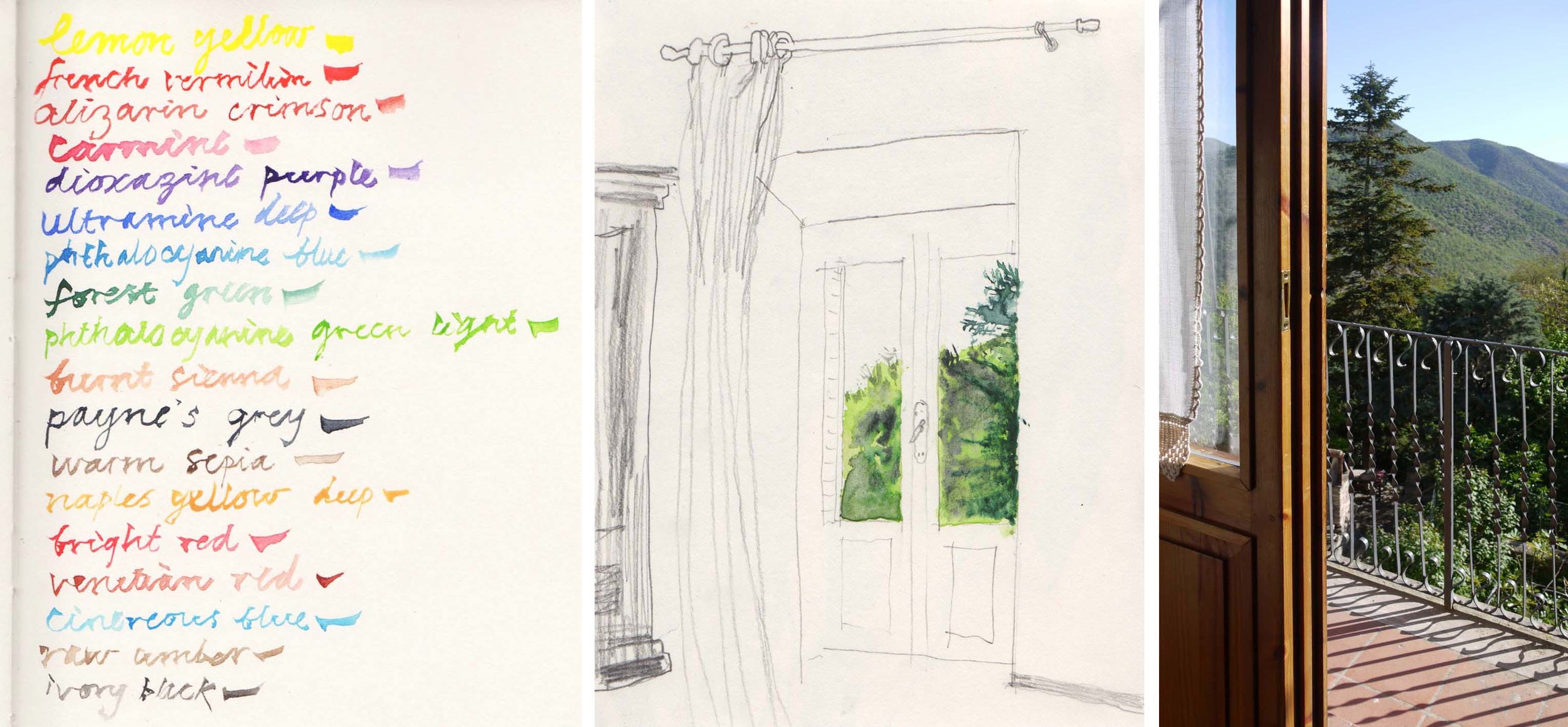
'Resolute Beginnings' was a title that I always liked given by one of my fellow art students to her mass of smashed up and refired glass pieces. In this case it refers to drawing with colour, which I never do. So, for a trip to Assisi, Umbria, Italy, I bought a new box of watercolours and set off with resolution. If in doubt I draw the view through the window, this green view (below) was what I could see when sitting up in bed.

 New watercolours                                         View from my bed                    …

 New watercolours                                         View from my bed                                      On opening the door

Through the door there was a balcony with a beautiful view of the mountains to the north east of Assisi. The camera captures the rhythms and shadows of the balcony, the ink drawings, one example below, are better at getting into the contours and details of the landscape.

On the last evening I went as far as painting the sky from the end of the balcony. As the sun set on the other side of the building there was a riot of colour in the sky and briefly across the illuminated landscape. Phthalocyanine and cinereous blues, even dioxazine purple, more useful than I could have imagined.

blog 3.jpg

With Added Plants by Sasha Ward

This has been the first winter that I've let the plants into my studio. I thought they would get in the way and I could just carry on making them up if I wanted a plant in a design. However it has been great watching the daily changes and working out how to keep them happy. I've even bought a new one whose flowers match my current window display - a yellow and maroon auricula.

The purple plant climbing up the window has flowered in a way that frames the star on one of my grey glass samples. I thought I'd add the plant to another of the grey samples, really enjoying using two of the best glass colours, yellow and pink and the red that results where they overlap, after a long period figuring out how to work in neutral tones.

Plants doing their thing                                            Painted plant on grey glass sample

Plants doing their thing                                            Painted plant on grey glass sample

Meanwhile, I came across a lovely neutral plant form window in a local church, St. Mary's in Great Shefford, Berkshire. It shows a stencilled vine on an opaque but very pale background, with scratches (looks like cleaning damage) that only add to the peaceful, textured atmosphere. These type of windows often have yellow silverstain details - you can imagine the dots being coloured in for example. This one looks great in its simplicity. 

Vine window and detail - St. Mary's, Great Shefford

Details From Local churches by Sasha Ward

Sometimes it's the details in the windows that are so marvellous. Once you know how to make stained glass windows, it is easy to see the hands of the makers and menders at work: choosing pieces of glass then deciding where to cut them and where to add painted detail. These pictures are from the same churches as those in my previous blog post "Nine Churches in Two Hours", and they show a range of interesting stained glass skills and effects.

St Peter, Manningford Bruce                                                                     St James, North Newnton

In the top of the annunciation window (above left) is a dove in an exaggerated circle surrounded by a jumble of architectural detail and pieces of very flat foliage. Every piece of glass has been painted, etched or stained in a mixture of styles, which is not uncommon. I chose the angels at the top of another window (above right) partly because of the pink/yellow combination that I love in glass but also, because the windows are so small, most of the detail is conveyed through economical painting rather than endless bits of leading.

Below are details from two of the William Wailes windows that fill the church at Chirton with a glaring, mainly red and blue, light. These windows have a lot of harsh coloured unpainted glass; the details that I found were in the top of one window where the colours are mercifully separated by stonework and lots of neutral glass, and in the bottom of another. I had been hoping to find some local landscapes behind the figures in my local windows, instead I found some great textures in the painted wood, grass and rocks around their feet.

Both from St John The Baptist, Chirton (c. 1850)

St. Nicholas, Wilsford                                                                                            Saints Peter & Paul, Marden

These feet (above left) belong to "Dorothy, wife of the Revd. Charles Hewitt M.A. Vicar of this Parish, who fell asleep in Jesus, 13th May 1928". The colours here don't say Wiltshire to me, but there is one piece of glass painting I love - the floating flowerhead on the green/yellow streaky glass at top right of Dorothy's feet. The 1958 window (above right) by Jasper & Molly Kettlewell in Marden Church is great (as mentioned in my previous blog), these feet look as if they have stepped out of an art school life room, the background colours are just what I would want to use. 

St Nicholas, Wilsford

St Nicholas, Wilsford

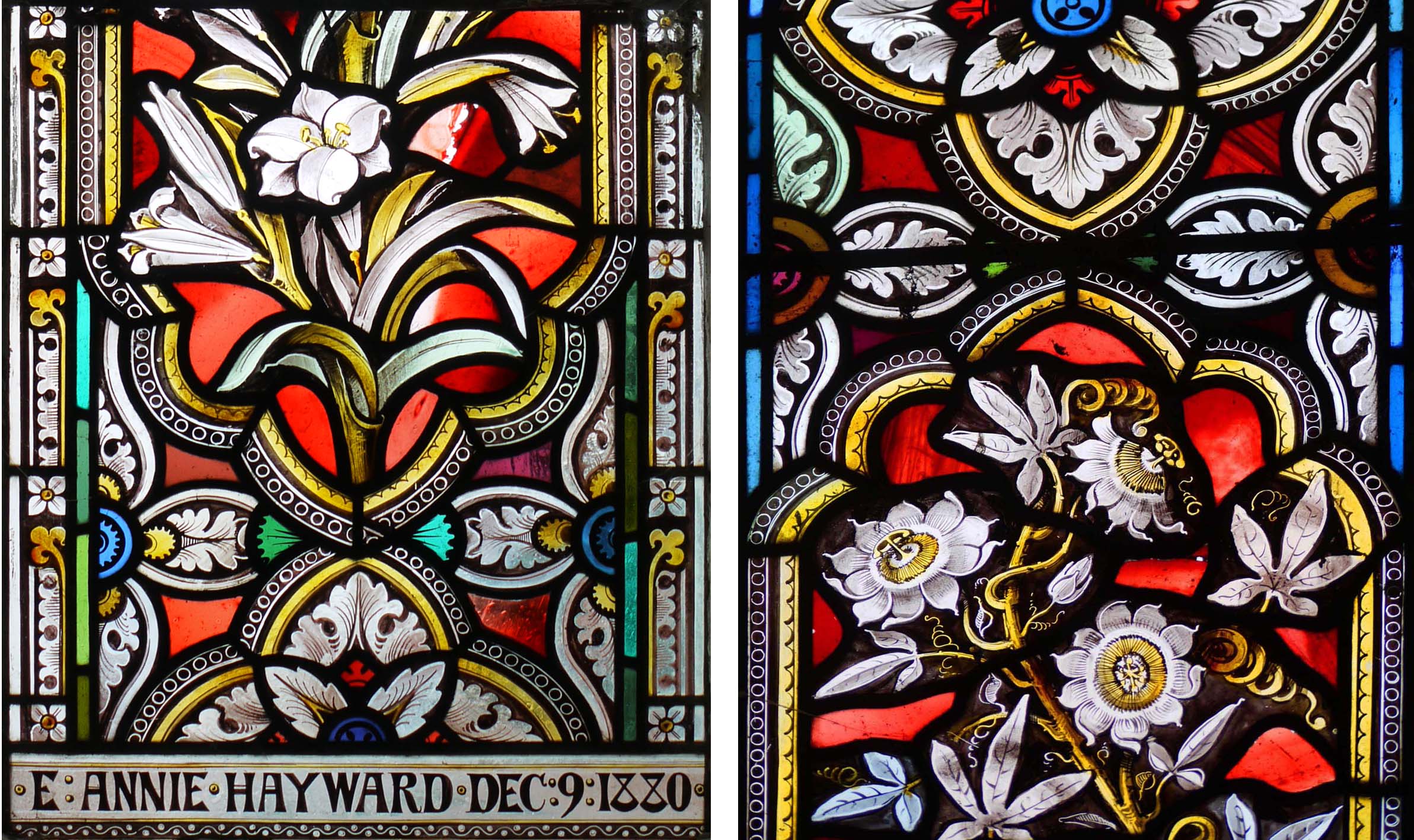
And finally two pairs of satisfying panels. There is a variety of window styles in Wilsford Church; the lily and passion flower windows (above) are opposite each other in the chancel. I love the combination of the geometric and the organic where formal floral borders and medallions meet botanical detail. 

I hate to say that the windows I marvelled at most where these two small fifteenth century panels mounted one above the other in a window in St. Matthew's Church, Rushall. All the glass pieces look so smooth and rounded, the decay on the paintwork is lovely and subtle, as are the faint expressions on the faces. There's even a bit of my favourite type of scratchy decorative landscape either side of the crucifix.  

St Matthew, Rushall

St Matthew, Rushall

Nine Churches in Two Hours by Sasha Ward

A slight exaggeration as I didn't include the time it took to get there and back, one of them was locked and one had become a private house. However these churches are all close together in the vale of Pewsey in Wiltshire - the route was Manningford Bruce, North Newnton, Upavon, Rushall, Charlton St. Peter, Wilsford, Marden, Chirton and Patney. Some of them were so uninviting that you wondered why anyone would want to sit there for more than ten minutes, others had an incredible atmosphere both inside and out. 

St. Mary Upavon, locked but this is a Henry Holliday window             St. Matthew's Rushall, window and doorway

St. Mary Upavon, locked but this is a Henry Holliday window             St. Matthew's Rushall, window and doorway

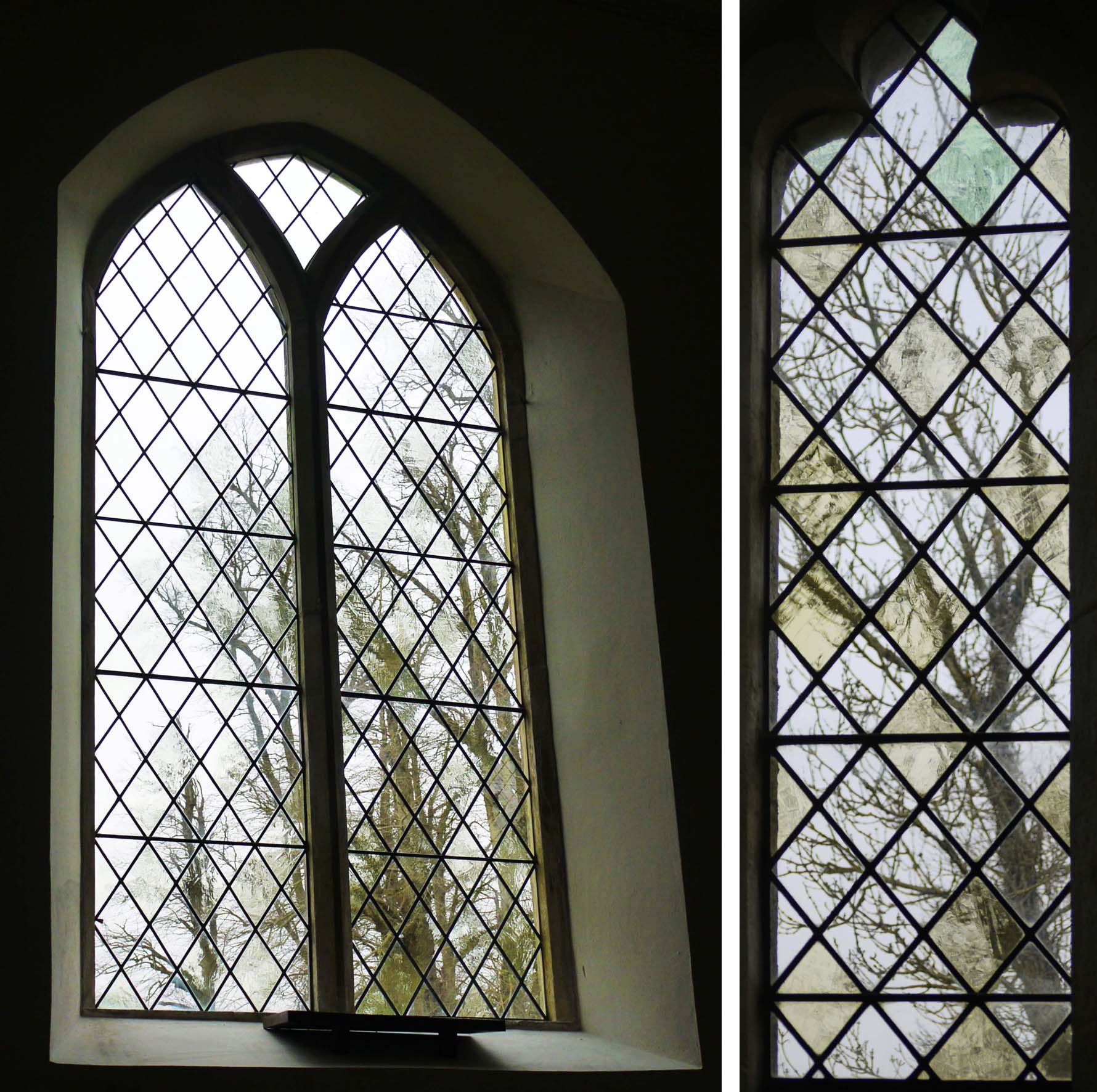
My favourite of these churches is St. Matthew's, Rushall, surrounded by fields. The light was streaming in and out through mostly clear windows distorting the winter trees outside.  As soon as you see even a slightly bad figurative window (this church has a four seasons one from the 1960s) you wonder why anyone would bother to have anything other than the plainest glass. 

Pale and textured glass at Rushall

Pale and textured glass at Rushall

It's quite easy to find a nice bit of detail in most of the nine, well seven really, churches that I visited, but that doesn't amount to a good stained glass window. What does, in my opinion, is one that changes the atmosphere inside the church by altering the light using subtle pattern and colour - three examples below, all fantastic.

Manningford Bruce                              North Newnton                                        Marden

There were also some small (about 1 metre tall) windows that I thought worked in their entirety. Rather than pick out details I want to look at the whole composition and think about the people in them. The Marden window (below right) of Saints Peter and Paul was made by Jasper and Molly Kettlewell in 1958. It is amazing to find such a bold pair of figures looking so 1950ish in a tiny and lovely local church.

Wilsford                                                    Wilsford                                       Marden