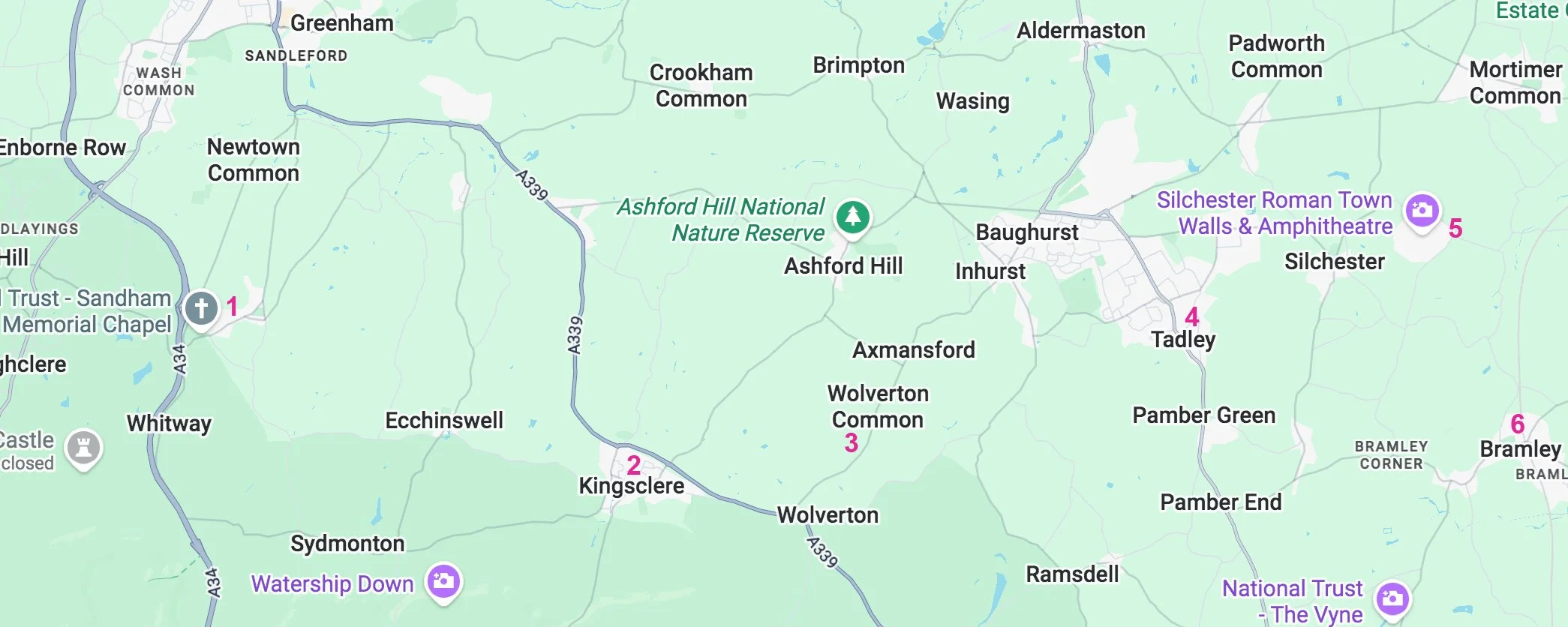
Route map - between Newbury, Berkshire and Basingstoke, Hampshire.
I planned a drive to some churches I had read about in the towns and villages south of Newbury and north of Basingstoke, travelling from west to east as shown in the map above. It proved to be a good day trip that also included views of Watership Down, the woods around Tadley - the site of two of my commissions from 1998 - and the Roman town of Silchester.
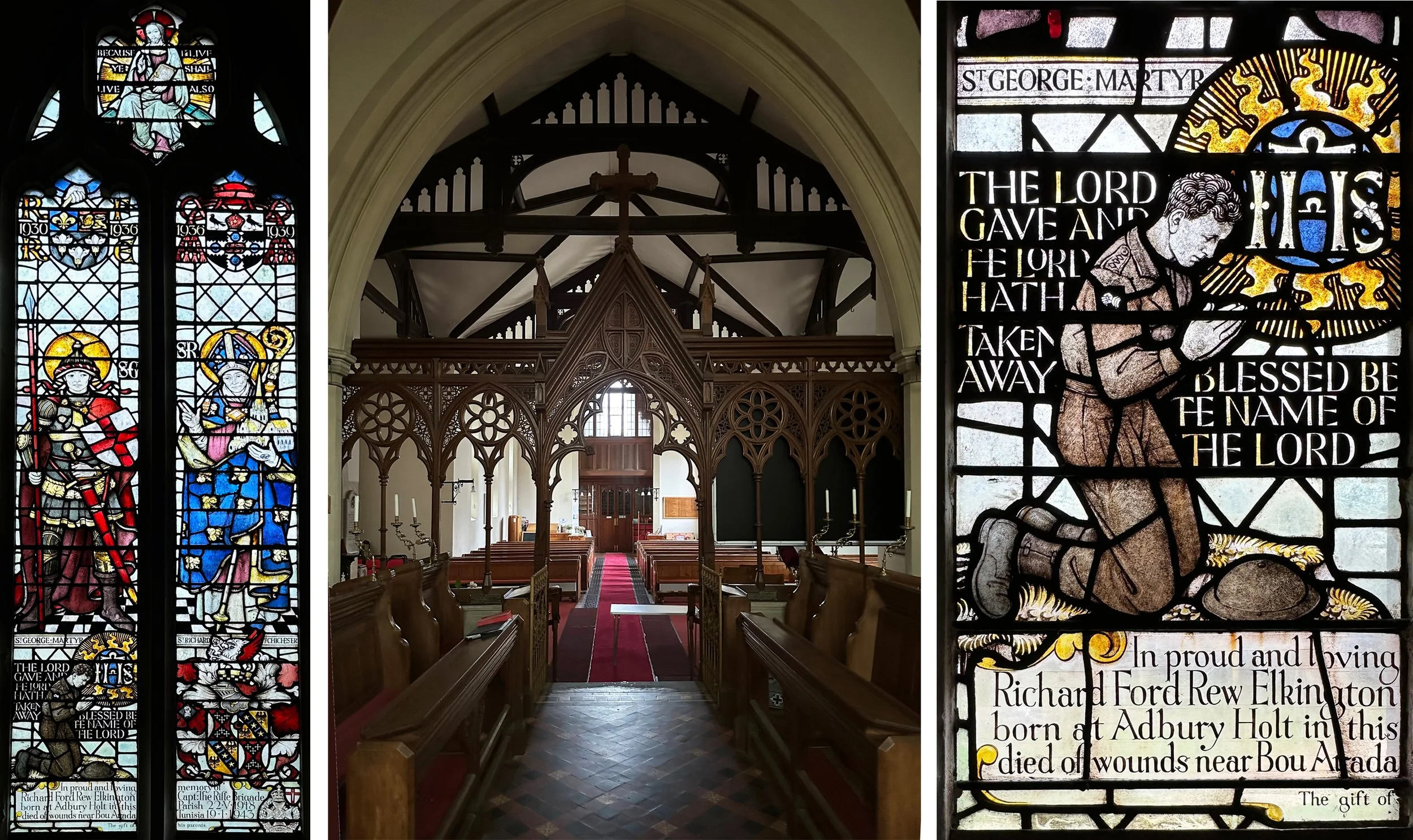
1. Ascension Church, Burghclere. Window by Martin Travers 1943
First stop was Ascension Church, Burghclere, a big flint church with lots of good things inside, for example the wooden rood screen viewed from the chancel in the photo above. As usual I was there for the stained glass and in particular a second world war memorial window by Martin Travers. This window looked to me totally successful; in the depiction of the saints (George and Richard of Chichester) the integration of the arms (Eton College, Christchurch College Oxford, the Elkington family crest, the Rifle Brigade crest, Mailed Fist of the 6th Armoured Division, Crusader’s sword of the First Army) and above all the wonderful hand drawn lettering (above right).
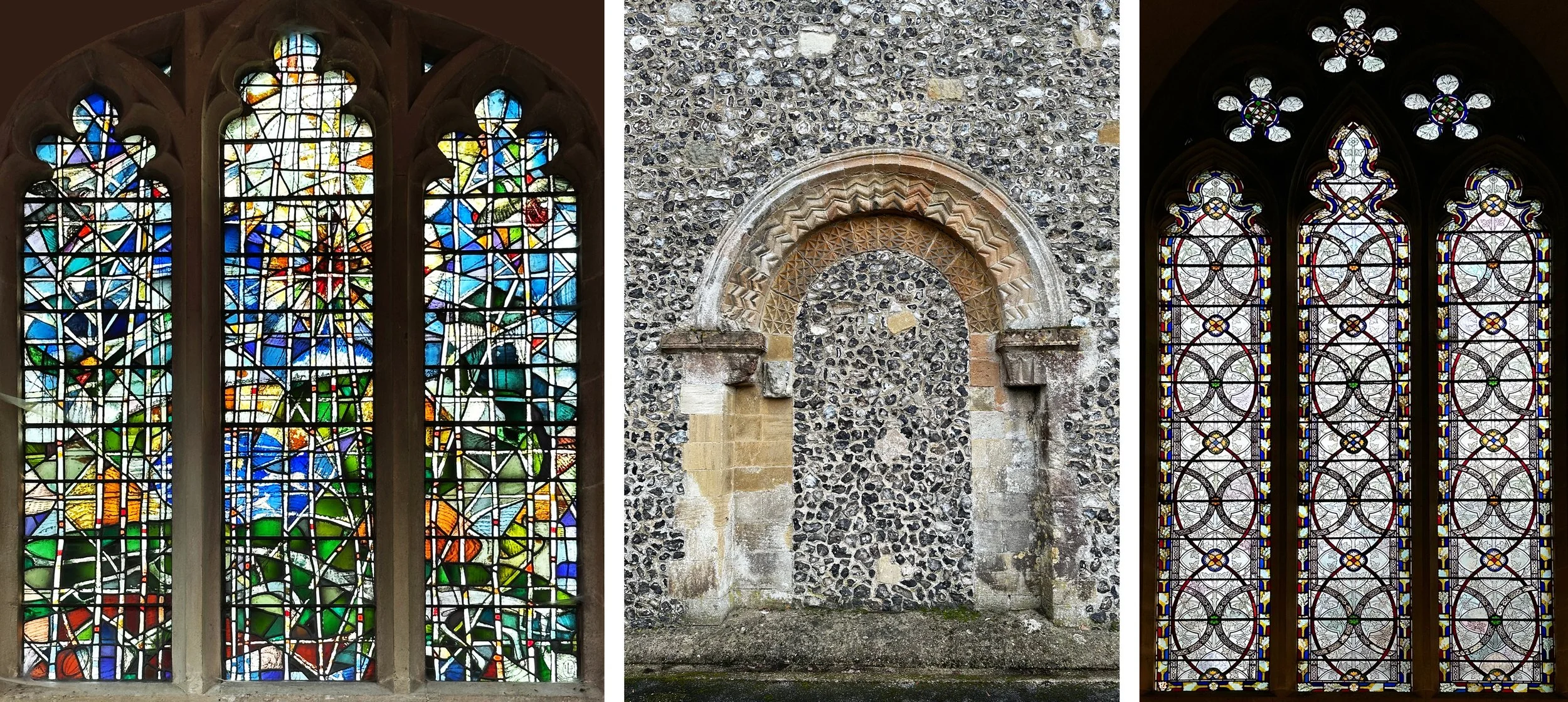
2. St Mary, Kingsclere. Windows by Lawrence Lee 1965 (left) and William Wailes 1849 (right).
Next was St Mary’s Kingsclere, an even bigger flint faced church with many styles of stained glass in its windows. The patterned grisaille glass by William Wailes seemed to work best with the architecture of the church, like the east window shown above right. In the south transept is the one I’d come to see (above left) a three light window from 1965 by Martin Traver’s pupil Lawrence Lee. I think of this as essentially a formal design, not abstract as I can see a landscape through the organic white grid, and with two patterns - landscape and grid - working with each other and their surroundings. The church leaflet tells us that the window commemorates the racehorse trainer Captain Peter Hastings-Bass, and that it contains pictures of vaguely suggested celestial creatures, also a sparrow-hawk, a red-legged partridge, a rugby ball, racehorses and the white horse of Uffington stretching across the base.
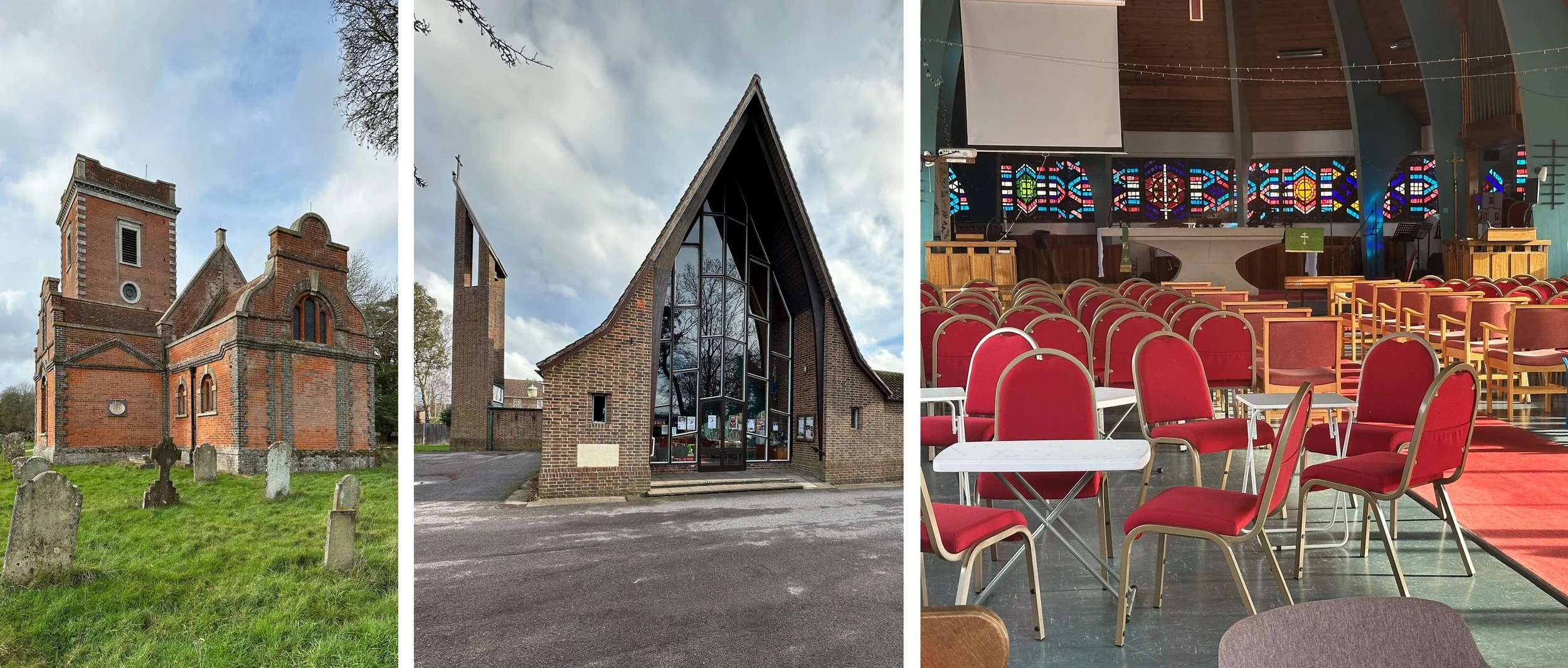
3. St Katherine, Wolverton. 4. St Paul, Tadley.
Next came two churches that were shut, but both with very interesting architectural forms. St Katherine, Wolverton (above left) has at its heart an old flint and wood church that was entirely encased with local hand-made brick in 1717. There is a tall tower, curves at the east end and crow stepped gables on the transepts.
The brick church of St Paul, Tadley built in 1966 (above centre and right) has a separate tower and a dramatic glazed west wall with low key doors in the centre. Through these I could see the beautiful wall of dalle de verre set in concrete stretching around three angled walls at the opposite end of the church. These are the work of Brian Milne who was a pupil of Lawrence Lee at the Royal College of Art from 1959 - 1963. He worked across various media on public art projects in the 1960s and 70s before setting up his stained glass studio in Suffolk which operated from 1983 until his death in 1996.
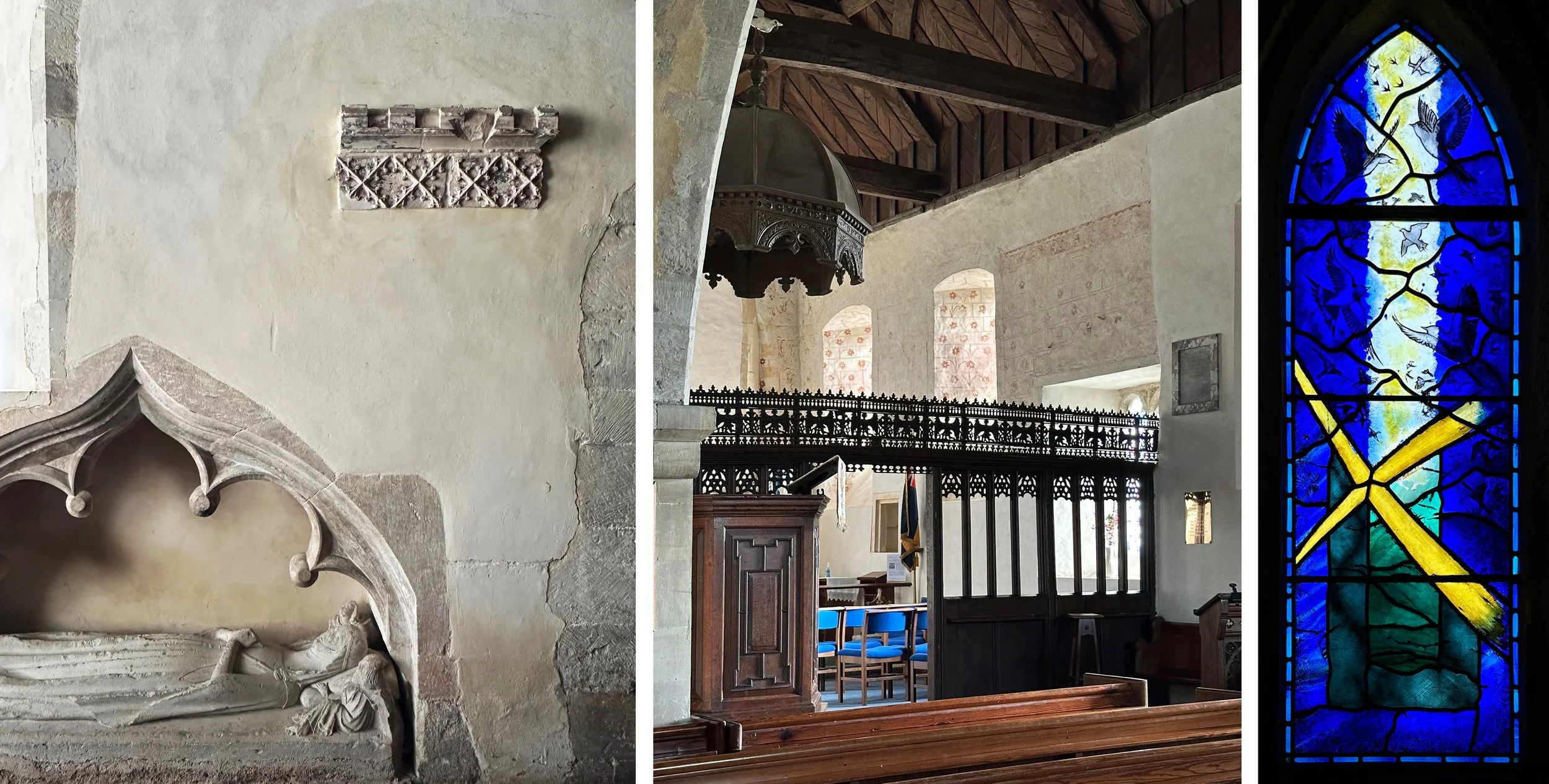
5. St Mary, Silchester. Window by Jon Callan 2005.
Then to St Mary’s, Silchester, a church built on an early sacred site within the Roman walls of Silchester - there is a great walk around the walls that includes the impressive site of an amphitheatre. Inside the church is a delicate wooden screen in front of 13th century wall paintings, recently conserved, and medieval carvings (above centre and left). Behind the font in the north wall is a 2005 window by Jon Callan entitled ‘Carpe Diem’. It’s a memorial window to Andrew Culbert and Sophie Wilsdon, as we learn from a plaque on the wall and a laminated A4 sheet that partly obscures the window and that includes a picture of the window itself. To me this is essentially a contemporary looking landscape with some obvious religious symbolism (cross, column of light) and some birds shoved in. The laminated sheet however tells us, The window is an abstract design intended to encourage people to put their own interpretation upon the spiritual meaning behind it. It then goes on to describe the design in terms of what it represents. I’m finding out that the word ‘abstract’ is beginning to mean the opposite of what it used to, that is something that had no basis in representation.
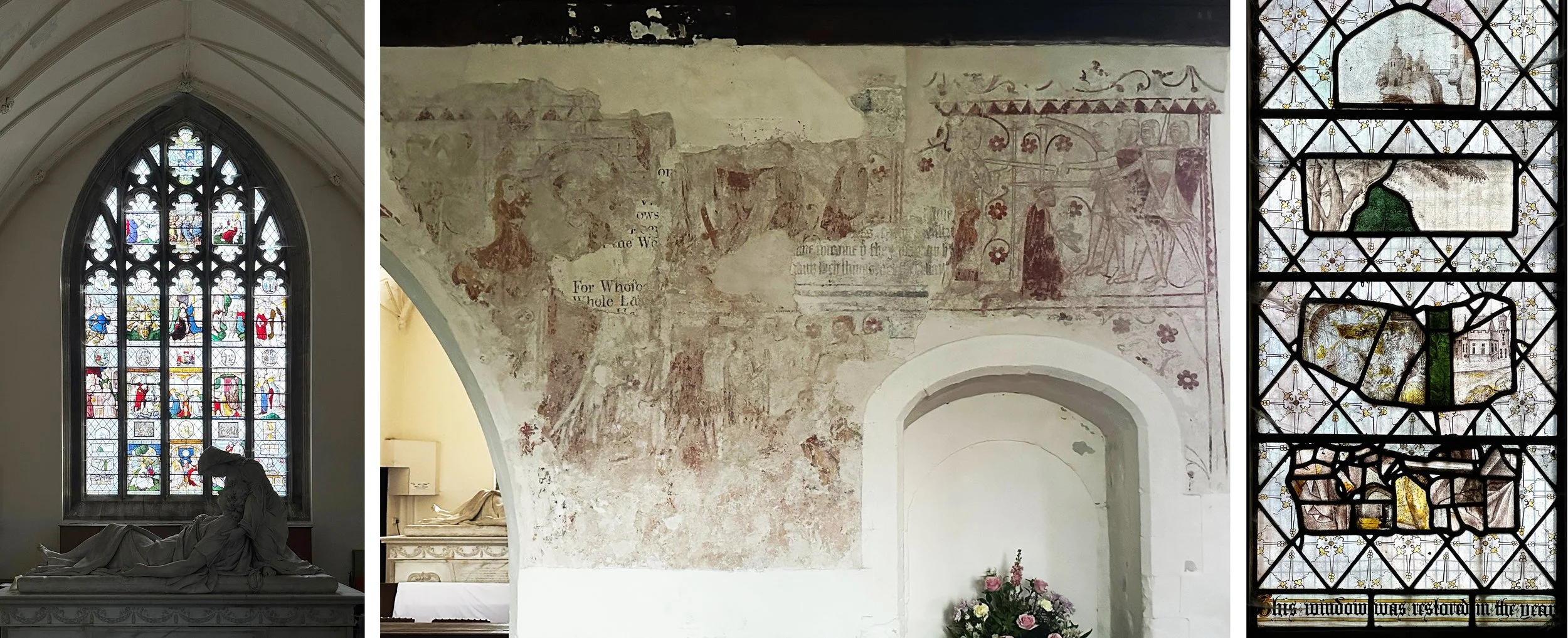
6. St James, Bramley. Window of C16th Flemish glass fragments. C12th wall painting of the murder of Thomas Becket.
The last church, St James, Bramley, contained the best things of the day. It is an interesting building with additions from many periods, it has a screen, monuments, wall plaques, medieval wall paintings and lots of medieval stained glass. In the Brocas chapel, added to the church by John Soane in 1802, is a large window that was set in 1889 by Burlison and Grylls with 16th century Flemish fragments, all delicately painted and presented on a subtle patterned background (above left and right). In the north aisle is a window with earlier glass, at the top are radiant suns of the House of York, dating from 1461 - 1483, while below are tiny figures of musicians and saints, including Saint Catherine (below right), these are thought to be from the 13th century. Next to the window is a well preserved, because painted over rather than destroyed during the Reformation, mural of St Christopher. The best of the wall paintings is on the opposite wall (above), Thomas Becket’s murder is one of several martyrdoms depicted, with the familiar flourish of red flowers all around.
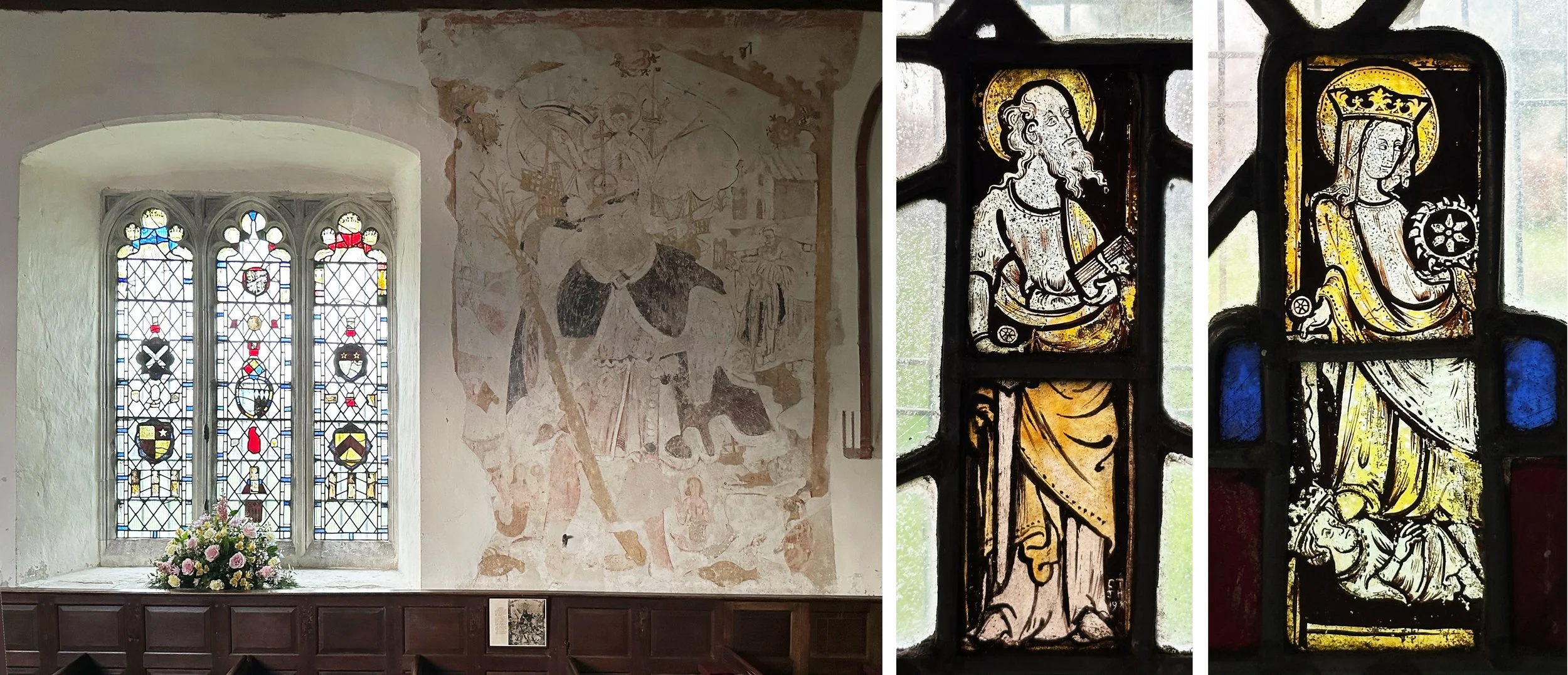
St James, Bramley. Window with C13th-C15th English glass fragments. C16th wall painting of St Christopher.