arts and crafts

Heaton, Butler and Bayne by Sasha Ward

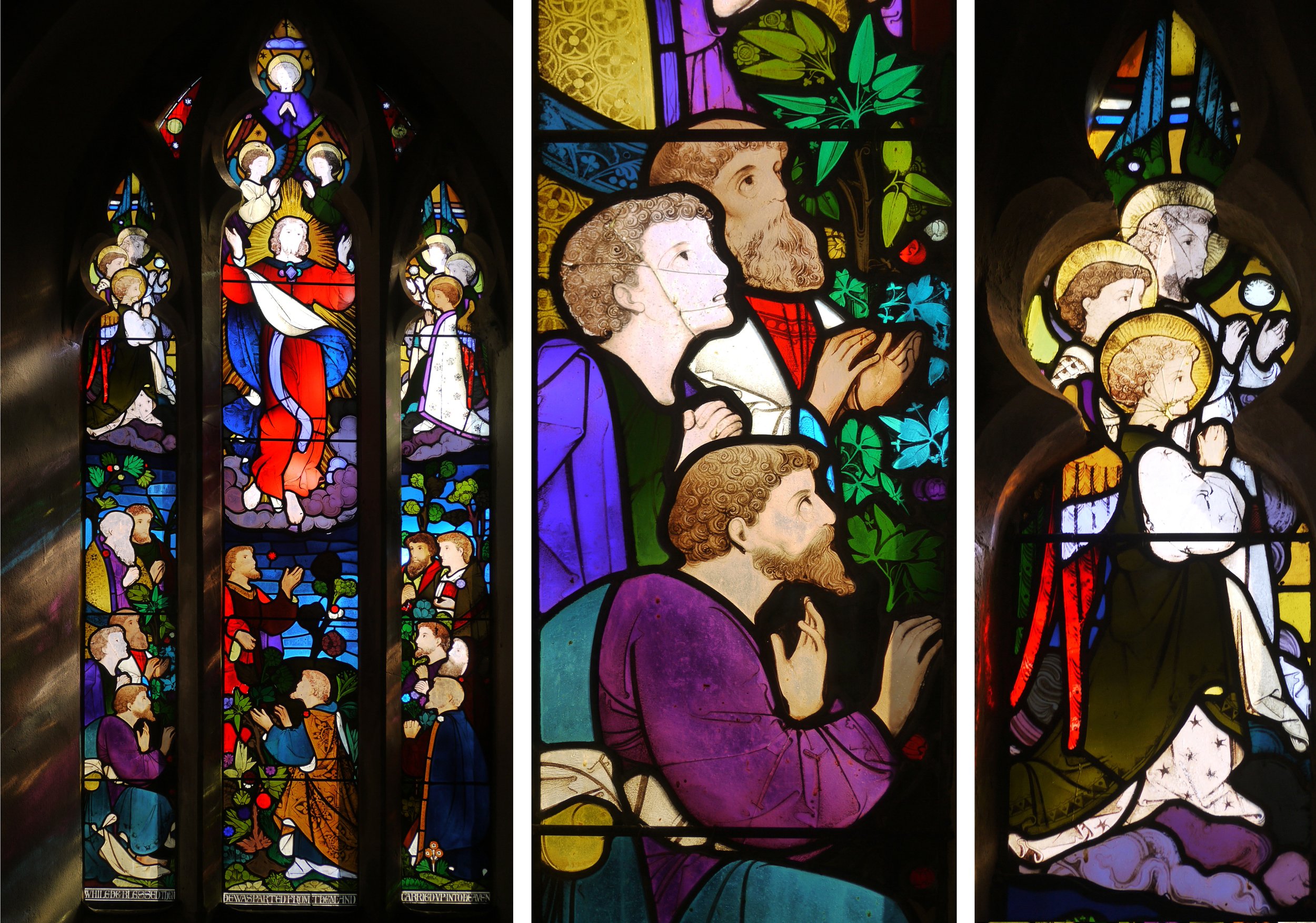
St Margaret of Antioch, Chilmark, Wiltshire. Ascension window by Heaton, Butler and Bayne 1866.

I’ve been on the lookout for early, that is mid 1860s, HB&B windows since I saw the ones in Kintbury, Berkshire and marvelled at their beauty and their colour combinations that glow even through the extensive paintwork - I wrote about them here. In late summer I visited the church at Chilmark, Wiltshire which is full of HB&B windows, but as the sun was glaring through the glass in the best one (the south facing Ascension window, above) the fine details, particularly on the faces, were difficult to make out. Painted hair - curly, flowing or facial is a speciality.
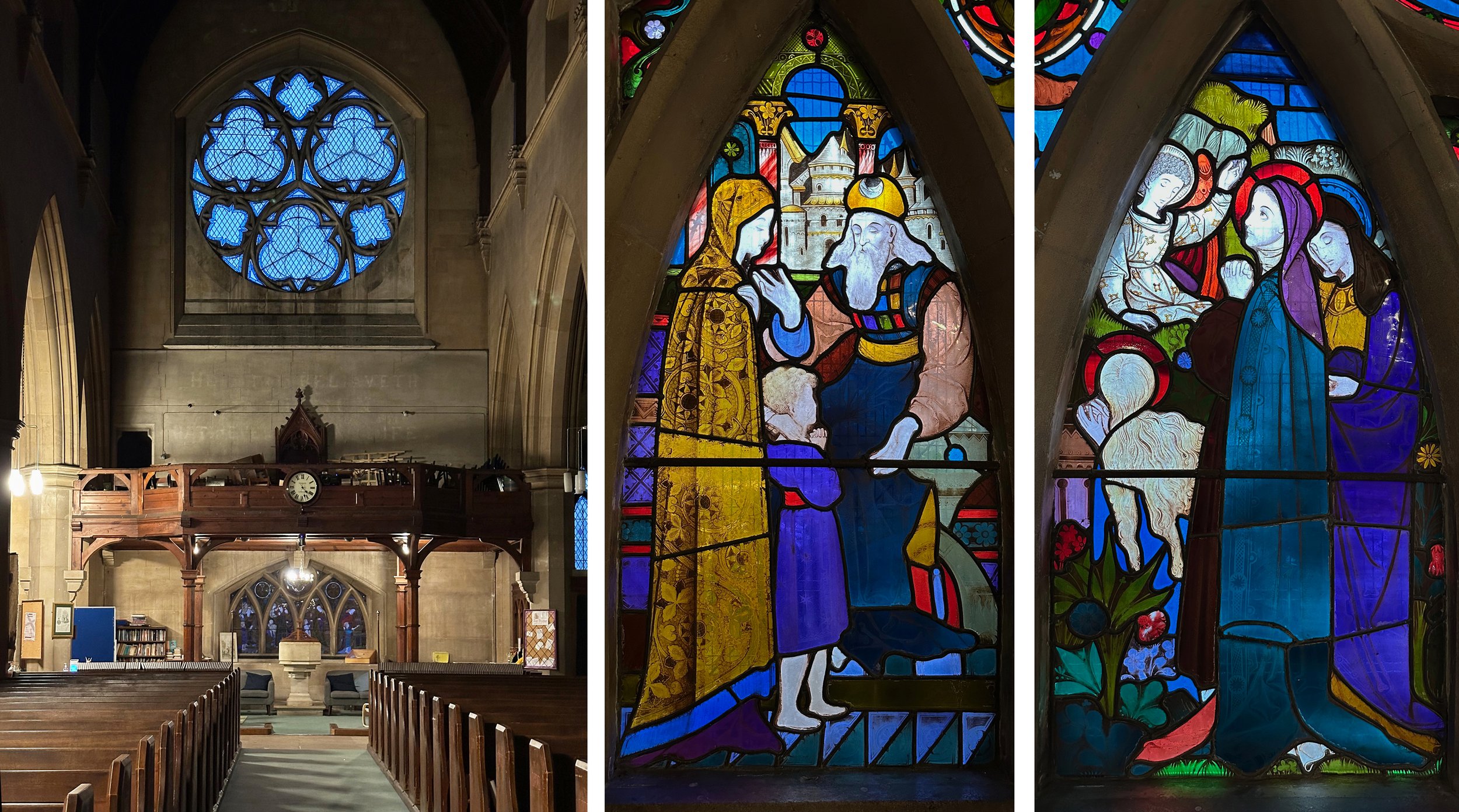
St Mary Spring Grove, Isleworth. West window, with details by Heaton, Butler & Bayne c. 1866.

Then I visited a large neo gothic church in West London, St Mary Spring Grove, with early windows by HB&B in the porch, west, east and side chapel windows - all of them magnificent and designed by Robert Bayne who was chief designer for the firm at this period. The west windows behind the font (above) are small and low down making it easy to appreciate the well drawn figures, the hair, and the patterns in the foliage and interiors. The scenes above show The Presentation and The Three Marys at the Tomb.
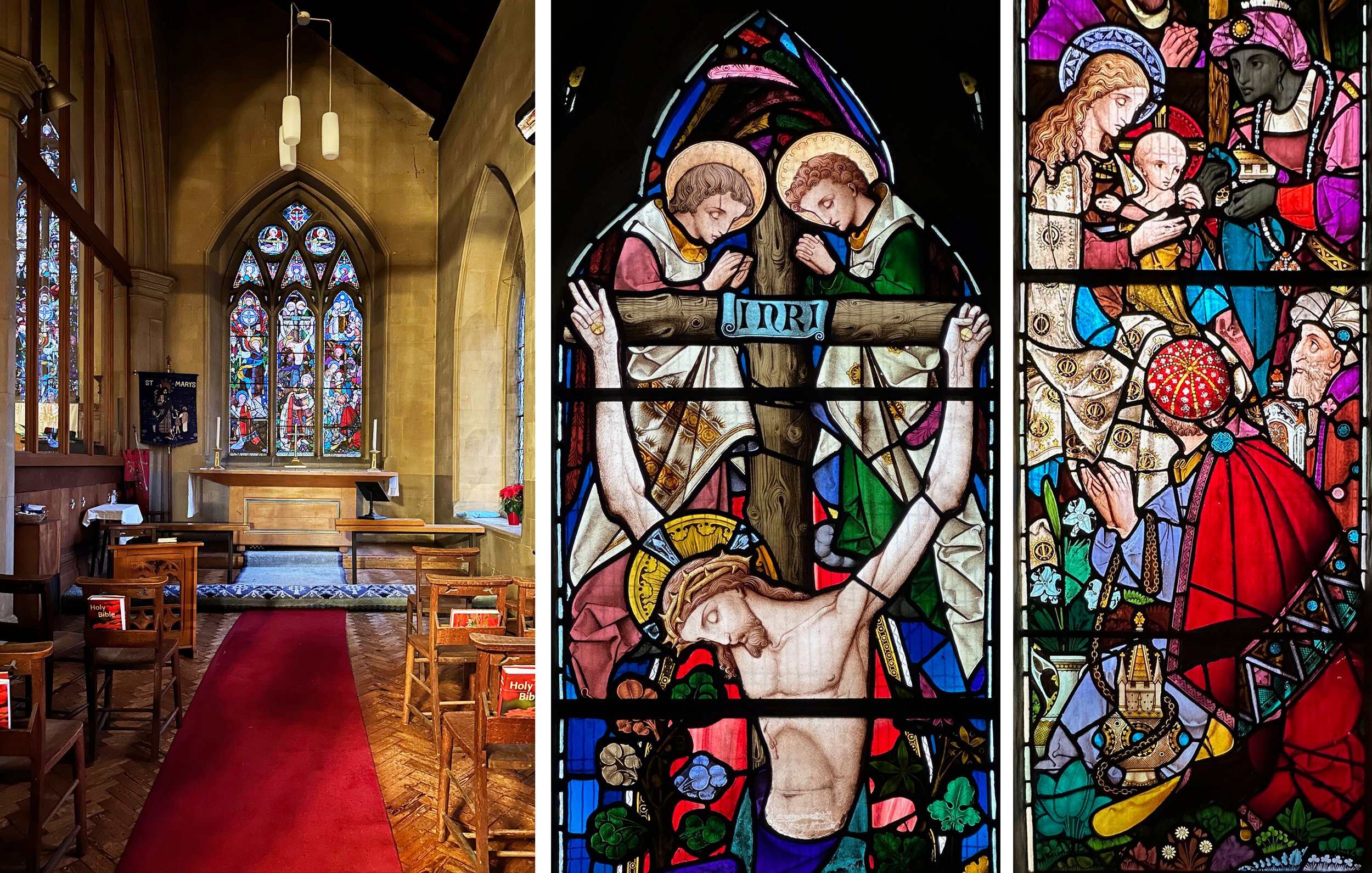
St Mary Spring Grove. South chapel, with crucifixion window by Heaton, Butler & Bayne c. 1866.

The crucifixion window in the south transept chapel (above) is also great. I’m starting to recognise the distinctive shape of HB&B heads in profile, like the angels above the cross and Mary in the nativity panel next to it. These and also some of the clothing, for example that red hat, seem to point forward to the elaborate stained glass of Harry Clarke.
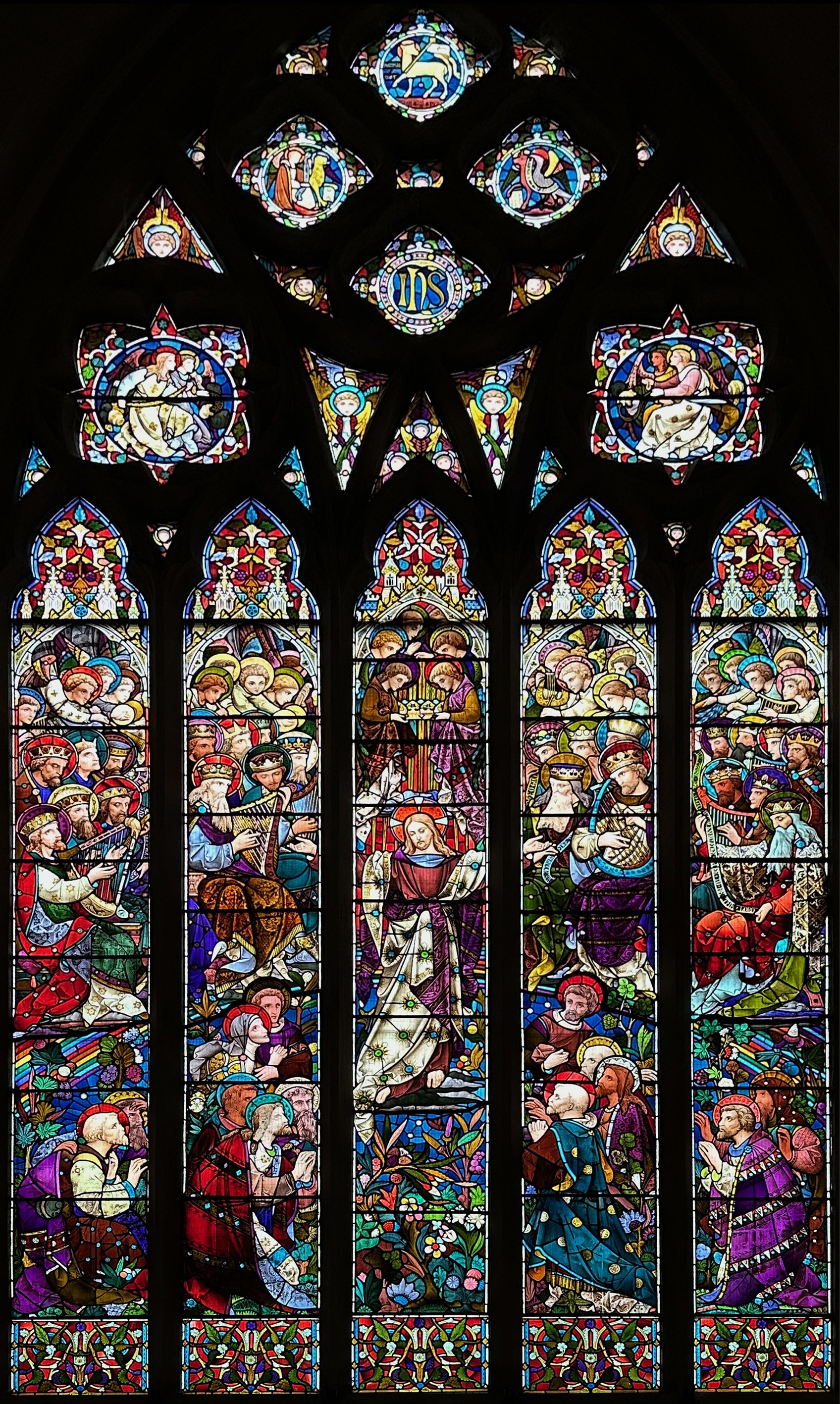
St Mary Spring Grove. East window. Below, details from the east window by Heaton, Butler & Bayne 1865.

The East window shows Christ in Majesty on a rainbow rising over a floral panel, with the haloed heads of saints and angels all around. There is the same purple, red and green combination that I loved at Kintbury Church. Although the details (below) are wonderful, it is really the composition of the whole enormous window that makes it work so well, it was effective even in the dim early evening light making it the best window that I’ve seen for ages.
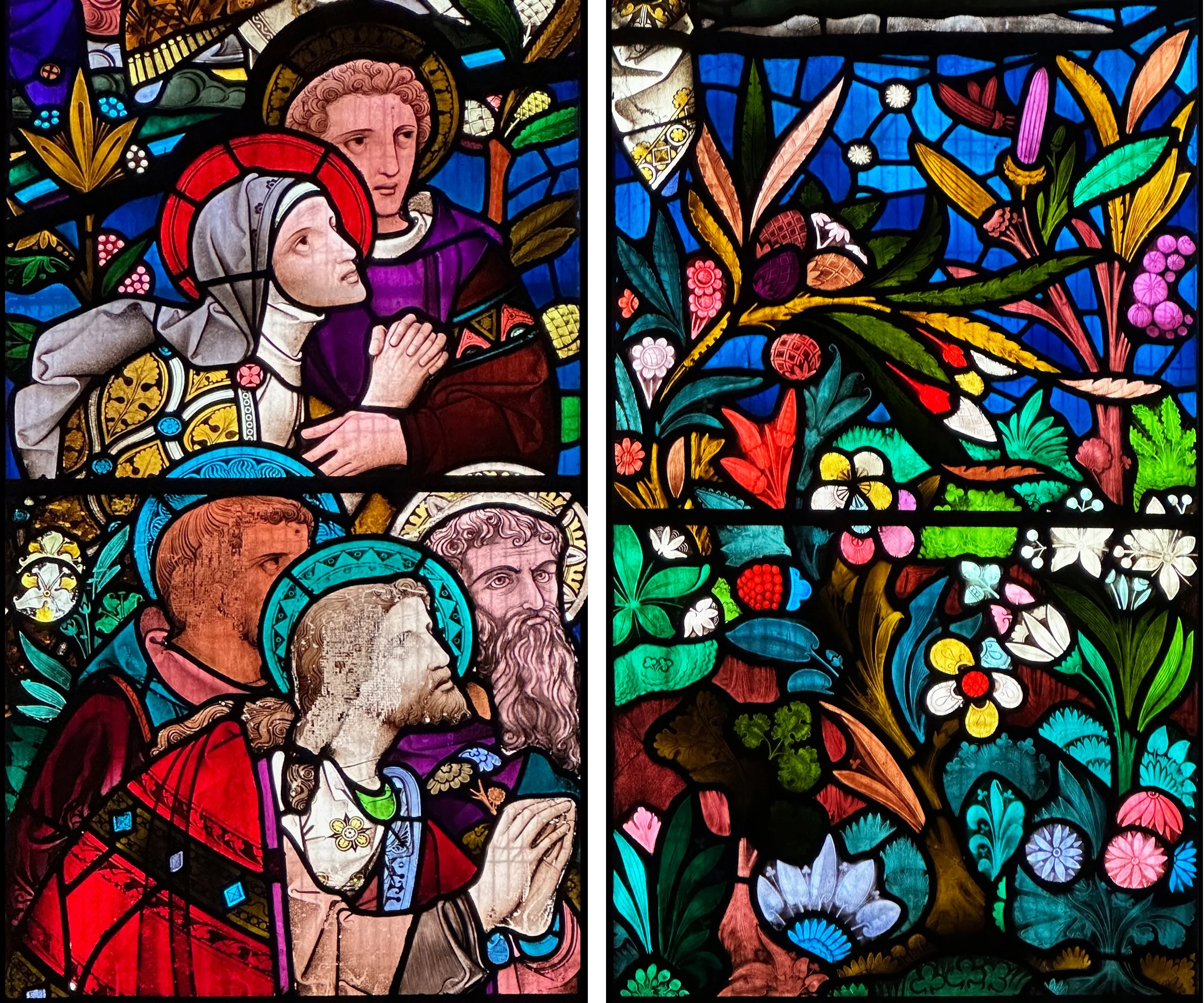
St Mary Spring Grove. Details from the East Window.
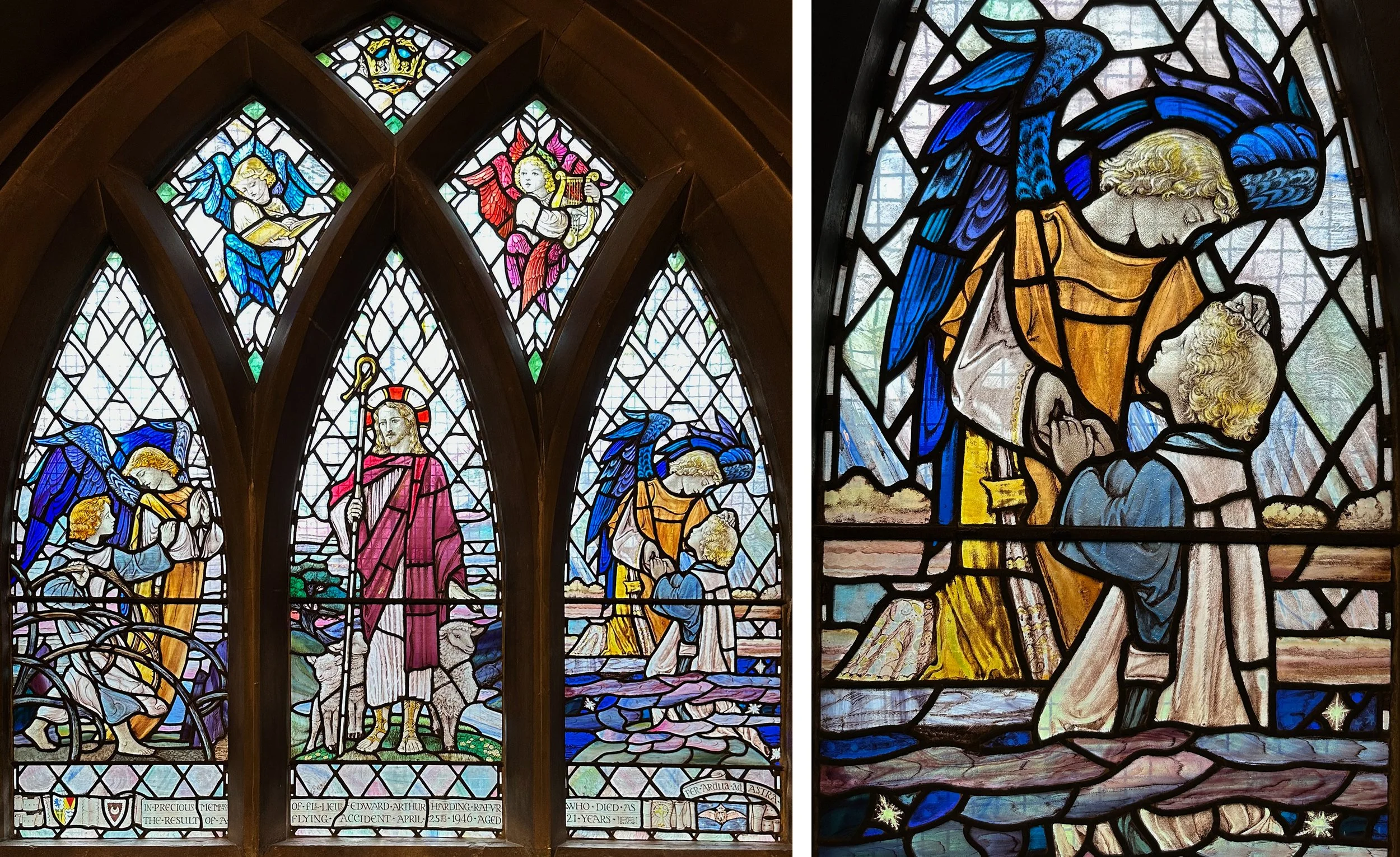
St Mary Spring Grove, north aisle window by Veronica Whall, 1948.

For comparison, here are two windows by Veronica Whall in the same church. People love Veronica Whall - because she’s the daughter of Christopher, and a woman working in the arts and crafts tradition? These two windows have plenty of great details and are made of gorgeous glass, but I saw passages of wishy-washy paintwork, particularly on those pale quarries - a background design device that I never like as it lets in so much light and leaves the (overly sentimental) figures stranded. These two windows didn’t work at all in the dim evening light - but the details, as always, look good on the screen (right, above and below).
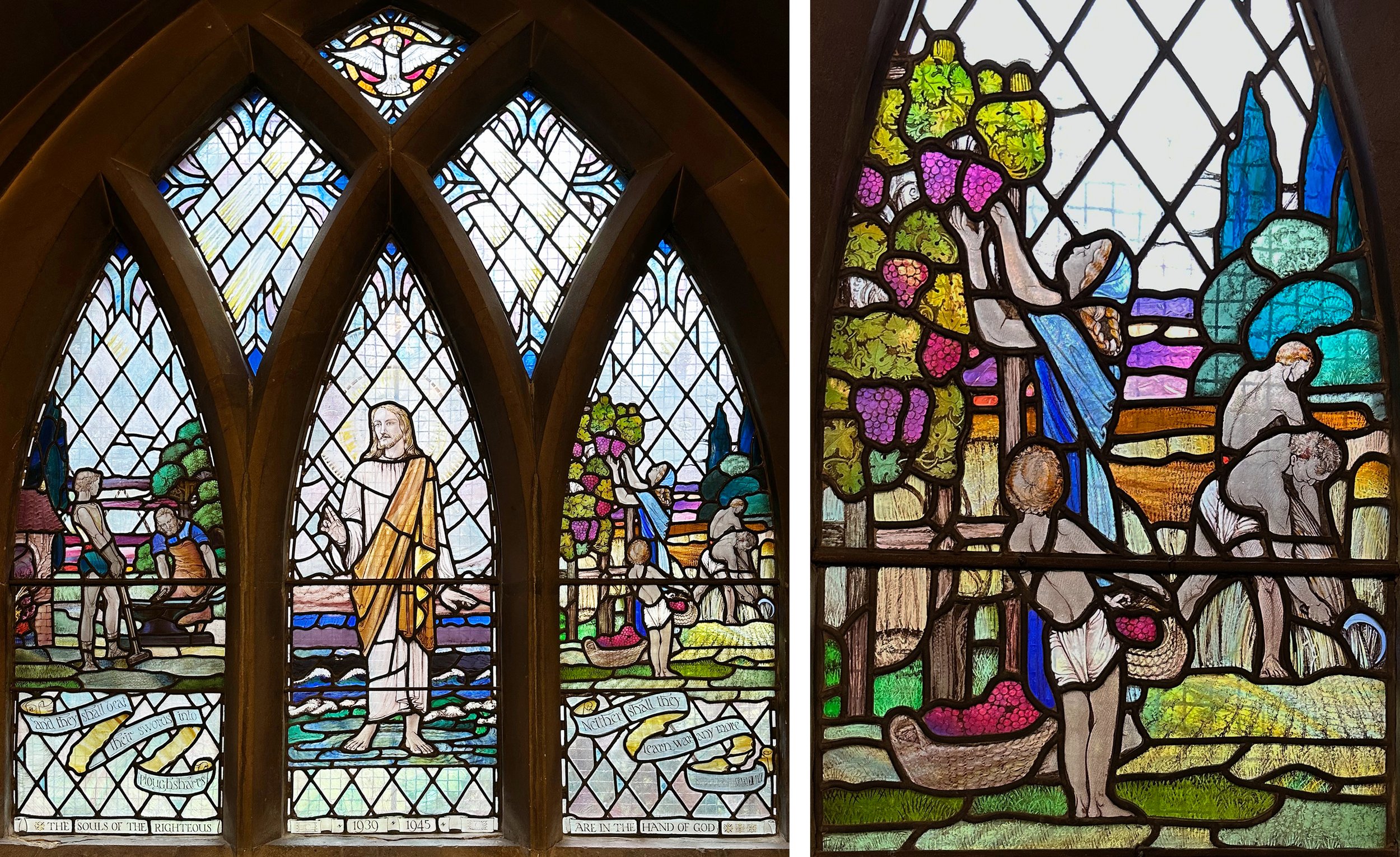
St Mary Spring Grove, south aisle window by Veronica Whall, 1949.

Church Of St Alban, Westbury Park, Bristol by Sasha Ward

Outer door, Inner door and inside the Church of St Alban, Westbury Park.

This is a church built beside an older one (still standing) that the congregation in the Bristol suburb of Westbury Park, had outgrown. The architect was CFW Denning, it was completed in 1915 with furnishings and stained glass in every window added over the following two decades. As a result the interior is cohesive and true to the arts and crafts ideals, with modest entrance doors, stone walls and wooden chairs amid the evidence of regular use by local groups. The designer of most of the wonderful stained glass in the church was Arnold Robinson, a pupil of Christopher Whall, who worked with and then bought the stained glass firm Joseph Bell & Son of Bristol. The east window (below and above right)) glitters with complementary purples, greens and browns and is crammed with detail - from rainbows and cherubs at the top to realistic figures of contemporary servicemen, with nurses, at the bottom.

The east window and detail , designed by Arnold Robinson, 1920.

Three windows in the north wall, two by Arnold Robinson, the third by Florence Camm.

Six of the nave windows are also by Robinson, on the north wall there is one by Florence Camm (1929) that fits in well with the general style although it’s very different in its decorative detailing. The details in Robinson’s windows show an interesting mix of pastel coloured streaky glass in chunky borders and characters in the nativity window that are taken from sources as diverse as Raphael’s Madonna della Seggiola (below left) and a toddler straight out of a 1920s popular illustration (below right).

Details from the nativity window (in the centre of the photo of the north wall).

South transept window by Margaret Chilton, 1915, and detail.

The window that is contemporary with the building of St Alban’s is a tall lofty one in the south transept by Margaret Chilton. It depicts classically dressed craftsmen working on the building, one holding up a model of it. The lower sections with eccentric leading, little squares of colour and finely drawn wild flowers has got a very Charles Rennie Mackintosh look about it, this window dates to three years before Chilton’s move to Glasgow.

Window 1 on the south wall and detail.

Continuing from that window along the south side of the nave are four more Robinson windows, all set in deep craggy recesses with sills covered in plastic sheets for groups of white candles. There are wonderful things to be found in all of these - in the first window there are little people processing towards the open door (above centre) and the handpainted note in memory of a local 2nd lieutenant (above right), a reminder of the boom in stained glass memorial windows caused by World War 1.

Window 2 on the south wall and detail.

The second window again has finely drawn flowers in the border, and clustered around the missionary Ruth Salisbury are a group of realistic, attentive children (above). The third window is in memory of a couple who were benefactors of St Alban’s, the details I picked out in this one are another group of little people including two sweet babies, and a walled town in the background (below).

Window 3 on the south wall and detail.

Window four (below) is a scene of the Revelation, with a wonderful sea shore, an angel with a visionary globe, a harp, a sword and a dedication to another young local 2nd lieutenant killed in the war.

Window 4 on the south wall and detail.

Looking west, windows by Arnold Robinson.

Coming to the west end of the church (above) are a pair of windows by Robinson from 1925, where pastel coloured angels soar above a nativity scene and an ascending figure of Christ. The ordered composition, pale backgrounds and geometric rays of light are in great contrast to the colourful riot of the Te Deum east window. Finally, in the baptistry and now cut off by a glass partition, are two smaller pairs of windows of small people, or cherub children with realistic heads (below). They are the work of Margaret Chilton, given by members of the Mothers’ Union in 1915. The font has been moved out of this space which is now a play area. I wonder if this was because the images of the cherub children were considered disturbing, or even confusing because of the popular belief that the dead turn into angels, whereas in Christian doctrine they are two different things. It’s hard to imagine this sort of imagery, thought provoking and poignant in a time of war, being allowed anywhere near a baptistry these days.

Two pairs of windows inside the baptistry by Margaret Chilton 1915.

Christ Church, Southgate N.14 by Sasha Ward

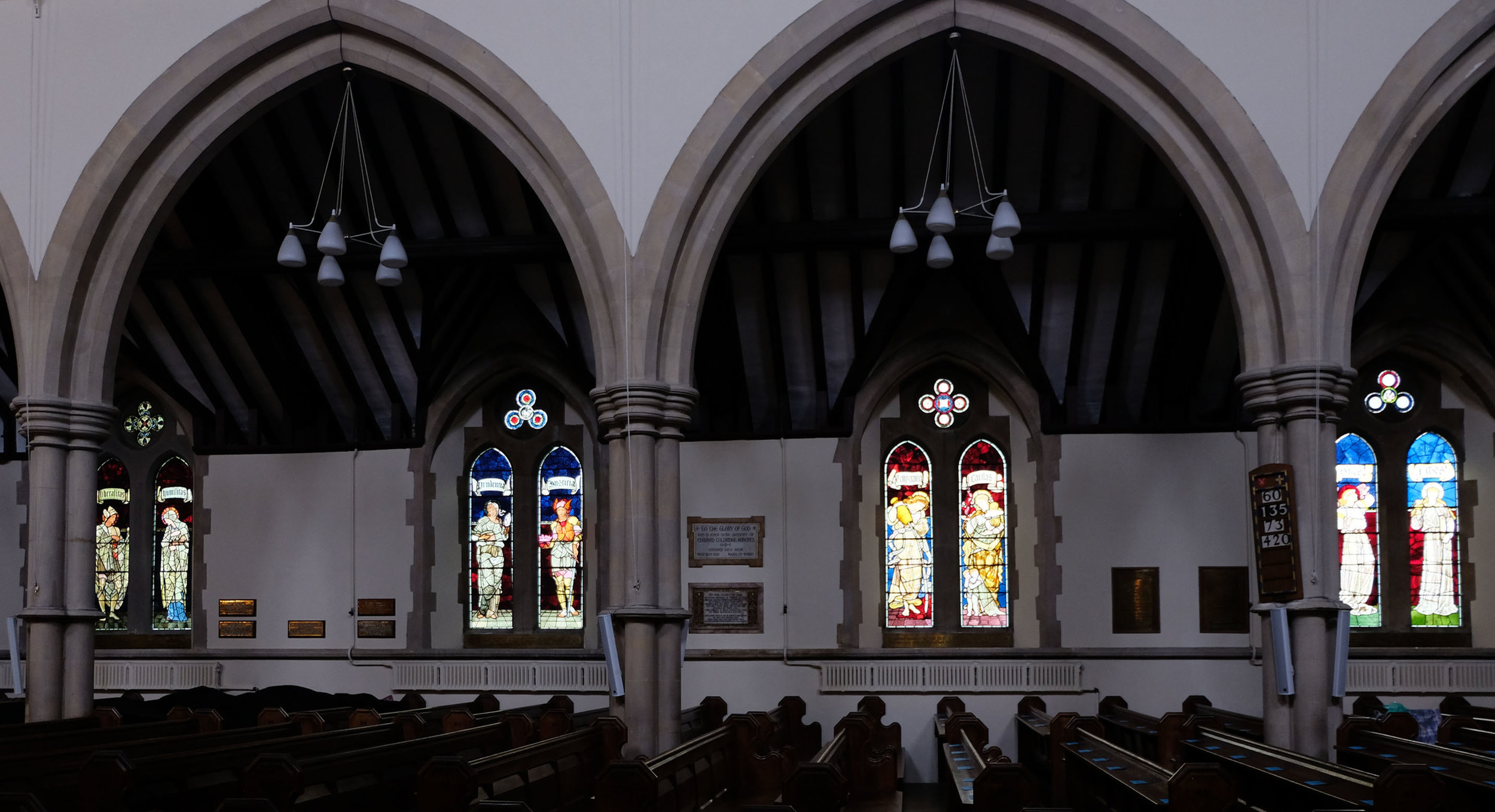
North Aisle, left to right: Liberalitas & Humanitas (1899), Prudentia & Justitia (1885), Temperentia & Caritas (1876), Spes & Fides (1876)

North Aisle, left to right: Liberalitas & Humanitas (1899), Prudentia & Justitia (1885), Temperentia & Caritas (1876), Spes & Fides (1876)

I’ve rediscovered my enthusiasm for the stained glass of Morris & Company after visiting Christ Church in Southgate, North London. The windows in this church cover every period of the firm’s production from 1861 until the twentieth century, with designs by William Morris, Dante Gabriel Rosetti, Ford Madox Brown, Philip Webb and Edward Burne-Jones. The photos I’d seen were mainly those rare early windows designed, made and painted by the partners in the original firm, in the Victorian Medieval style i.e small figures engulfed by patterned borders and backgrounds. But the ones I really liked are shown in the photo below. There are pairs of figures in all the windows of the north and south aisle, they look great from a distance because of this consistency of design and are full of amazing detail and colour. Burne-Jones designed all except the figure of St. Francis which is the latest and is by Henry Dearle (1911).

Left: Detail from Liberalitas. Right: The figure of Justitia

Left: Detail from Liberalitas. Right: The figure of Justitia

The eight figures in the north aisle are all fantastic examples of the firm’s stained glass style as it developed, with gorgeous patterned backgrounds and drapery in Liberalitas and Humilitas (above left) and the use of amazing coloured glass, particularly in Justitia (above right.)

The next two pairs of windows were made earlier, the figures of Temperentia and Caritas are flowing and curvy, with a pair of astonishing babies, shown below left. The earliest two, Spes and Fides are plainer, calmer and they let in a lot more light.

Left: Babies at the feet of Caritas. Right: The figure of Fides

Left: Babies at the feet of Caritas. Right: The figure of Fides

South Aisle, left to right: Patientia & Pax (1909), Martha & Phebe (1903), King David & St Francis (1911), St Peter & St Paul (1865).

The figures on the south side are all much darker, particularly the matching backgrounds. Below are details of two of the figures, with beautifully painted faces, hands and clothes. In the set of windows in this church the faces are all different and quite mesmerising. At the end of the row (above right) are earlier windows of Saints Peter and Paul with wildly patterned surrounds, they are figures familiar to me from other Morris & Co windows.

Left: The figure of Patientia. Right: The figure of Martha.

Left: The figure of Patientia. Right: The figure of Martha.

The other pair of windows that show the designs of EBJ at his flowing best are high up on the north wall of the chancel, apparently the first ones where he used photographic enlargement of drawings to prepare the stained glass cartoons. All in lovely light colours and with a great detail of a rip over the knee of the ragged girl (below right) visible even from a distance.

North chancel: Left, Dorcas. Right, The Good Samaritan (1876).

North chancel: Left, Dorcas. Right, The Good Samaritan (1876).