art in churches

Heaton, Butler and Bayne by Sasha Ward

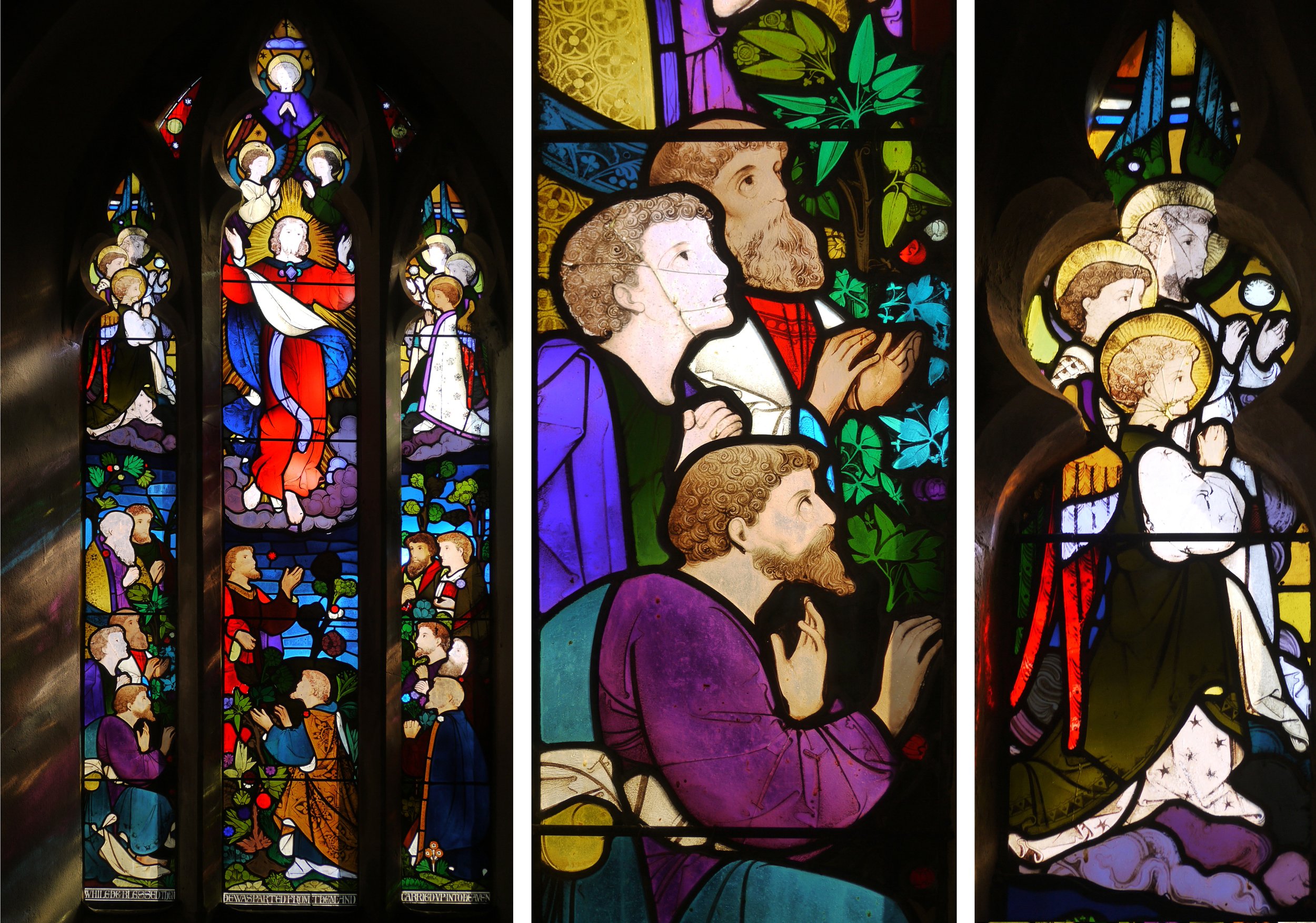
St Margaret of Antioch, Chilmark, Wiltshire. Ascension window by Heaton, Butler and Bayne 1866.

I’ve been on the lookout for early, that is mid 1860s, HB&B windows since I saw the ones in Kintbury, Berkshire and marvelled at their beauty and their colour combinations that glow even through the extensive paintwork - I wrote about them here. In late summer I visited the church at Chilmark, Wiltshire which is full of HB&B windows, but as the sun was glaring through the glass in the best one (the south facing Ascension window, above) the fine details, particularly on the faces, were difficult to make out. Painted hair - curly, flowing or facial is a speciality.
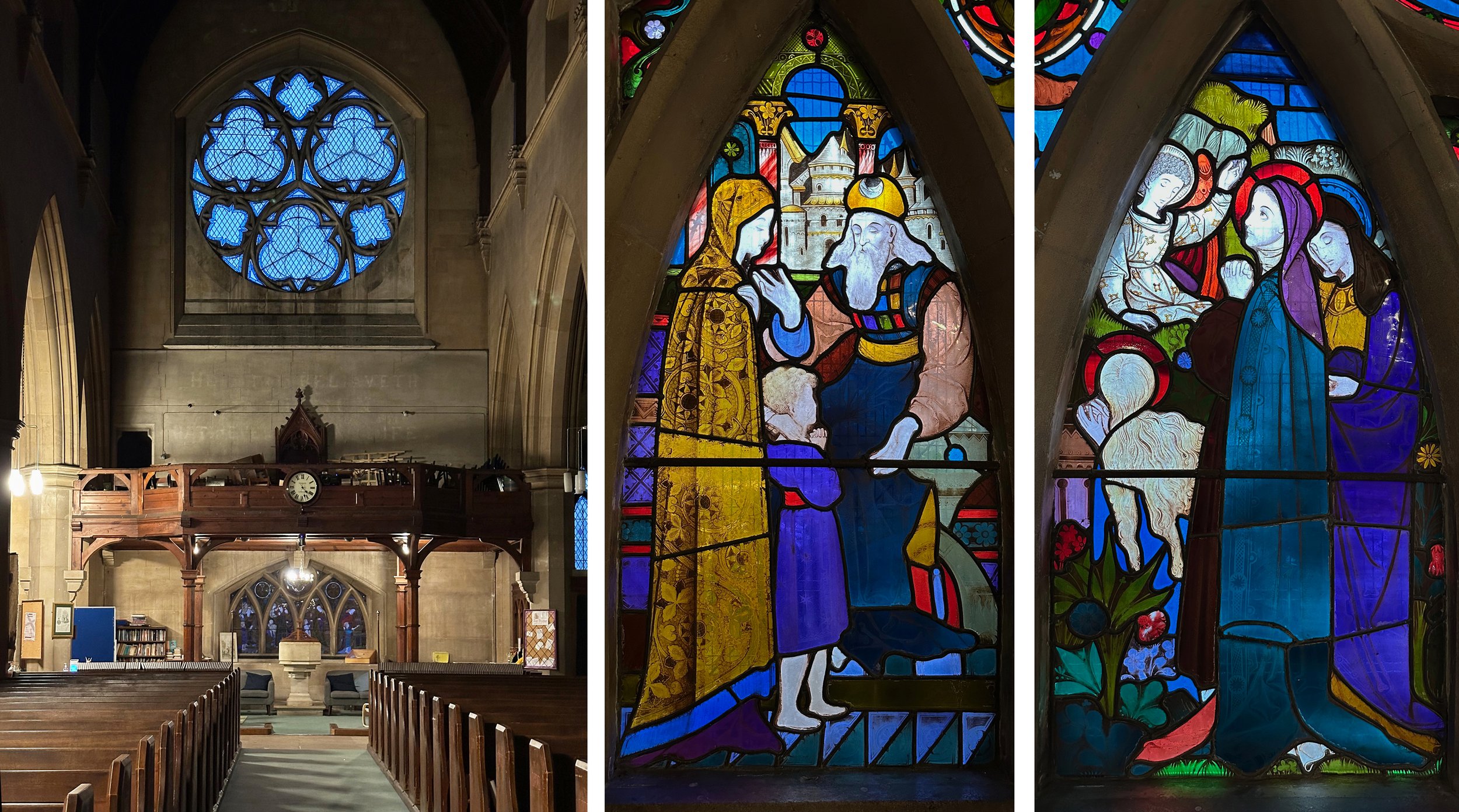
St Mary Spring Grove, Isleworth. West window, with details by Heaton, Butler & Bayne c. 1866.

Then I visited a large neo gothic church in West London, St Mary Spring Grove, with early windows by HB&B in the porch, west, east and side chapel windows - all of them magnificent and designed by Robert Bayne who was chief designer for the firm at this period. The west windows behind the font (above) are small and low down making it easy to appreciate the well drawn figures, the hair, and the patterns in the foliage and interiors. The scenes above show The Presentation and The Three Marys at the Tomb.
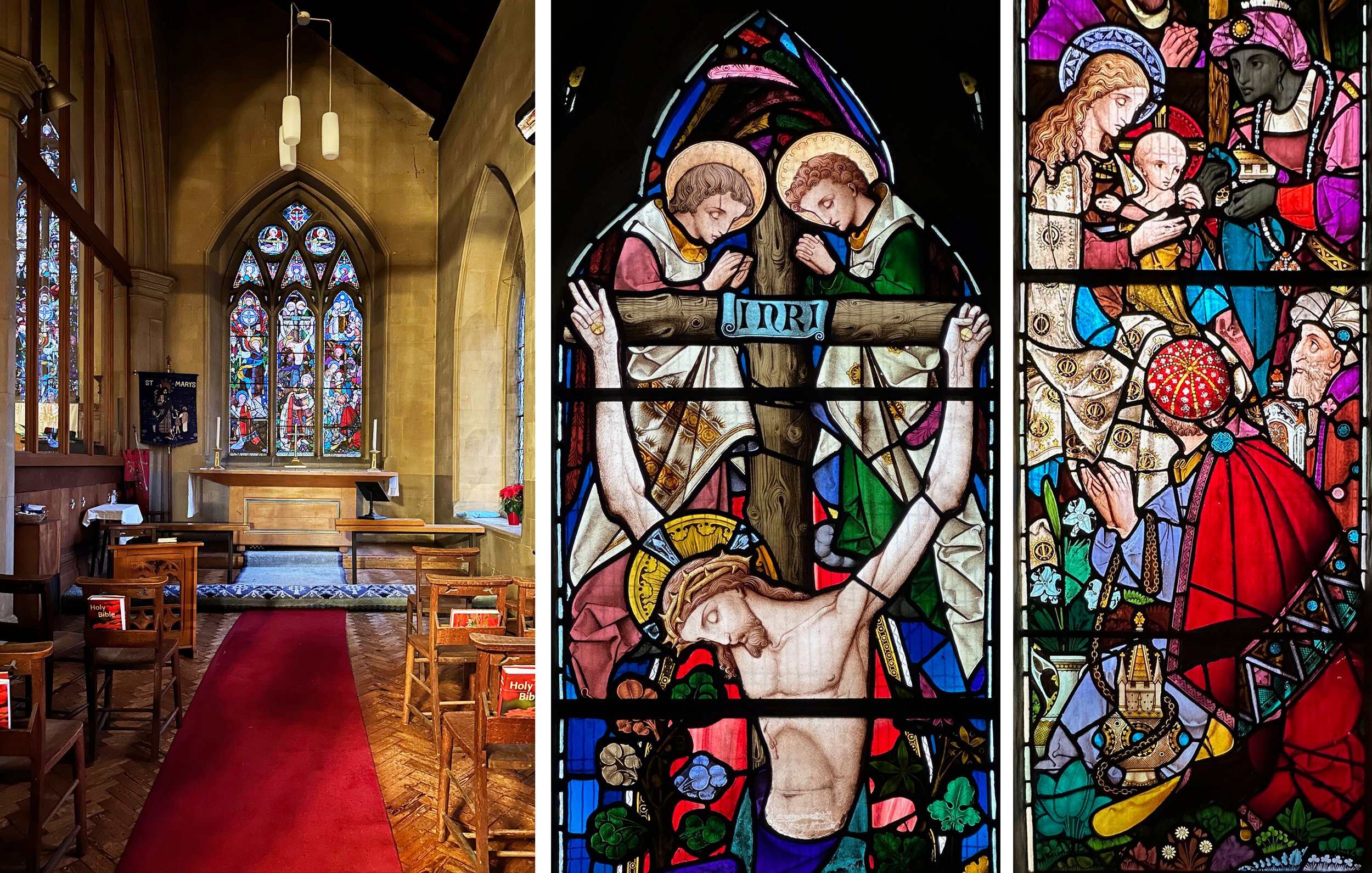
St Mary Spring Grove. South chapel, with crucifixion window by Heaton, Butler & Bayne c. 1866.

The crucifixion window in the south transept chapel (above) is also great. I’m starting to recognise the distinctive shape of HB&B heads in profile, like the angels above the cross and Mary in the nativity panel next to it. These and also some of the clothing, for example that red hat, seem to point forward to the elaborate stained glass of Harry Clarke.
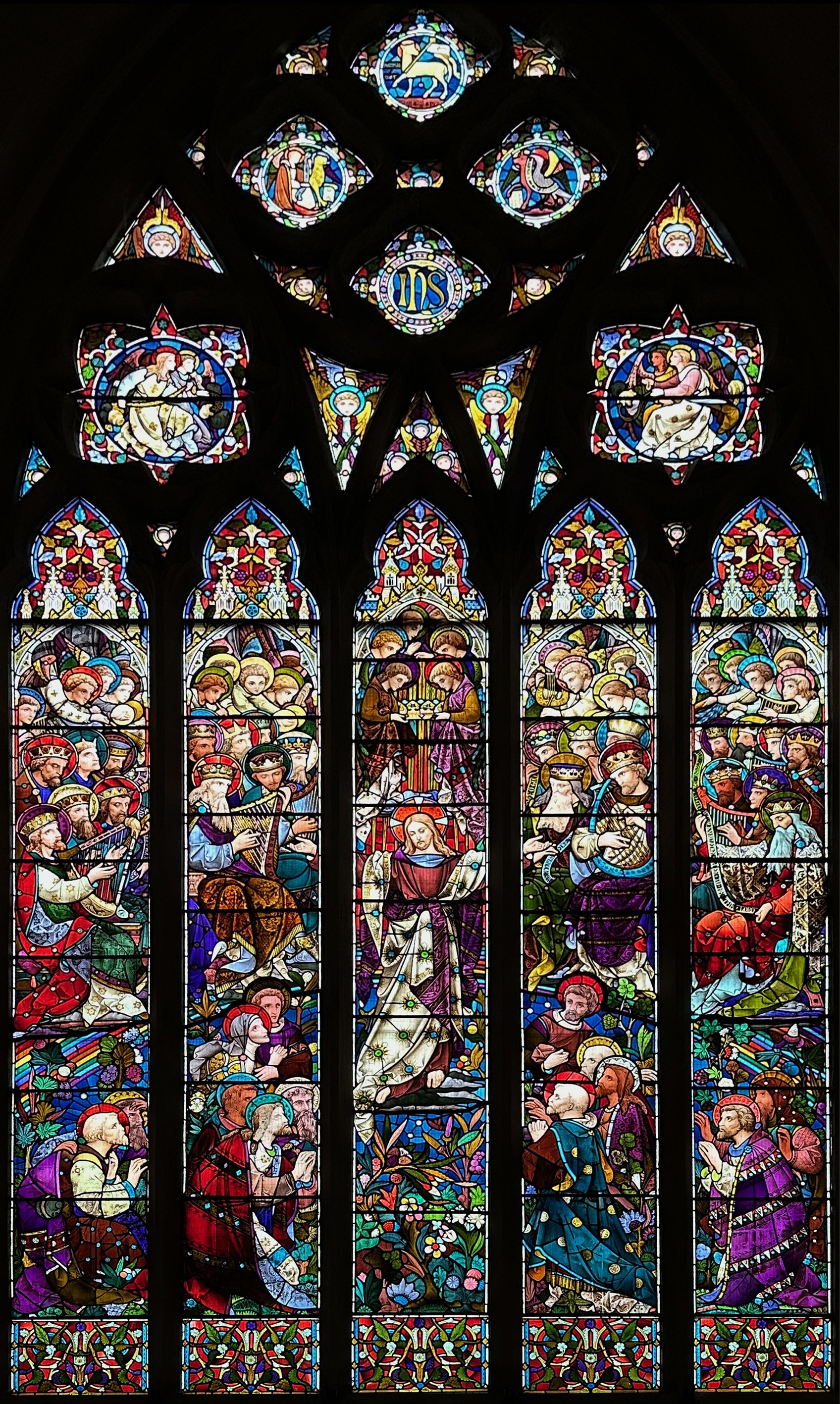
St Mary Spring Grove. East window. Below, details from the east window by Heaton, Butler & Bayne 1865.

The East window shows Christ in Majesty on a rainbow rising over a floral panel, with the haloed heads of saints and angels all around. There is the same purple, red and green combination that I loved at Kintbury Church. Although the details (below) are wonderful, it is really the composition of the whole enormous window that makes it work so well, it was effective even in the dim early evening light making it the best window that I’ve seen for ages.
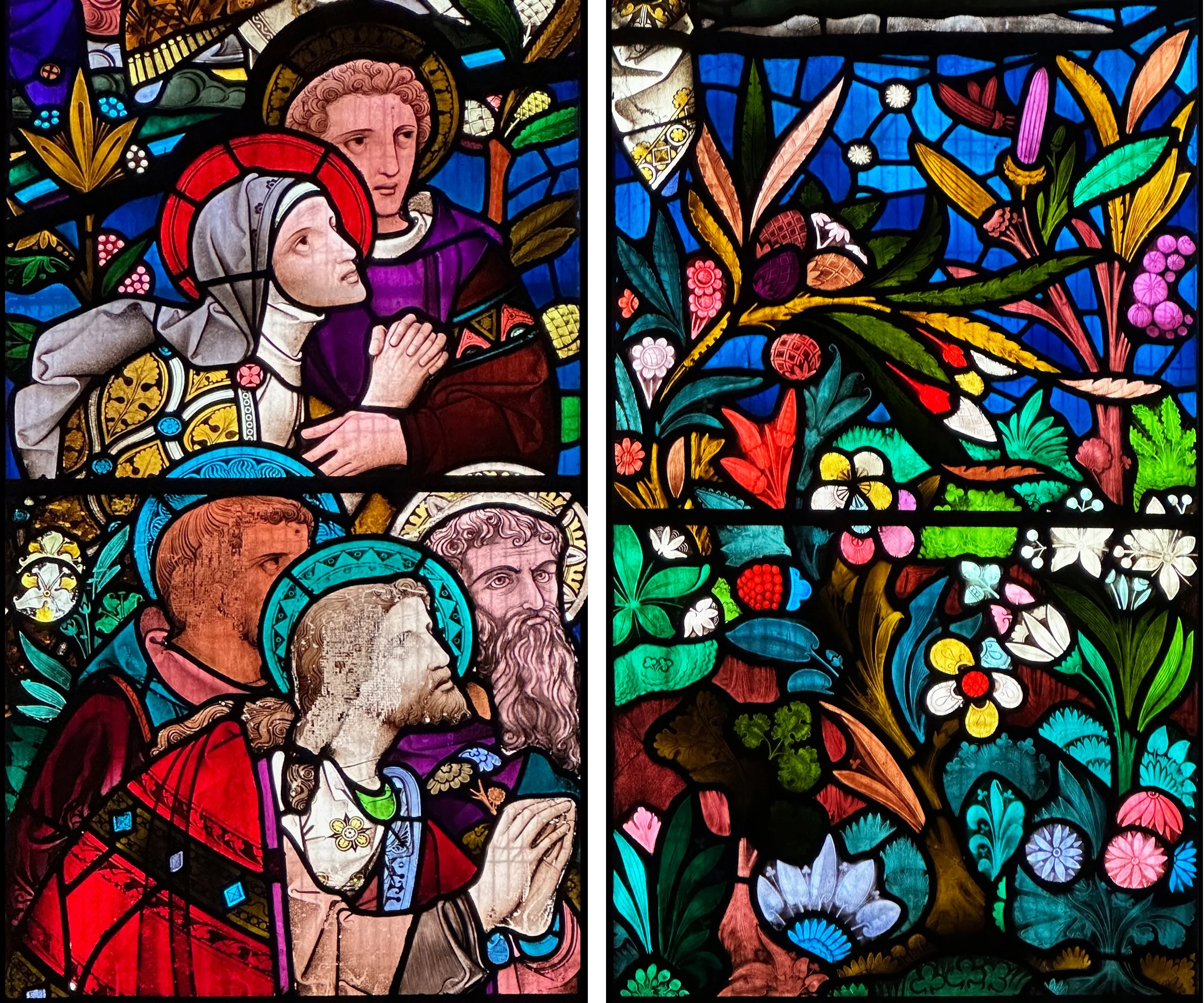
St Mary Spring Grove. Details from the East Window.
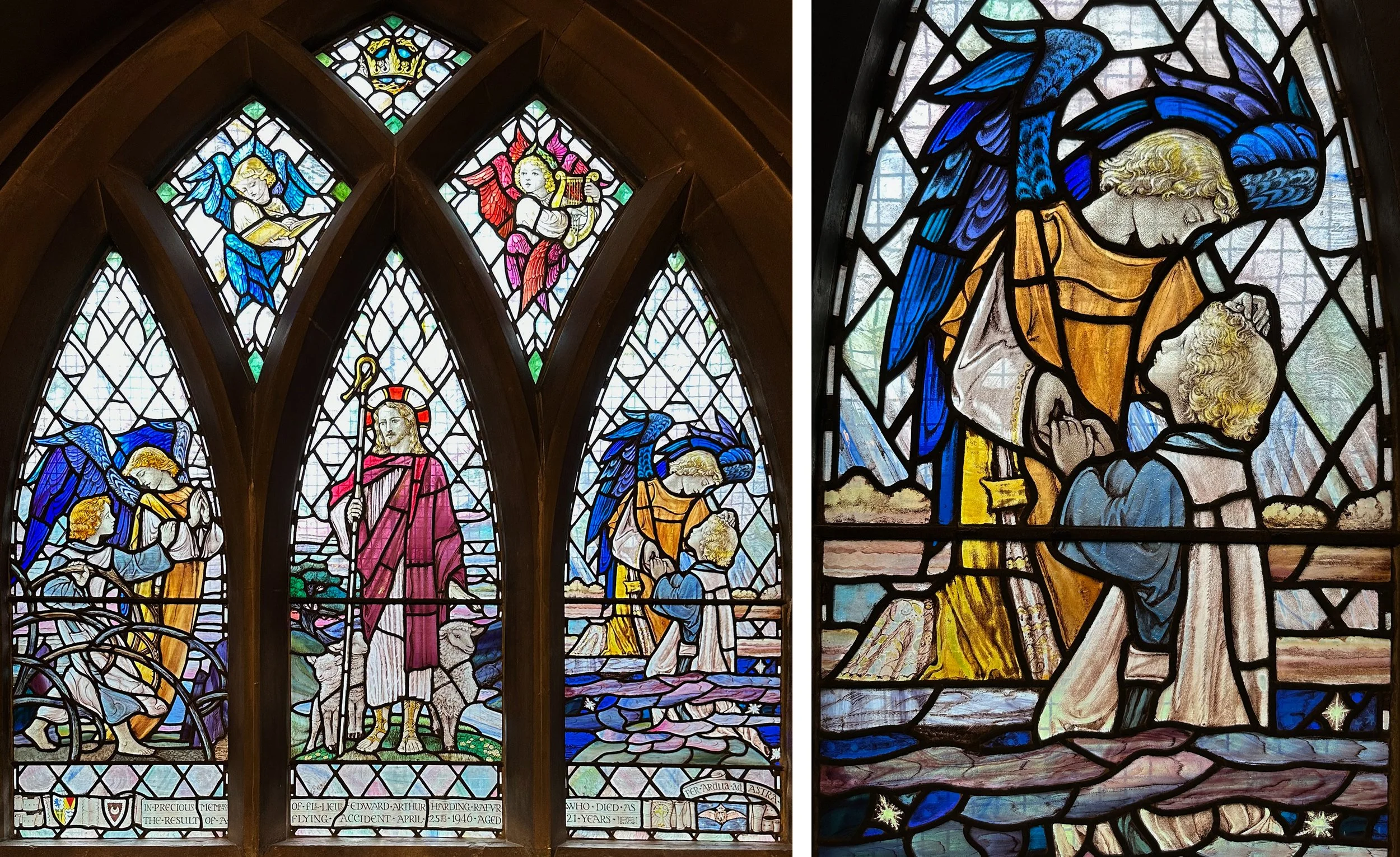
St Mary Spring Grove, north aisle window by Veronica Whall, 1948.

For comparison, here are two windows by Veronica Whall in the same church. People love Veronica Whall - because she’s the daughter of Christopher, and a woman working in the arts and crafts tradition? These two windows have plenty of great details and are made of gorgeous glass, but I saw passages of wishy-washy paintwork, particularly on those pale quarries - a background design device that I never like as it lets in so much light and leaves the (overly sentimental) figures stranded. These two windows didn’t work at all in the dim evening light - but the details, as always, look good on the screen (right, above and below).
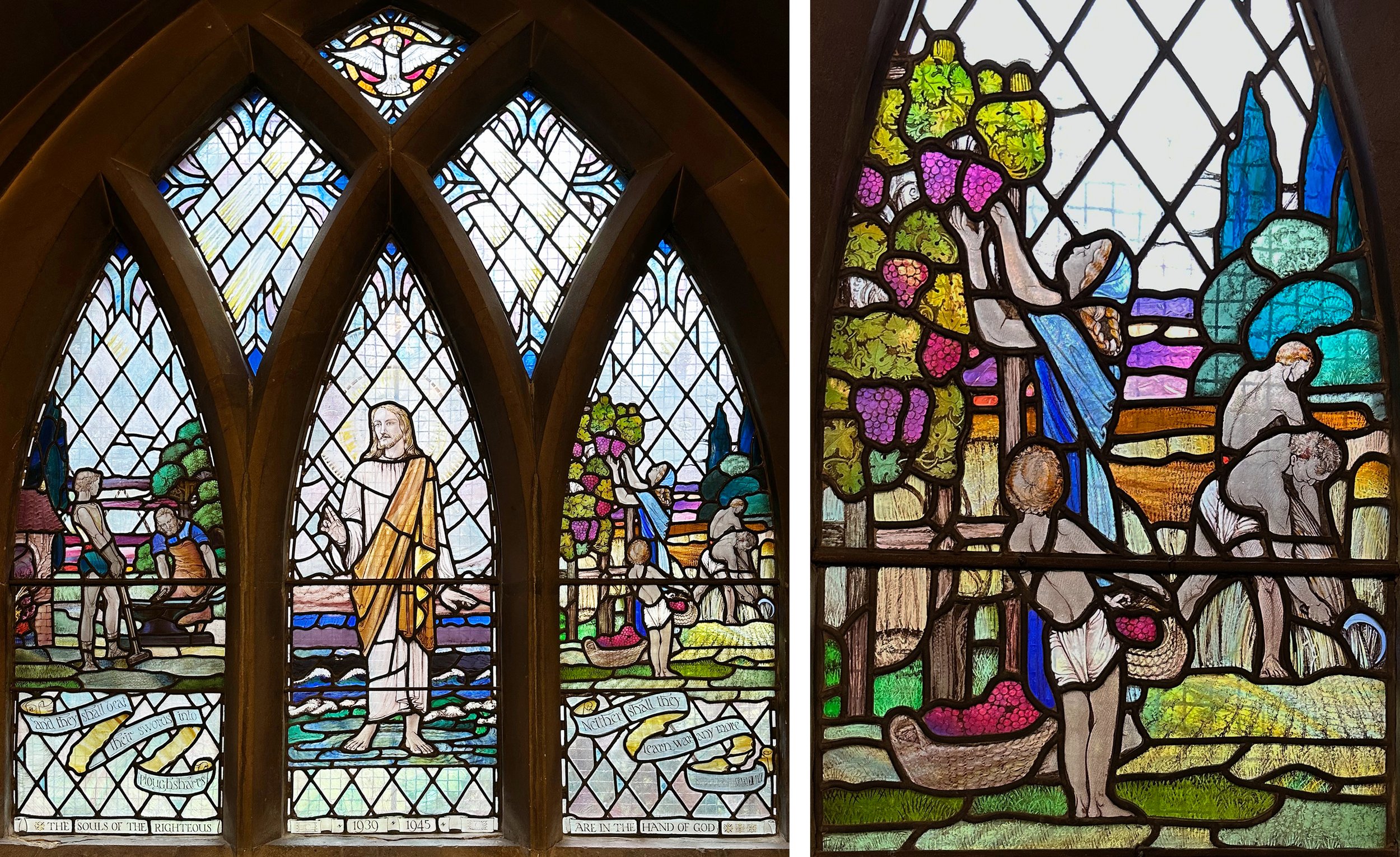
St Mary Spring Grove, south aisle window by Veronica Whall, 1949.

More Mark Angus by Sasha Ward

Small window in St Andrew, Steyning, West Sussex. Mark Angus 2000

Since I appreciated (and described in a blog post last March) a whole church full of Mark Angus windows I have been looking for more. The one in St Andrew’s church, Steyning, didn’t disappoint, high up in the north east corner and casting an inky light on the stuff accumulated below (above right). The coloured glass is beautiful, the detail not painted but using what I think of as his signature - the abundant use of those liberated lead lines, veering off the dividing lines between glass pieces like the strokes of a thick pen.

The church website says that, wanting to commission a millenium window, a decision was made to seek a good example of contemporary art. A number of artists was approached but most of the proposals were judged to be unimaginative, so Mark Angus was commissioned because of his “Daily Bread” window in Durham Cathedral. The Steyning window, seventeen years later, does resemble that one, but the subject matter is (supposedly) inspired by Ezekiel 47:12: “On the banks, on both sides of the river, there will grow all kinds of trees for food.”

In Mark Angus’ 1984 book Modern Stained Glass in British Churches, he wrote “The Artist must always bear in mind that his work is experienced daily by ordinary people. His work’s must be accessible, explain mystery, and yet maintain mystery, give insight and meaning alongside awe.”

West window in Christ Church, Bradford-on-Avon, Wiltshire. Mark Angus 1993

Before he moved to Germany, Mark Angus lived near Bath and there are several of his windows in that region, including two in Bradford-on-Avon. I think I love his west window in Christ Church, although I could hardly see it. There is no colour but there are different types of white glass and more of those wonderful lead lines making a picture that describes a rainbow with cloud, rain and sunshine in the most original way. You get no direct view of this window inside the church (did you ever? I wonder) as there is an inaccessible gallery above the west door, beyond which an accumulation of gloomy stuff again (above right).

East window in St Mary Tory, Bradford-on-Avon, Wiltshire. Mark Angus 1999

Also in Bradford-on-Avon and with a Mark Angus east window, the chapel of St Mary Tory is a rare treat. This is a tiny building, rebuilt in the late nineteenth century on the site of a former chapel and hermitage dating from the fifteenth or early sixteenth century. When I took the photo above right I was standing with my back against the west wall and facing through the windows a fantastic view of the town.

The window was commissioned by retired vicar Canon Bill Matthews on behalf of the donor Enid German who wrote “An inner image prompted me to finance a coloured window to replace the existing plain glass one. After deep concentration in prayer, the design for the central panel came. Those of the two side panels I left to the artist, Mark Angus, then unknown to me. I passed my ideas to Bill who acted as go-between.” It is fascinating to get such an insight into the commissioning process, especially, as in the same bit of text on display in the church Mark remembers it differently. He describes in detail how he arrived intuitively at the design for each lancet, aiming for a mood of “active quietness”. After describing each panel he wrote “So now we have the whole image. Of a garden, of nature, of light, of the mystic, of refreshing tears and raindrops, of sky, of heaven. It is an escape from the hard realities of life, a retreat and a resting place.”

The view from the chapel of St Mary Tory.

Of course the central lancet is quite obviously a flower, in Mark’s words “a mystical rose, which is both contained and is free”. I had to get up close to check on the yellow splodge of stamen in the middle (below left), it’s so unusual to see him using glass enamel and it looks more superficial than those wandering signature lead lines. There are views of houses and trees through the coloured glass, who on earth would prefer nothing but plain glass windows?

St Mary Tory, detail and view from a south facing window.