ST Mary's Church, Cheltenham by Sasha Ward

I've learnt not to ask about the stained glass when visiting churches as the information I want (who made it? when?) is rarely there. I am usually told that it's only Victorian and then given stories about the iconography. However in the oldest building in Cheltenham, St Mary's Church, there are two guide books which in combination tell you almost everything you need to know. One takes you around the church with pictures, plans and bible references, while the other (not to be taken away) gives you historical information.

The Rose Window, William Wailes glass 1879         Detail from the Central West Window, Heaton, Butler & Bayne 1885

The Rose Window, William Wailes glass 1879         Detail from the Central West Window, Heaton, Butler & Bayne 1885

The beauty of The Rose Window (above left) is in the fourteenth century tracery, slightly angled and very low in the wall  - east facing in the north transept. All of the windows on this level are filled with stained glass from the late nineteenth century.  Here are photographs of some of my favourite details: the H,B&B radiating star (above right), The Parable of the Talents (below left), foliage done in a completely different way by Clayton & Bell in the window of St. Peter (below right) where I also love the painted ship and the pale landscape colours.

South Aisle, Bell & Son 1877                                                      The Chancel, Clayton & B…

South Aisle, Bell & Son 1877                                                      The Chancel, Clayton & Bell 1879

I'm not able to guess which firm made the North Transept window (information missing from the book) whose apostles showed up well in the afternoon sunlight (below). The L,B&W Last Supper Window also looks particularly good in the fine ancient tracery and is full of the sort of details that people love to point out. This from the guide book: 'Can you see the disciple with the brown halo in the far right panel? This is probably Judas Iscariot..." 

Top : Matthew, Mark, Luke & John from The North Transept Window.  Below : The Last Supper Window, Lavers, Barraud & Westlake 1880 
Top : Matthew, Mark, Luke & John from The North Transept Window.  Below : The Last Supper Window, Lavers, Barraud & Westlake 1880


The Outside of Stained Glass by Sasha Ward

The Vyne (NT, near Basingstoke) and some of its heraldic glass

The Vyne (NT, near Basingstoke) and some of its heraldic glass

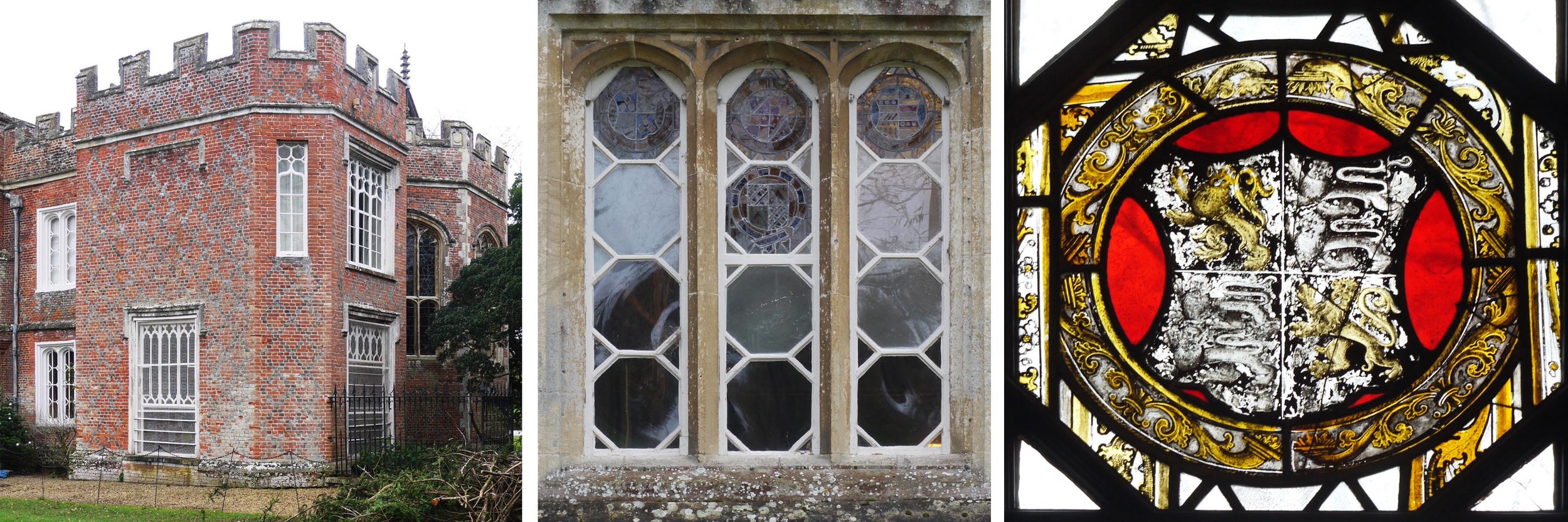
Fantastic fenestration at The Vyne, those glazing bars that form octagons, triangles, lozenges and diamonds also contain some great heraldic glass. You can tell how good it is - and well restored - from the outside (above).  My favourite panel on the right, the arms of Henry VIII, has lions painted and scratched back in such a way that it is easy to imagine the painter's hand at work. 

C16th glass : the base of the Crucifix and Henry VIII panel

C16th glass : the base of the Crucifix and Henry VIII panel

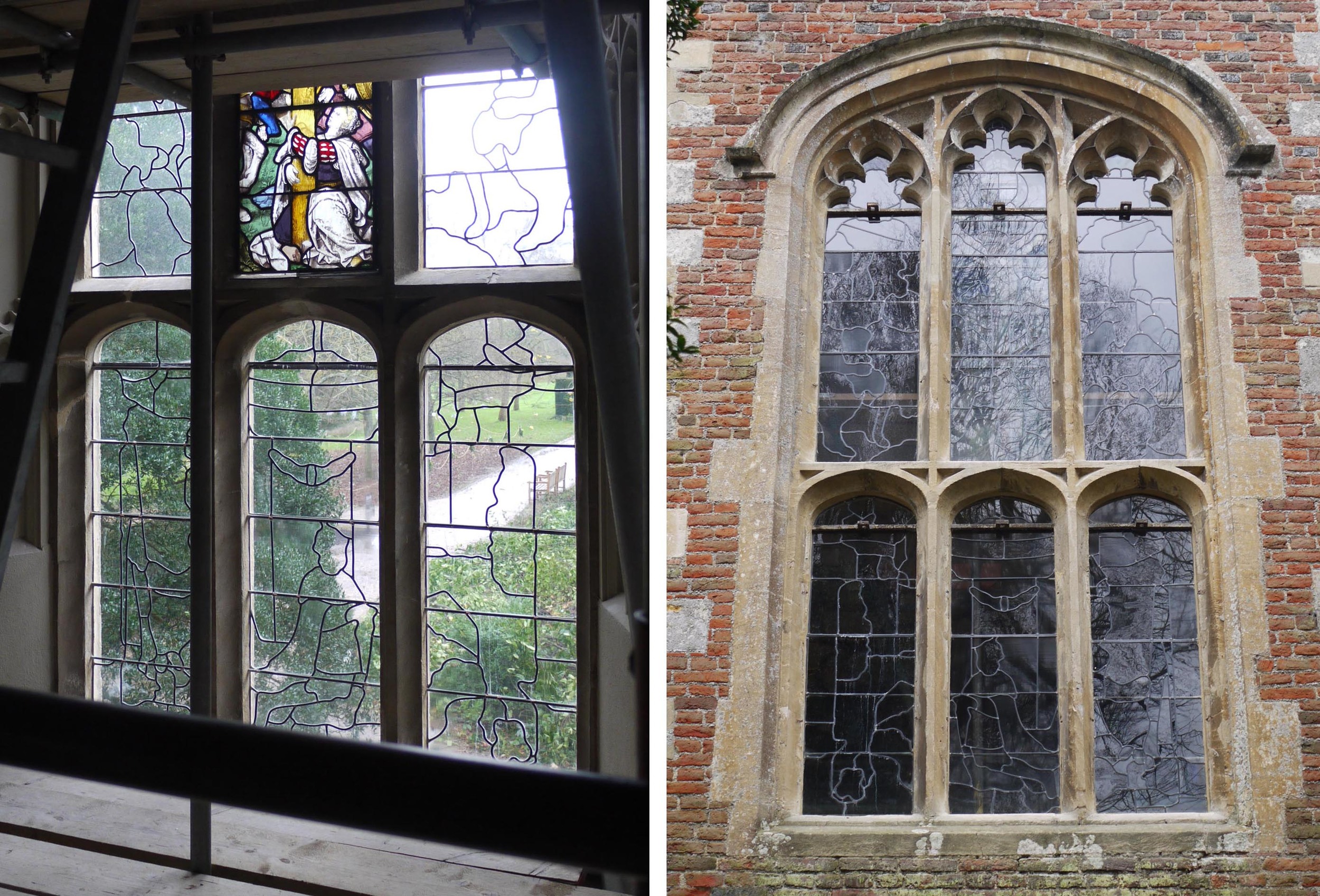
Inside the chapel there is a rare opportunity to get close to the exceptional 16th century glass by climbing the scaffolding that is there while the glass panels are conserved. The crucifix panel (above left) is already in place and the one featuring Henry VIII is on display on a light box in the house, also great for a close up view. Adjacent panels feature Queen Margaret of Scotland (his sister) and Catherine of Aragon.

panel 2.jpg

It easy to see where these three figures, together with gorgeous canopies and name Saints, will go by looking at the leading pattern in the clear glazing installed in the chapel windows before the coloured ones arrive back. Curious idea, but It looks good from the outside (above right) while protecting the precious glass inside. 

How good to get so close up to Henry VIII, portrait at about 30 years old. Glass possibly by Flemish glaziers, commissioned by Lord Sandys of The Vyne in the 1520s.

How good to get so close up to Henry VIII, portrait at about 30 years old. Glass possibly by Flemish glaziers, commissioned by Lord Sandys of The Vyne in the 1520s.

Glass Enamel Samples by Sasha Ward

Enamels in the studio

Enamels in the studio

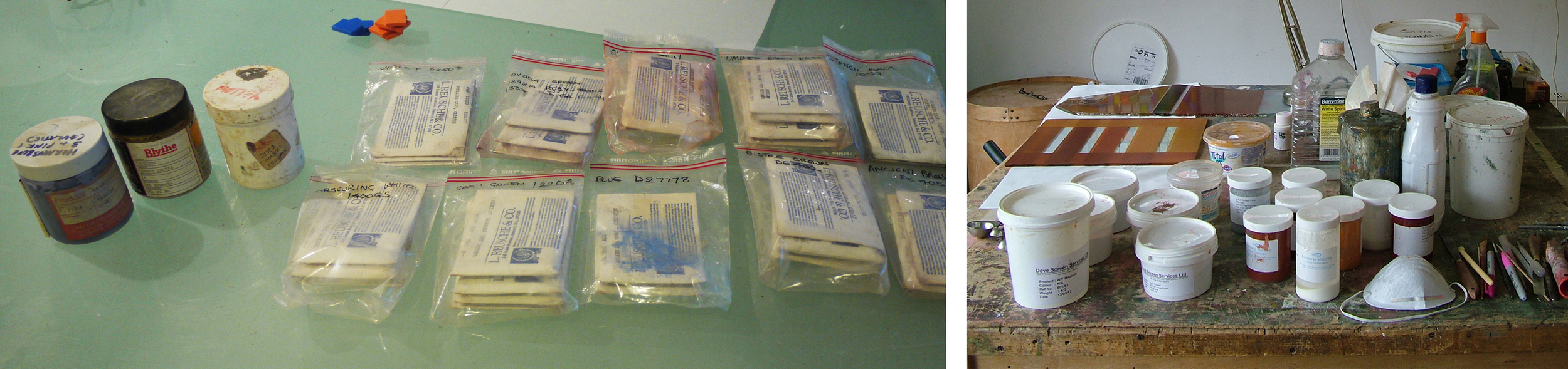
Since I started using glass enamels in 1984 (date verified by original Blythe pot above) I have sampled the products of most enamel suppliers. I have just tried out some ancient looking envelopes of Reusche enamels, very fine but expensive, given to me by a colleague. I save my old enamels for small projects as many of them are now unobtainable because of the elements, including lead, that they contain.  In my favourite range I have completely used up some colours - my best ever test strips are on the windowsill below right, next to the new Reusche samples. 

Colour samples in my studio window                                                    Best ever enamel test strips &amp…

Colour samples in my studio window. Best ever enamel test strips & recent (smaller) Reusche strips.

The test pieces, which I sometimes vary by using dots or another layer of colour going the other way, look great in the studio windows but because they are usually on 6mm (thick) glass, it is hard to use them in stained glass commissions. They have recently been sorted or chucked during the great studio clear out. For our new shed door (below left) I used fifteen sample panels of the mostly brown enamels from a job shown in the photo at top right - complete with notes on colour mixes scratched through the paint. For one of my first ever stained glass commissions (below right) I made fake sample strips, this time texture added with acid etched stripes, an even more deadly substance that I no longer use.

Our shed door, 2014                                                                 &nbsp…

Our shed door, 2014. Detail from front door commission, 1988

View From The Window by Sasha Ward

If in doubt, I draw the view from the window. Last weekend (of the attacks) I was staying in a friend's flat in Paris, being very critical of the view from the windows on to the blank wall of a block of flats less than three metres away (drawing 1). However, as shown in drawing 2, we ruined the view from the bedroom window at home in Marlborough by building our tall studio in front of it. Looking at the little patch of sky that remains at top left, I remembered another sketchbook page (drawing 3) drawn from my bedroom at West Dean House last January, where I had to peer between the thick flint walls and the courtyard castellations to find my view.

drawing 1, Paris.  drawing 2, Marlborough. drawing 3, West Dean House, Sussex

drawing 4, Loch Lomond.  drawing 5, Lewis. drawing 6, Berneray

There are window drawings in all of my sketchbooks, here I've chosen three Scottish ones from 2011 when I did a commission on the Isle of Lewis. On the way there was a hotel window near Loch Lomond, some tree tops and lots of sky visible (drawing 4). Then the ugly bungalow we stayed in on Lewis had only one high window facing south towards a magnificent view of The Minch (drawing 5) - invisible when you were sitting down at the kitchen table. Drawing 6 is a view from the kitchen window of the most beautiful place I have ever stayed, that is undisputedly the hostel on the Isle of Berneray.

Words and Pictures by Sasha Ward

Details from the patchwork windows in the North Aisle

These photos are all from the ancient parish church of Saint Michael and All Angels in Ashton-under-Lyne, where the restored fifteenth century glass has been installed at eye level in the North and South Aisle windows. There are beautifully made patchwork style windows in the North Aisle, with some mysterious figures, a useful inscription and the five pointed star from the coat of arms of the Assheton family.

The set of four windows in the South Aisle depicts the life of Saint Helen, and in windows 3 & 4, members of the Assheton family who donated them. 

Window 3 South Aisle: Saint Helen above, Asshetons below.

Detail: lower central panel, window 3

I'm not usually that bothered about the iconography,  but these portraits grabbed my attention initially because of the huge black family stars on their stomachs. Then the inscriptions are easy to read, I could even make out the names of Thomas Assheton and his wives Agnes, Elizabeth and Anne surrounded by gorgeous painted patterns.

Two of the lower panels in window 2 that depict the life of Saint Helen, translations below

Hic inveniebant tres cruces an aliis et veram crucem non discernebant                                                            Here they found three crosses and could not tell which was the true cross

Hic crucem veram petentes fodiunt                                                                                                                      Here they dig in search of the true cross

I found these translations in a great guide book to the Saint Helen windows by members of The Friends of Ashton Parish Church with not only word by word translations of each inscription but also grammatical notes - so useful for latin revision.