A WM Wiltshire Stained Glass Tour by Sasha Ward

Map of North Wiltshire showing the location of the three churches - it's about seven miles between Sopworth and the other two.

Map of North Wiltshire showing the location of the three churches - it's about seven miles between Sopworth and the other two.

We started at St Mary's Sopworth, where a low, south facing three light window shows Mary Magdalene, The Virgin Mary and Mary of Cleopas. I had never seen a reproduction of this window and was amazed at how beautiful it looked, with lovely colour, detail and organisation of the background space. The figures were originally designed for Bradford Cathedral, the central Mary by Edward Burne-Jones, the outer two by William Morris. The Mary of Cleopas panel is simple and stunning - I've always heard that Morris couldn't do figures, perhaps it's the skilled glass painter's work that I admire the most.

Window in St. Mary's Church, Sopworth and detail of the right hand panel. EBJ & WM 1873. Click to enlarge.

Next we went to Malmesbury Abbey to see a much later Edward Burne-Jones window. These figures I did recognise from their appearance in earlier windows made by the firm of Morris and Company, where Faith was originally St. George, Courage originally King Ethelbert of Kent and Devotion a centurion. The backgrounds and foliage are also quite standard, but fit well with the lofty space of the Abbey. Painted details, especially on the clothes, are as usual fantastic.

The Luce Window, Malmesbury Abbey. Made by Morris & Company in 1901 to designs by EBJ. Click to enlarge.

Three miles south of Malmesbury is Holy Rood Church, Rodbourne, with some small windows made in the early years of the firm of Morris, Marshall, Faulkner and Company. The designs are by Ford Madox Brown and Dante Gabriel Rossetti; there is also a pelican roundel by Philip Webb in another small window. I love Rossetti's angel and the crucifixion with red background above it. These must have been painted in the period when the firm's paint recipe contained unstable elements because much of the lettering and detail has come off. Strangely the paintwork on the pelican roundel is still perfect, lovingly painted too.

Holy Rood, Rodbourne. Left: The Fall by FMB. Above: Annunciation by DGR.  Pelican roundel by Philip Webb. Click to enlarge.
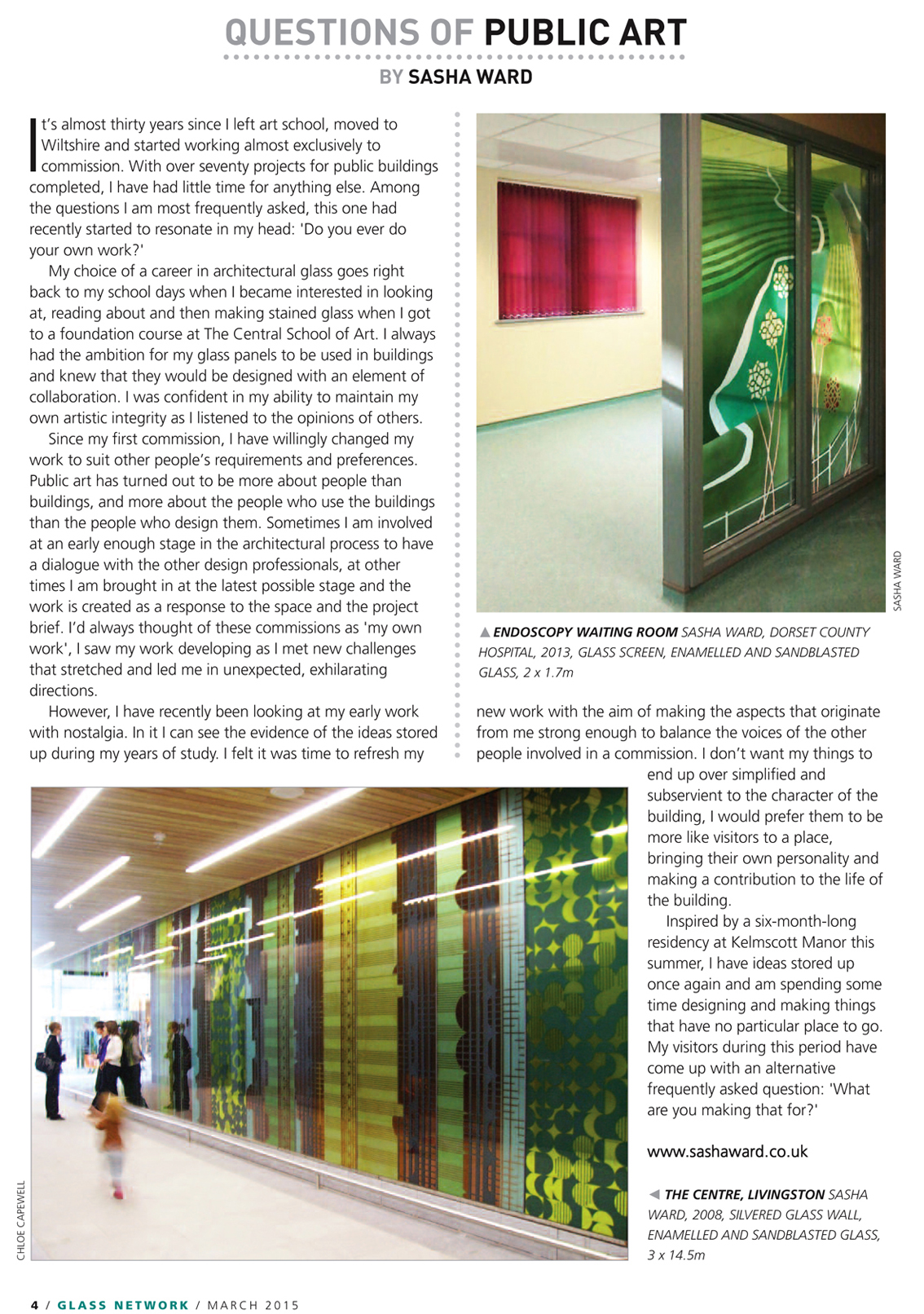
Glass Network Questions by Sasha Ward

Today "Glass Network", the quarterly magazine of The Contemporary Glass Society arrived - here is my page. The questions I wrote about in this piece may be familiar to people who work to commission, or to those who have read my posts from Kelmscott Manor when the questions most frequently asked by visitors were spinning in my head.

Patchwork Windows by Sasha Ward

Cirencester Parish Church

I think I've found my favourite patchwork window ever, particularly the top left hand face that I spotted across the complicated interior of Cirencester Parish Church. It made me realise that it's the juxtaposition of images as much as the pattern making that is so appealing about these windows. My previous favourite was the one in Hereford Cathedral (below), where a hand skilled in design put together the section about Joseph's dream.

Pages from the Hereford Cathedral stained glass brochure (click to enlarge)

I've also admired windows put together by artists, like the one at Ripon Cathedral (below), featuring Kempe figures surrounded by beautiful Bridget Jones patterns in blue and sharp yellow. It has a huge impact from a distance and the modern glass is just as lovely as the old.

Pages from the Ripon Cathedral stained glass brochure (click to enlarge)

Although I occasionally make sheets of patterned glass to cut up for patchwork windows as if it were fabric, I really consider this to be cheating. My glass scrap boxes are full of pieces made as samples or ones that broke during manufacture. The birds below were fired in my first ever kiln for my first public commission. I don't know why they kept breaking - the result was a whole extra window.

My bird window, 1986

My bird window, 1986

Teaching Stained Glass by Sasha Ward

Twentieth Century glass and stained glass lantern in The Oak Hall, West Dean House.

I always say that the inspiration for my own glass came from looking at examples of old stained glass. I worked out why certain techniques and design features were used and this enabled me to invent my own way of doing things using modern methods and contemporary imagery. When I teach short courses at West Dean College, as I did last week, I try and get my students to take the same approach using as examples the stained glass in West Dean House

Windows representing the four seasons above the entrance doors, West Dean House.

Above the front door you find these beautiful women representing the four seasons. Their provenance is unknown to me; I concentrate on the pattern making in the background, the detailed clothing and the border. Rob Veck's panel below uses the same paints, iron oxide and silver stain, with a face and some patterns borrowed from another Pre-Raphaelite and her gown.

Detail from autumn window, West Dean.                                                        Rob's panel in progress at West Dean College.

The stained and enamelled fragments that patch windows and lanterns in The Oak Hall (top), are a great example of my favourite type of reassembled stained glass. I was very happy to have a fellow patchwork enthusiast, Jane Brocket, on my course for whom a different way of working with glass seemed to make sense. Below left is Jane’s work in progress, where pieces that she has sandblasted, painted and fired are combined with scraps from the off cuts box. I was reminded of panels made at the Bauhaus by Josef Albers, nothing pointlessly complicated here. 

Jane's panel in progress at West Dean College.                         Glass, lead and wire panels by Josef Albers, 1921.

Intricate Designs by Sasha Ward

Inside the Quiet Room, Churchill Hospital, Oxford.

Inside the Quiet Room, Churchill Hospital, Oxford.

Our refurbishment of The Quiet Space/Multi Faith Room in Churchill Hospital is almost finished. It used to be a white walled storage space  and now, after much consultation, I have designed glass and acrylic panels, wallpaper, lino floor, and bought some new furniture. Often, during the development stage, my designs are more intricate than everyone else thinks they should be - despite much loved examples of really complicated patterns used to decorate buildings throughout the ages. 

Details from the Vyner Memorial window, Morris & Co. 1872. On the right rare (for stained glass) initials of EBJ, designer and CFM, glass painter. Christ Church, Oxford

Details from the Vyner Memorial window, Morris & Co. 1872. On the right rare (for stained glass) initials of EBJ, designer and CFM, glass painter. Christ Church, Oxford

Medieval grisaille glass: left from Exeter Cathedral, right from Christ Church, Oxford c.1350

Medieval grisaille glass: left from Exeter Cathedral, right from Christ Church, Oxford c.1350

These medieval grisaille windows are my favourite examples for showing the techniques of painting and staining on different types of coloured glass and the combination of geometry and plant life  that I use in my own work. I was shown around by great guides at Christ Church; Jo Cottrel who also volunteers at Kelmscott Manor and Edward Evans who has written the Pitkin Guide to the windows and therefore knows the history of every single window in the cathedral.