Intricate Designs by Sasha Ward

Inside the Quiet Room, Churchill Hospital, Oxford.

Inside the Quiet Room, Churchill Hospital, Oxford.

Our refurbishment of The Quiet Space/Multi Faith Room in Churchill Hospital is almost finished. It used to be a white walled storage space  and now, after much consultation, I have designed glass and acrylic panels, wallpaper, lino floor, and bought some new furniture. Often, during the development stage, my designs are more intricate than everyone else thinks they should be - despite much loved examples of really complicated patterns used to decorate buildings throughout the ages. 

Details from the Vyner Memorial window, Morris & Co. 1872. On the right rare (for stained glass) initials of EBJ, designer and CFM, glass painter. Christ Church, Oxford

Details from the Vyner Memorial window, Morris & Co. 1872. On the right rare (for stained glass) initials of EBJ, designer and CFM, glass painter. Christ Church, Oxford

Medieval grisaille glass: left from Exeter Cathedral, right from Christ Church, Oxford c.1350

Medieval grisaille glass: left from Exeter Cathedral, right from Christ Church, Oxford c.1350

These medieval grisaille windows are my favourite examples for showing the techniques of painting and staining on different types of coloured glass and the combination of geometry and plant life  that I use in my own work. I was shown around by great guides at Christ Church; Jo Cottrel who also volunteers at Kelmscott Manor and Edward Evans who has written the Pitkin Guide to the windows and therefore knows the history of every single window in the cathedral.

Patterns in a Dorset Church by Sasha Ward

I was slightly worried about the way that I had shoved my three Kelmscott designs together in The New Brewery Arts Exhibition (see my last post), but after my visit to The Parish Church of St Peter & St Paul in Cattistock, Dorset I realise that I could have gone further with my display.  The baptistry under the tower was designed by Gilbert Scott and decorated in 1901 probably by W.O. & C. Powell. It's a small space filled with patterns, texts and images with no spare space between them. I was particularly taken with one design, used in two different colourways, my drawings of this repeat pattern are shown below right.

Interior of the baptistry at Cattistock Parish Church

Interior of the baptistry at Cattistock Parish Church

I was really there to visit this small, rich Morris window from 1882. The colours are strong and the design is clear, facing the porch this window is immediately more eye-catching than any of the others although they are all filled with interesting stained glass of different types. The detail that I picked out here is the depiction of the wooden surface of the angel's zither - ways of showing wood grain on glass is something that I've played around with too.

My glass painting "Slice through Yew Tree" 2007 (click to enlarge)

Kelmscott design no. 3 by Sasha Ward

3 glass sketches for the repeat design Kelmscott No. 3

3 glass sketches for the repeat design Kelmscott No. 3

Glass and print versions of the design to show how the repeat works

Glass and print versions of the design to show how the repeat works

I've put my three wallpapers and corresponding glass panels up next to each other in an exhibition about artists' residencies. Design No 3. links Kelmscott Manor with the River Thames and its gardens with clumps of  waterside plants. I'll be tweaking all of these designs in the next few months - seeing them printed on a large scale and all together gives me a great opportunity to evaluate my work from the residency.

The three Kelmscott wallpaper designs installed together in an exhibition at New Brewery Arts

The three Kelmscott wallpaper designs installed together in an exhibition at New Brewery Arts

The River Thames by Sasha Ward

My third Kelmscott repeat design features the river and has been stuck at the stage above since August, so I returned to the river Thames for some winter drawing. Does it feel melancholy because I have read William Morris' descriptions of the place so many times?

"…though it has a sadness about it which is not gloom but the melancholy born of beauty I suppose it is very stimulating to the imagination".

"…and am writing among the grey gables and rook haunted trees, with a sense of the place being almost too beautiful to work in". from WM's letters to Louisa Macdonald Baldwin in 1871 and 1872.

two of my winter drawings

two of my winter drawings

The "Anarchy & Beauty" Exhibition includes May Morris' embroidery of the river. I chose this work to write about on The National Portrait Gallery blog of modern makers' responses to the exhibition.

Extract here :

This small embroidered rectangle by May Morris is the best representation of the River Thames at Kelmscott that I have seen. I love the dense overlapping stitches she used to show the plants and the flat landscape beside the water. I spent last summer drawing along the banks of the river and in Kelmscott Manor, the Morris’ country home just a stone’s throw away. The huge expressive stitches on the embroidered hangings in the Manor gave me an incredible sense of the presence of William Morris, his wife Jane and their daughters Jenny and May. I wondered whether they would have approved of what I was doing there as Artist in Residence as I found my own way of depicting the house and garden in the melancholy Oxfordshire landscape.

White Windows by Sasha Ward

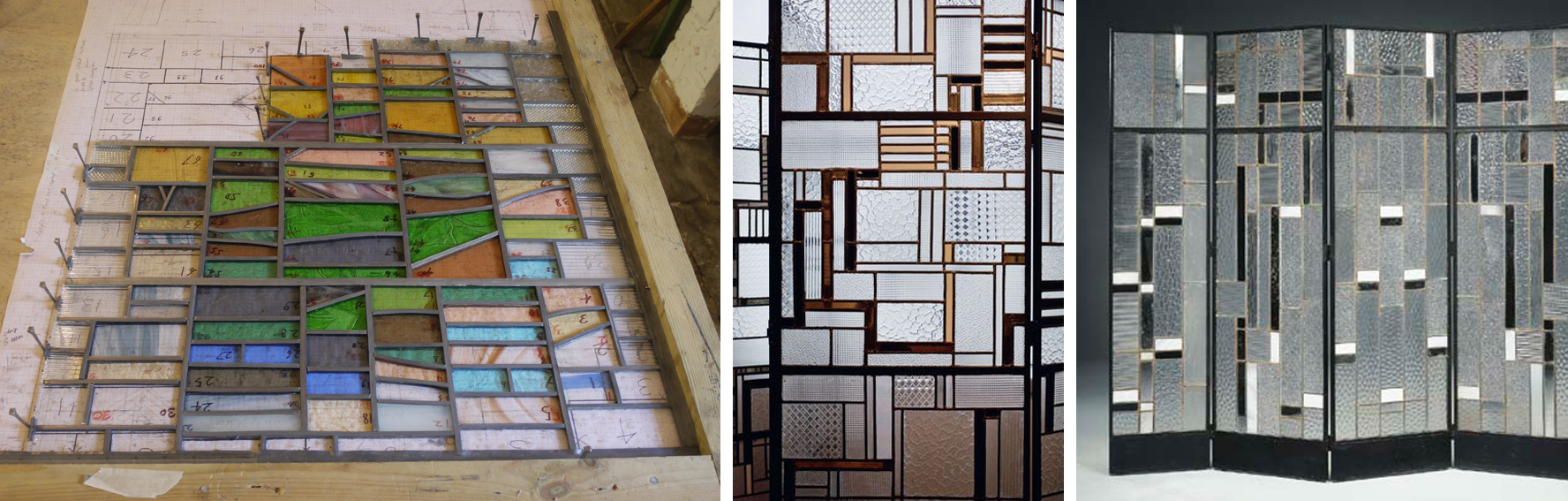
Signatures panel in progress                                                    Two screens by Louis Barillet

Signatures panel in progress                                                    Two screens by Louis Barillet

When I was making the signatures panel border, made of recycled white glass, a visitor mentioned the work of Louis Barillet from the 1930s. When I saw his screens I could see the link. Now I am finding windows made of different types of textured white and clear glass everywhere.

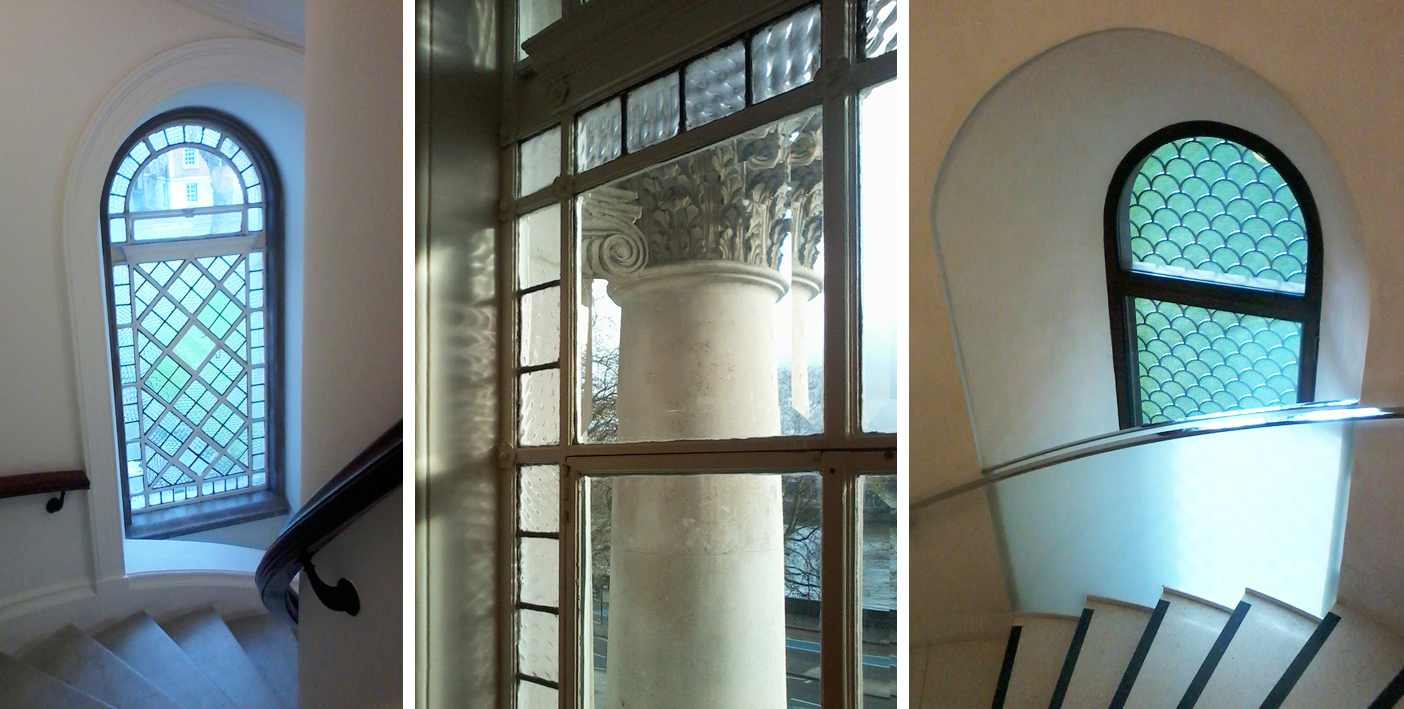
National Portrait Gallery entrance                  Tate Britain : original window & detail from the new panel by Richard Wright (2013)

National Portrait Gallery entrance                  Tate Britain : original window & detail from the new panel by Richard Wright (2013)

There is a row of four white windows in the entrance of the National Portrait Gallery, and many examples of the genre in the newly refurbished Millbank Entrance of Tate Britain. When the building opened in 1898 there were two of these clear decorative windows, one was subsequently removed and a new leaded window by Richard Wright has been commissioned in its place. This window has the simplicity that I have noticed in so many stained glass windows designed by artists - from Henri Matisse to Gerhard Richter. I am reminded of the comments I got at college when I made my stained glass pictures; "the material is so beautiful you should let it speak for itself". I always wanted to do some of the speaking myself - the windows I really love bring a bit more personality into the buildings they inhabit.

Windows on the stairs to the members' room: windows inside the room with many textures and a wide bevel on the larger panes.

Windows on the stairs to the members' room: windows inside the room with many textures and a wide bevel on the larger panes.