This was a day organised by Rachel Mulligan of The British Society of Master Glass Painters, based around five churches from Caroline Swash’s book (The 100 Best Stained Glass sites in London), all with post war glass that replaced windows damaged during the Blitz.
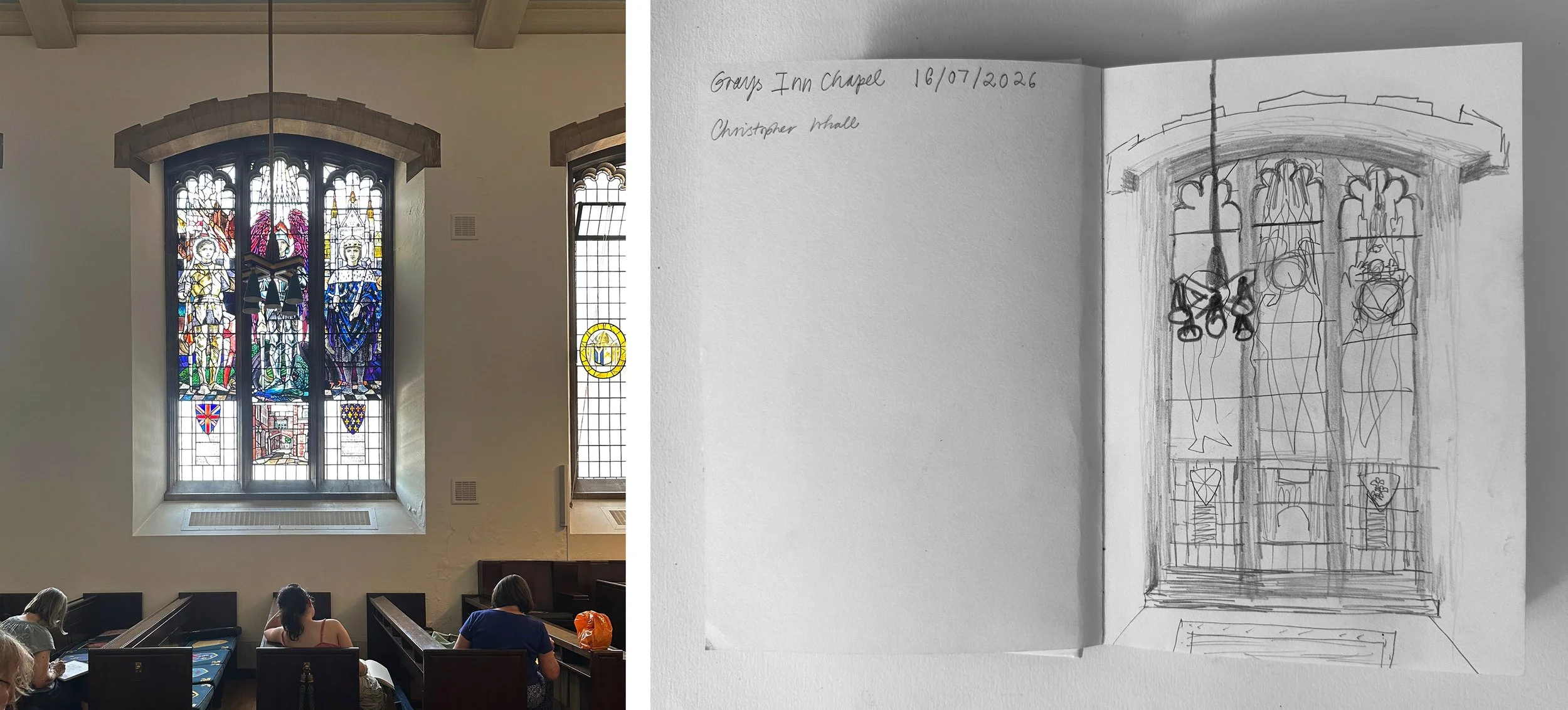
Gray’s Inn Chapel, Memorial window by Christopher Whall 1919.
The earliest work that we looked at was Christopher Whall’s memorial window in Gray’s inn Chapel. We sketched away peacefully as Rachel read the relevant section from the book, the lights were off and no one else was there other than the organ player - perfect. I was very comfortable drawing the setting and the light fittings, before zooming in on what was behind the light, some beautiful flames rising behind the head of St George. I am always less comfortable drawing heads and decided not to avoid them but to think of them as just another part of the picture, with lines and shading in vaguely the right places.
Why were we drawing? Was it to learn more about the stained glass artists, to get good at copying, to make a nice drawing or to capture the atmosphere of the church? There was hardly time for that, as after less than an hour we needed to pack up and walk to the next church.
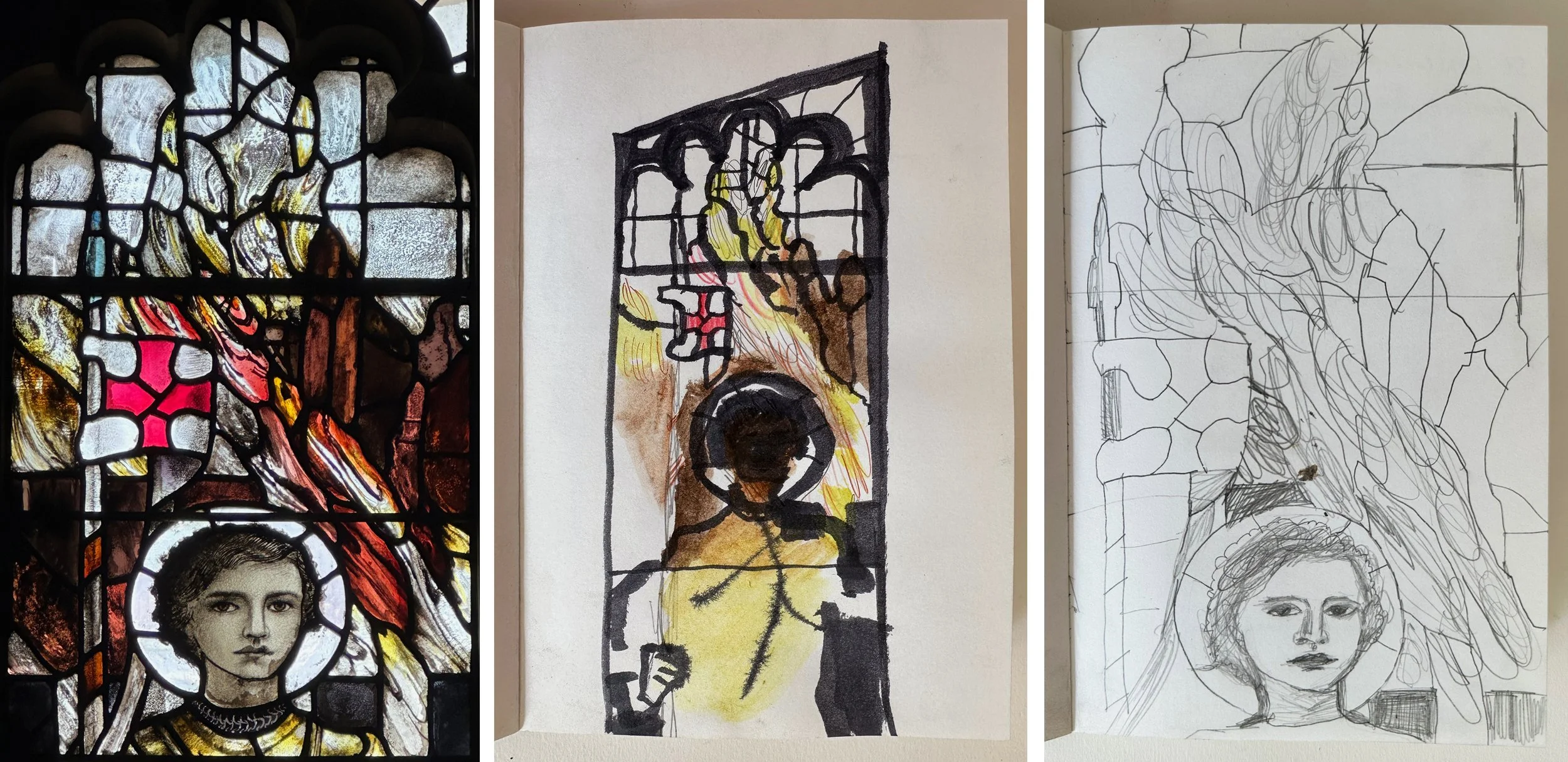
Gray’s Inn Chapel, detail of St George by Christopher Whall.
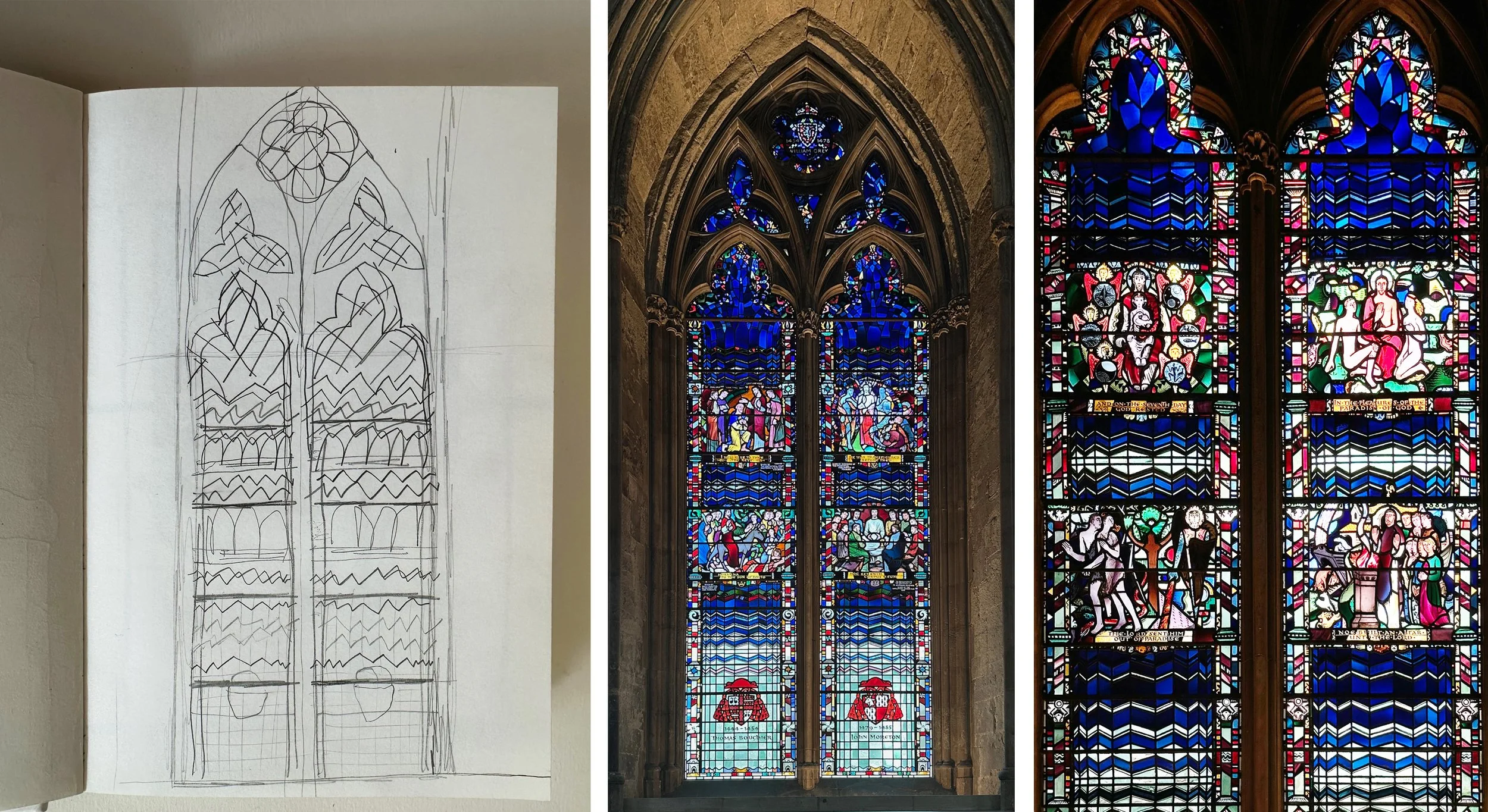
St Ethelreda’s Church, Ely Place. Two of the nine nave windows by Charles Blakeman 1952-58.
The church of St Ethelreda’s in Ely Place was definitely my favourite of the day. All the windows in the nave are by Charles Blakeman and are filled with small scenes surrounded by a coherent pattern of irresistible dark blue zigzags, such as I have never seen before. Drawing the pattern helped me work it out and to see how The Annunciation scene fitted in to the spikiness of the framework above and below. There was so much to draw here, but this being a Catholic Church it was filling up with lunchtime worshippers so on we went.
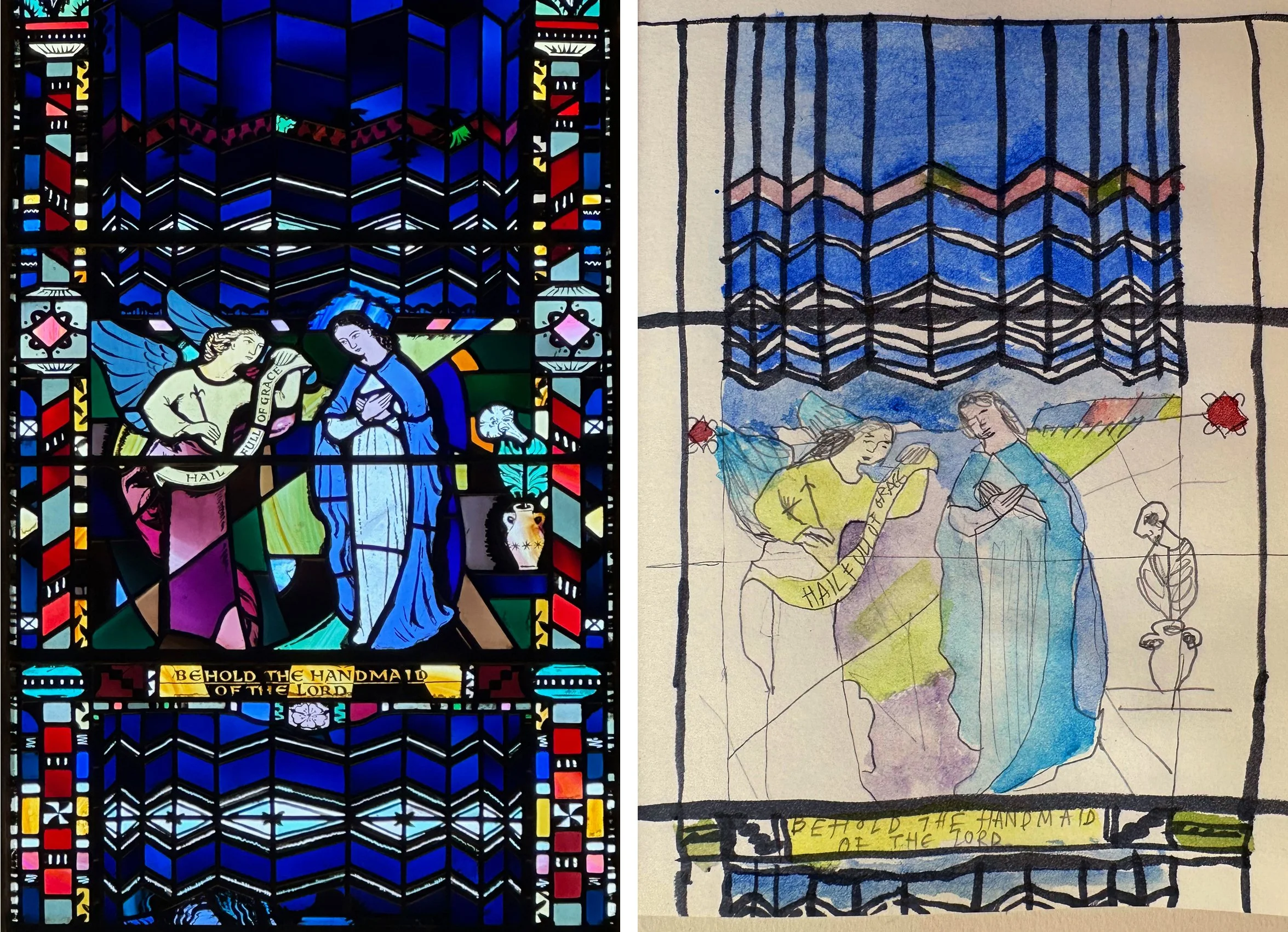
St Ethelreda, Annunciation from north nave window by Charles Blakeman 1958.
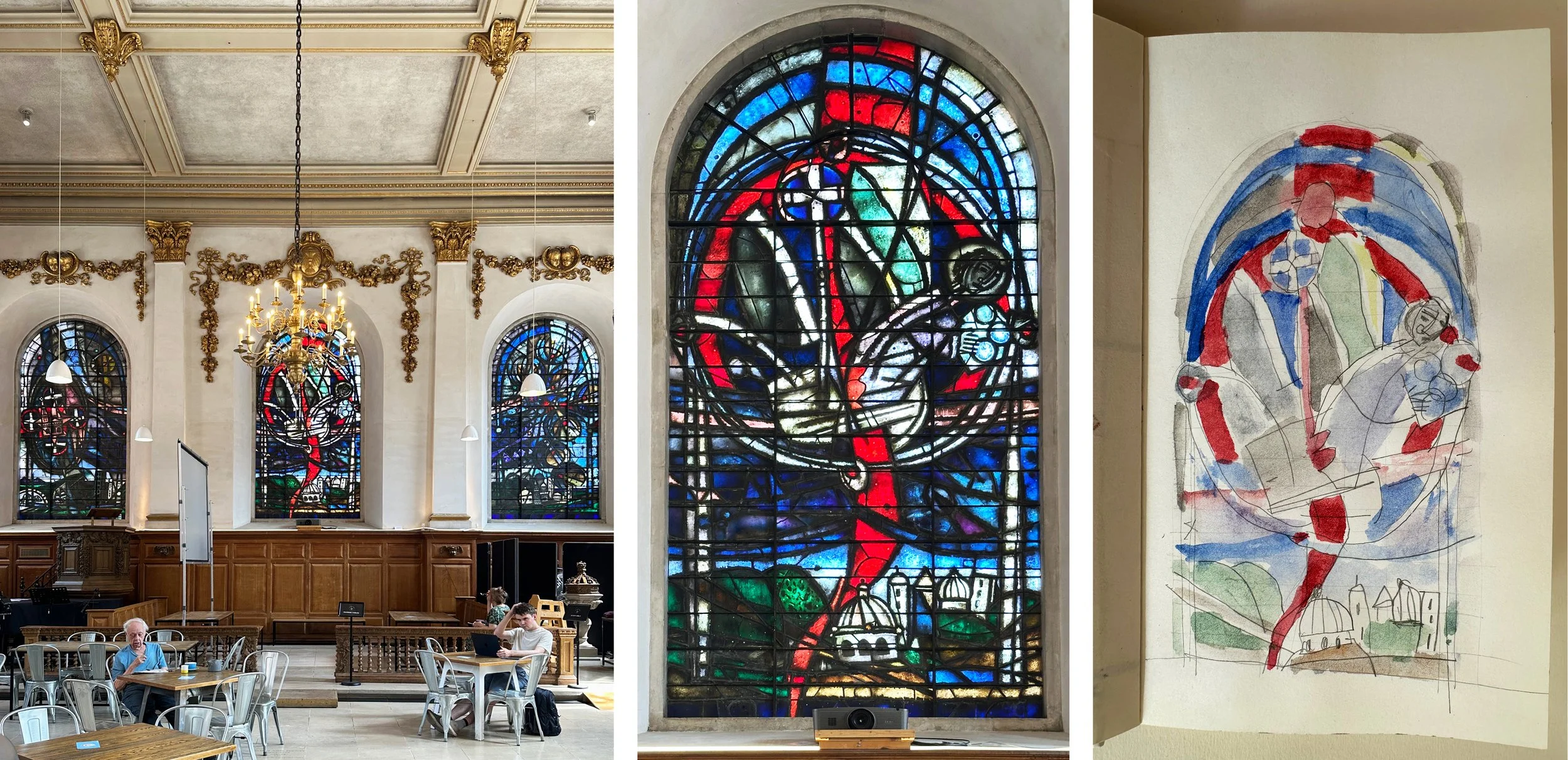
St Nicholas Cole Abbey, 3 windows by Keith New including St Nicholas window 1962.
St Nicholas Cole Abbey is a Christopher Wren church refurbished in 1961-2 when the glass for three arched windows was commissioned from Keith New (above). There was another refurbishment in 2013 and now it’s basically a cafe. The windows looked much better once they’d removed the screen that is normally in front of the bottom of the middle window but were still hard to draw. There is a tangle of lead lines, painted lines and structural support bars with irregular circles meandering around them leaving me floundering in the lack of regular patterns and the right sort of lighting.
St Mary Aldermary is half church, half cafe. I settled down in front of the west window by John Crawford (below) and drew the bottom right corner, more flames and depictions of London’s buildings and more questioning of the purpose of this type of drawing when you’re just copying someone else’s work, only not very accurately.
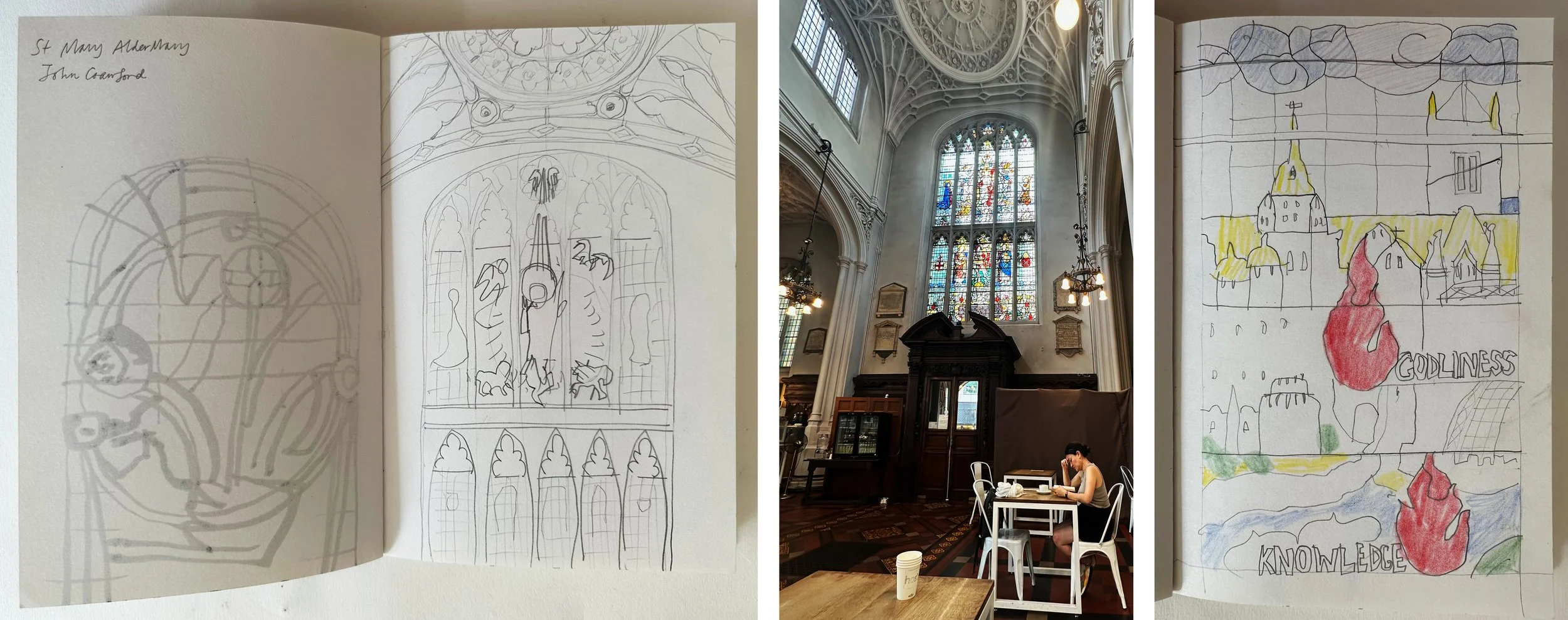
St Mary Aldermary, west window by John Crawford 1950.
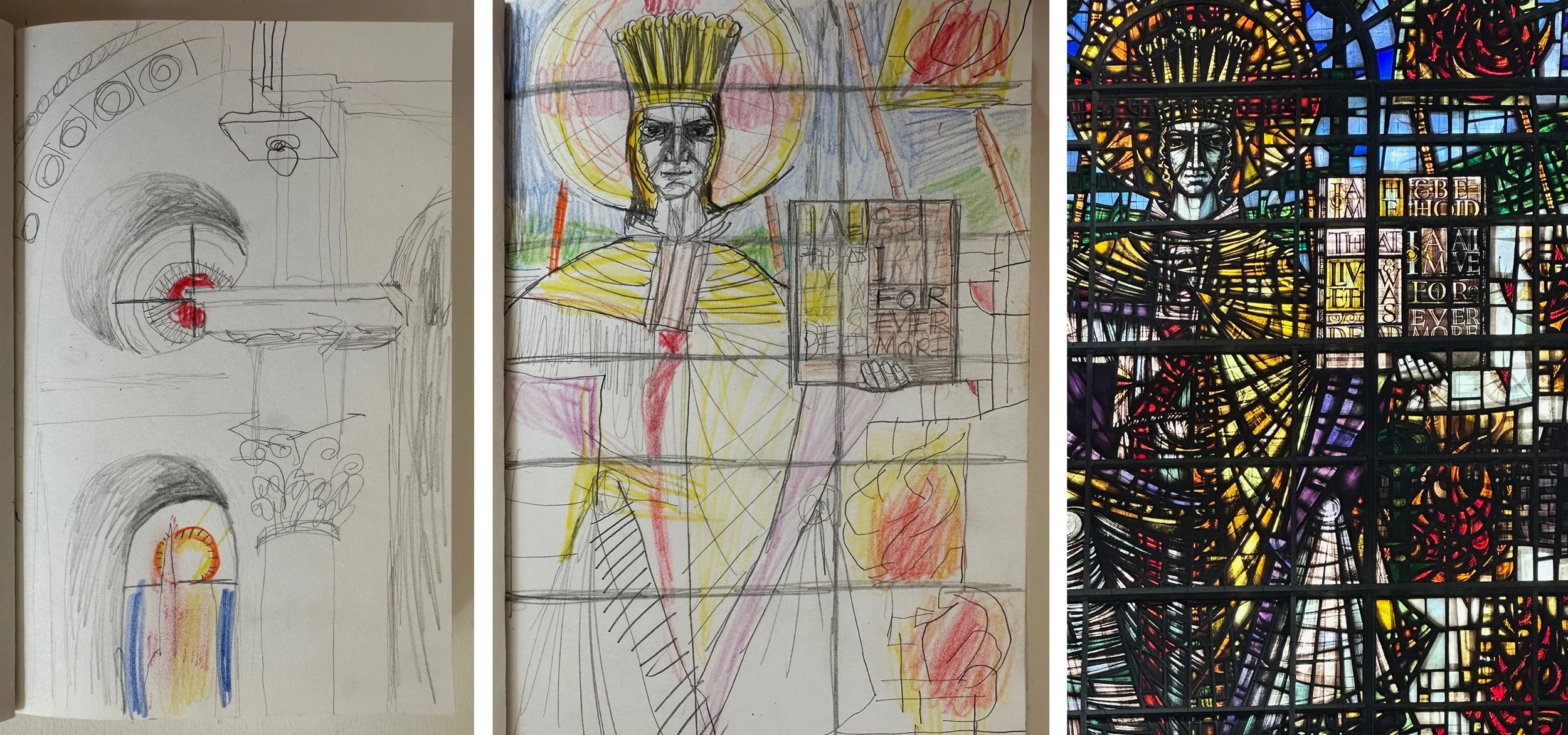
St Mary le Bow, Christ in Glory window by John Hayward 1963.
I suppose the key is to find something that you’re really interested in, and I would guess that our last church, St Mary le Bow, had something for everyone. John Hayward’s career is unlike most mid twentieth century stained glass artists as he joined a firm of church decorators rather than continuing with post graduate studies in glass. He received the commission to design all the windows and much of the furnishing in this church, designed by Christopher Wren ,when he was only 30 and the mix of old and new here is incredibly successful. I began to see the sort of drawing I could spend more time on with architectural volumes and splashes of colour (above left), and I also found a detail I really liked on the book in the hands of the risen Christ (above right) - blocks of muted colour and jumbled words bounded by Hayward’s criss cross leading.
So it probably took me all day to get me eye in. Not in order to make nice or accurate drawings, but to remind me of the things that interest me about stained glass in its architectural setting, things that may help me with my own work.
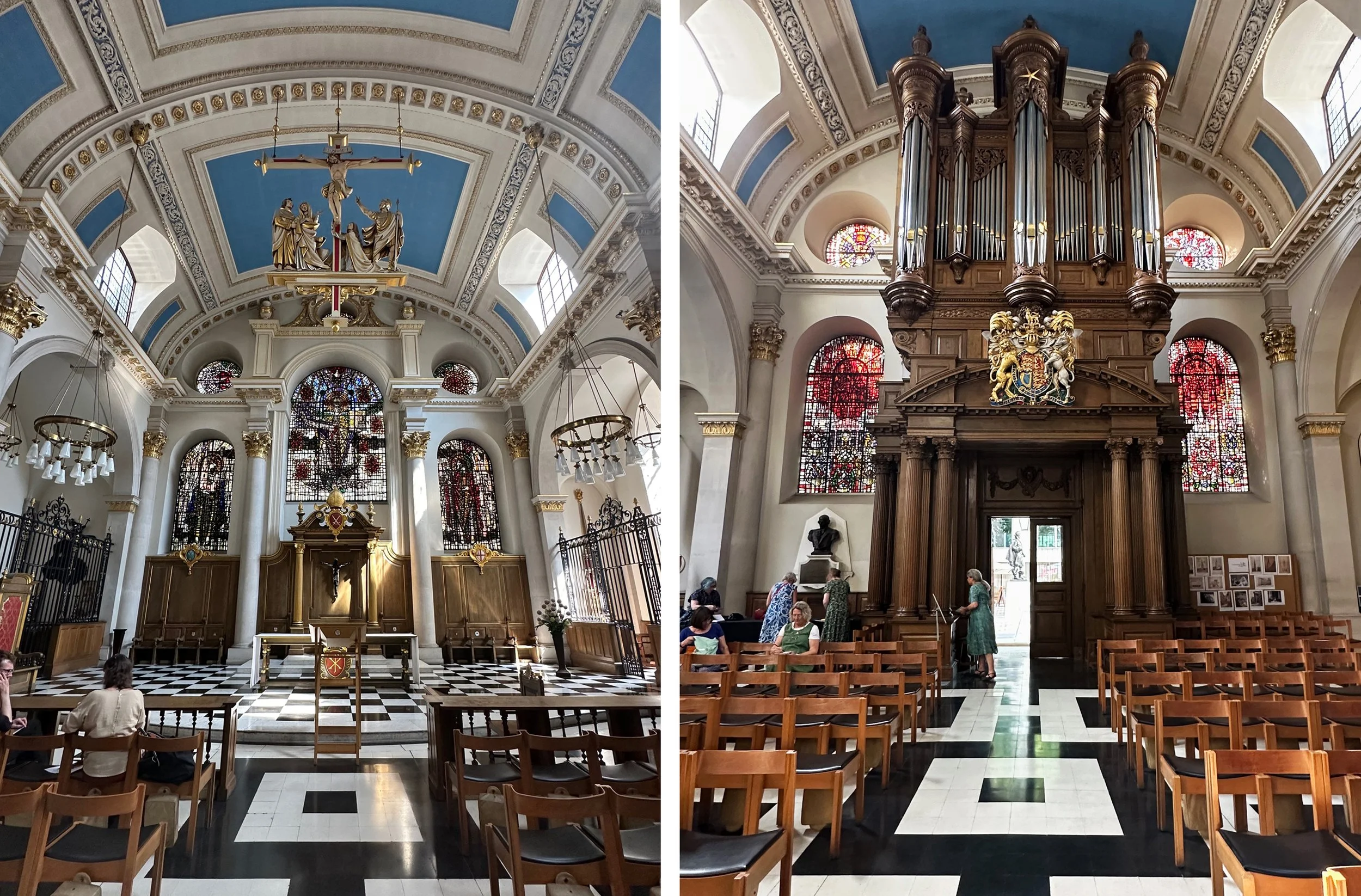
St Mary le Bow, east and west ends with windows and furnishings by John Hayward.


