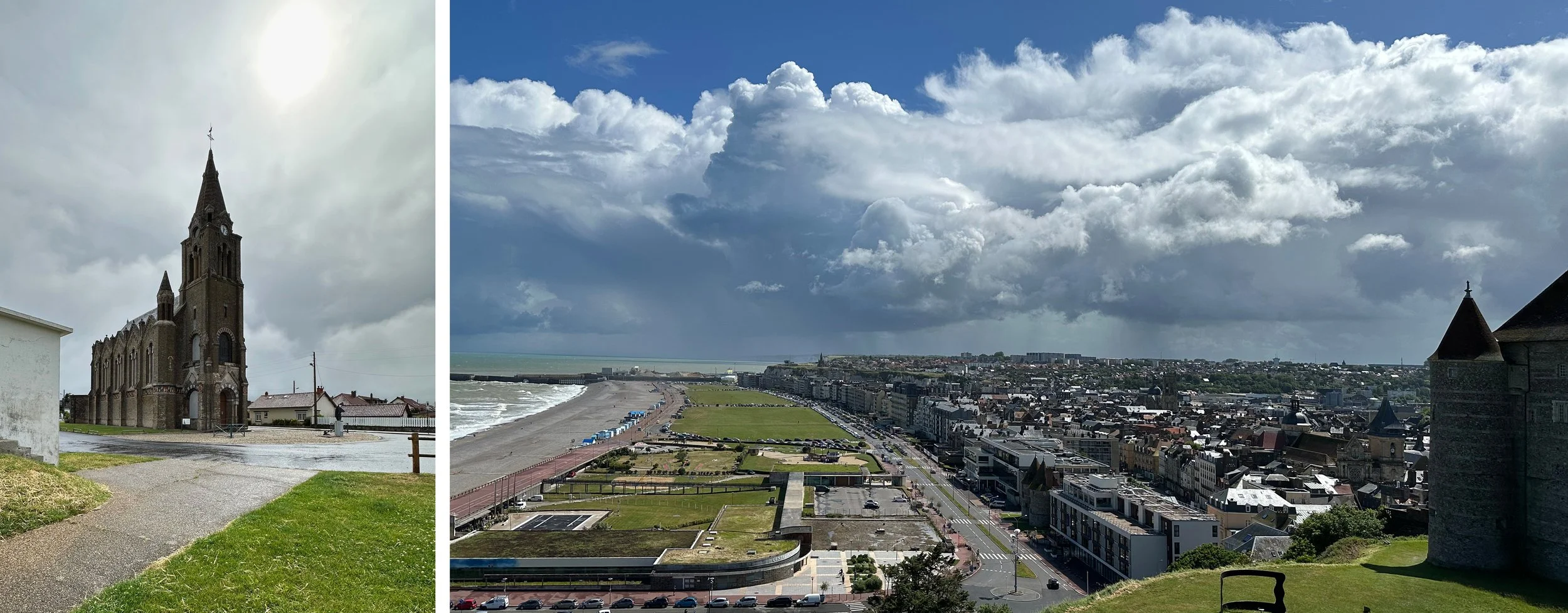
Left: Chapelle Notre Dame-de-bon-Secours. Right: View of Dieppe from the castle, the chapel is on the left horizon.
You see Notre-Dame-de-Bon-Secours as you come in to Dieppe on the ferry. Originally a chapel of pilgrimage for sailors who offered models of their boats to the Virgin Mary, it now also serves as a place for memorials to those lost at sea. It was suitably bleak outside on the rainy day that I visited, but inside all the windows were filled with the most lovely coloured stained glass from the 1950s - geometric patterns that fill every space. The symbols and figures are arranged seamlessly within this network, the female saints are on the left and the male saints are opposite them - everything is orderly and neat.
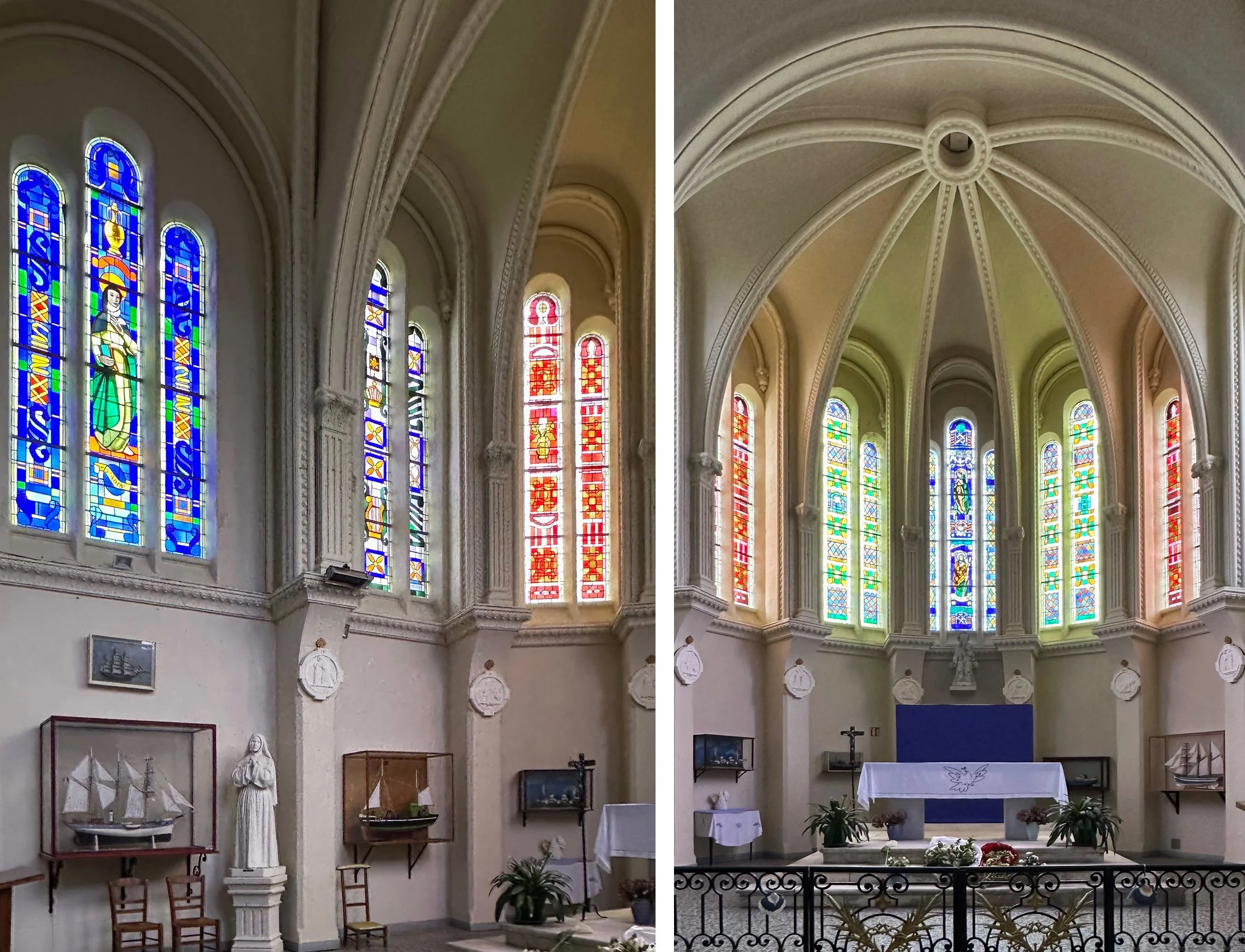
Interior of Notre Dame-de-Bon-Secours.
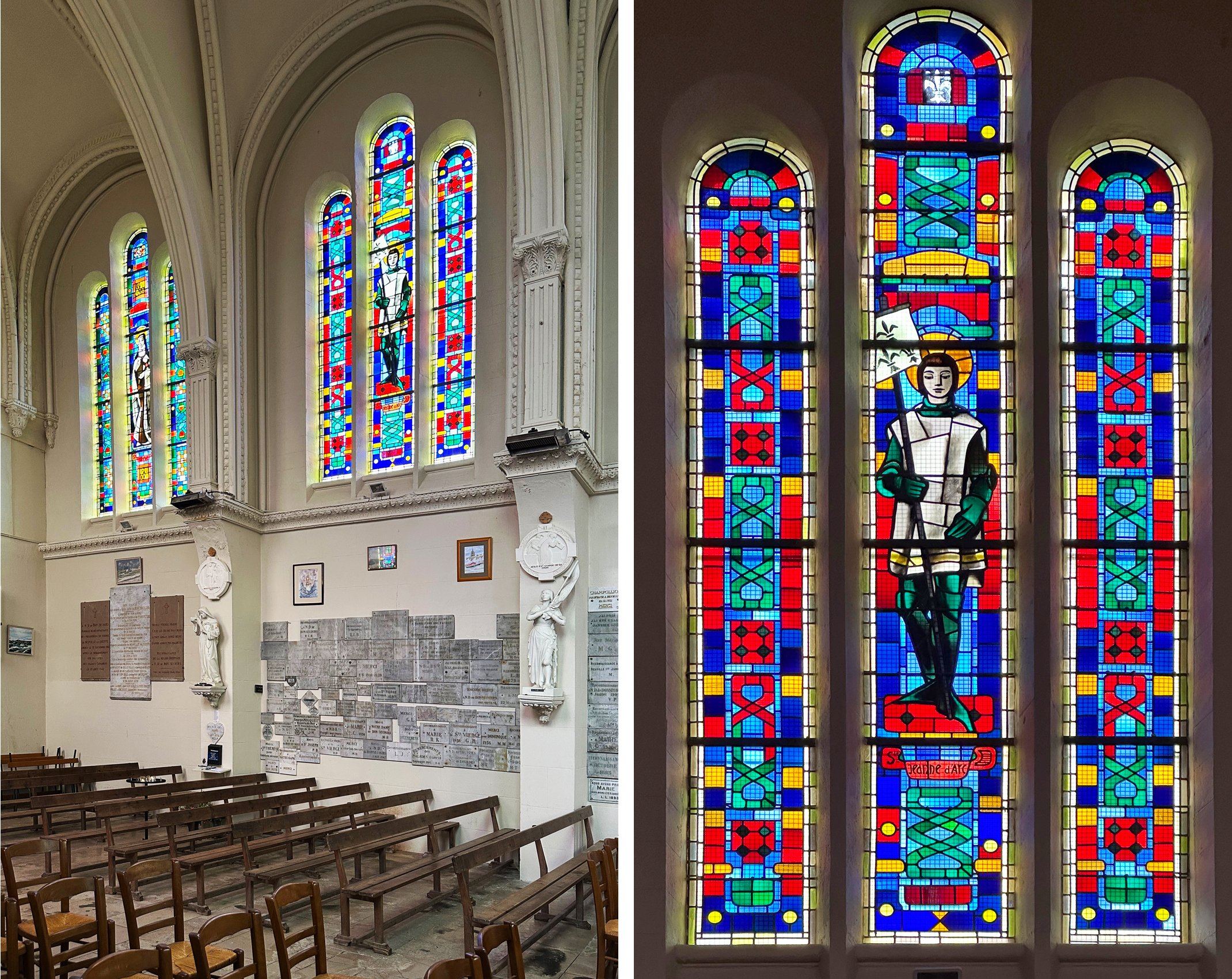
Notre Dame-de-Bon-Secours, interior with Joan of Arc window and wall memorial plaques.
Luckily there was a clear maker’s name and date on the window of the Virgin and child (below right) as I found no other information about the stained glass. The maker (maitre verrier) Francois Lorin is from the third generation of the famous family of stained glass makers in Chartres, where Maison Lorin was founded in 1869. These windows are dated 1951, they confirmed to me how interesting French post war glass is.
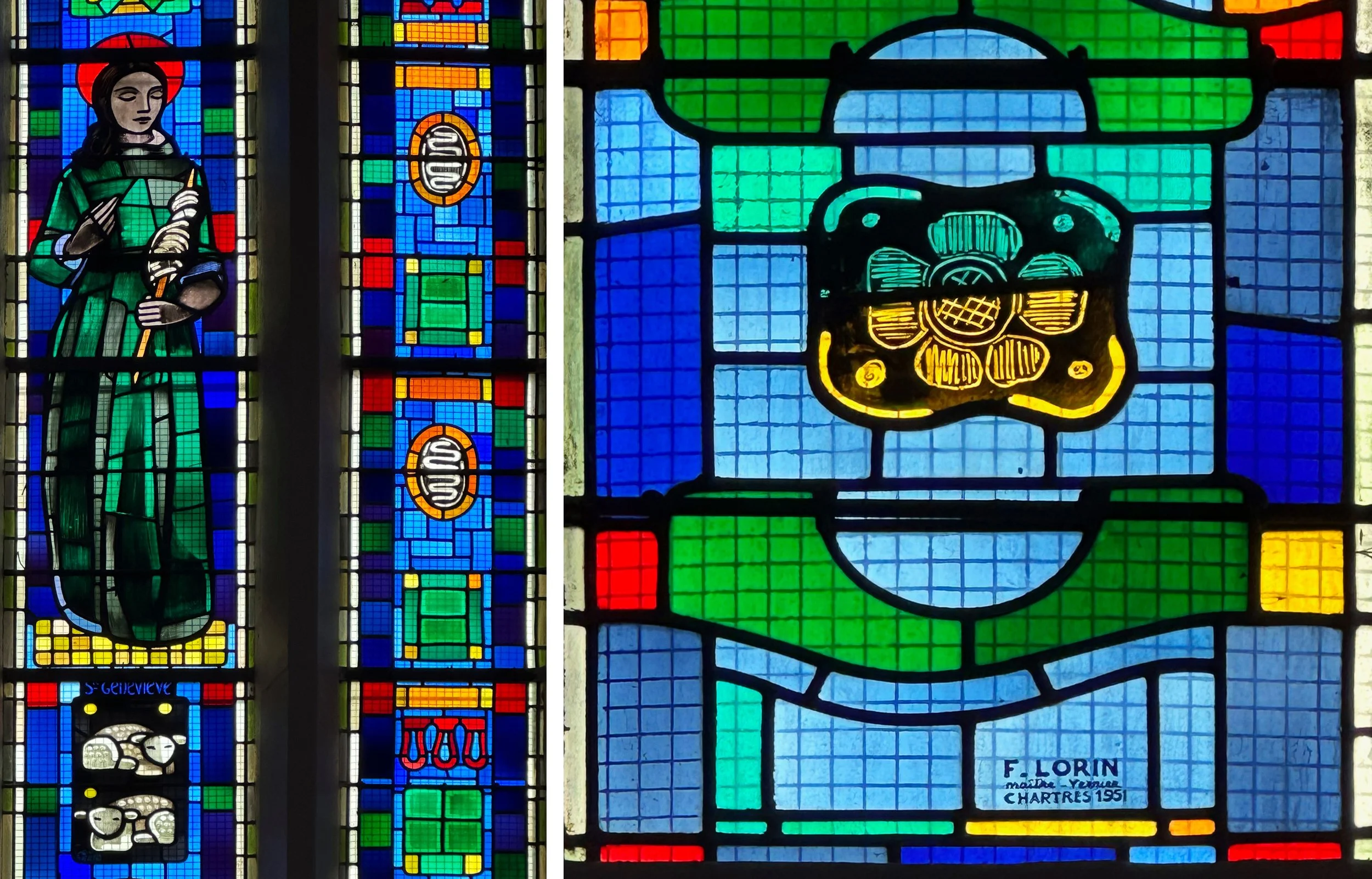
Notre Dame-de-Bon-Secours. Left: St Genevieve window. Right: Detail with maker’s name and date.
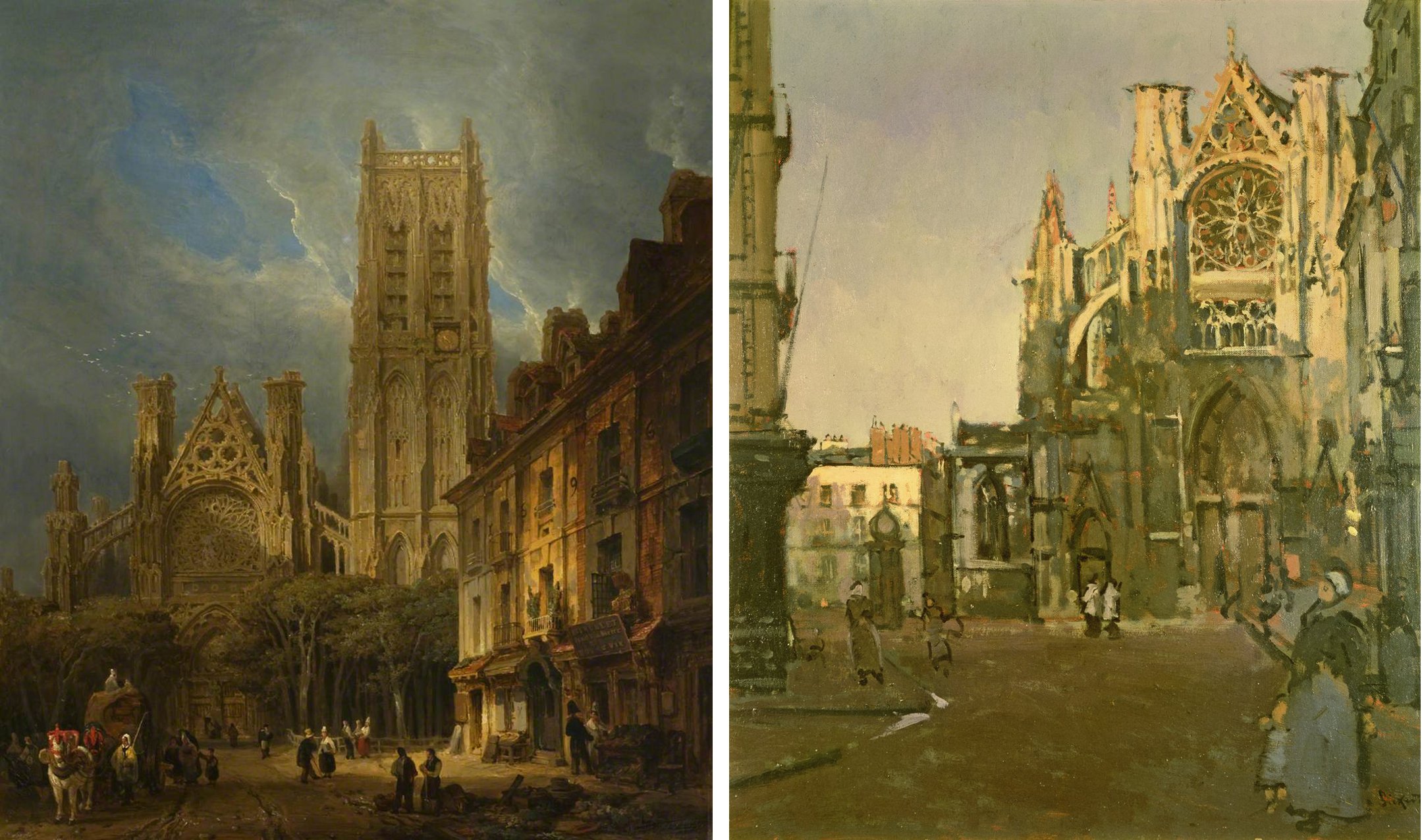
Left: The church of St Jacques, Dieppe by David Roberts 1826. Right: St Jacques Church by Walter Sickert c.1899.
This was the best type of unplanned stained glass trip, I had no idea what I would find inside the huge, much painted (examples above) Gothic church of St Jacques. In the fifteenth century its lower walls were opened up to accommodate chapels that were originally dedicated to the patron saints of their founders. There are nineteen altogether, with sculpture, paintings and stained glass made from the fifteenth to the twenty first century inside.
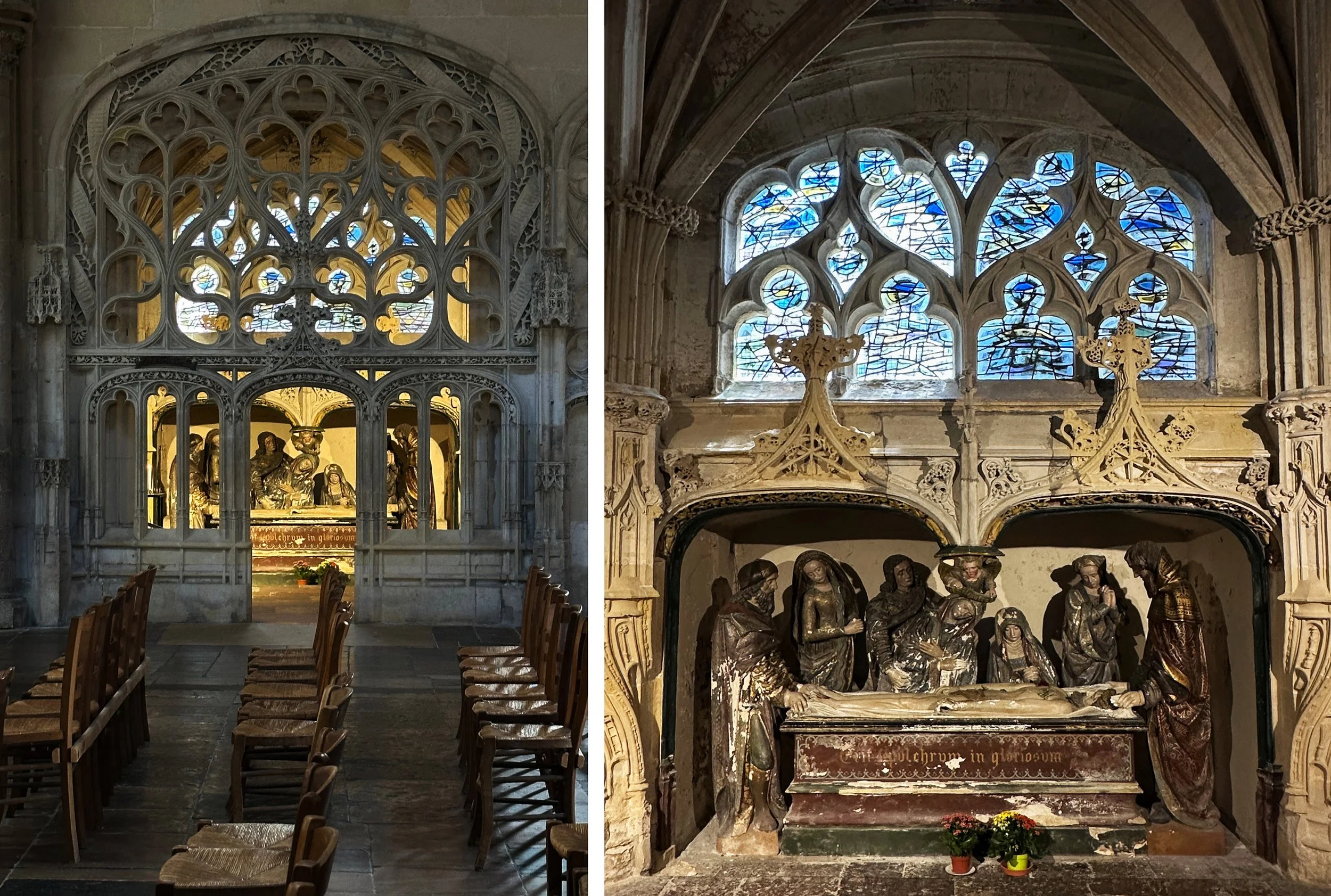
St Jacques Church, The Chapel of St Sepulcre with stained glass by Anne Le Chevallier 2000.
The first chapel on the right, dedicated to St Sepulcre, has a wonderful combination of gothic tracery, seventeenth century sculpture and modern stained glass. These fantastically light and subtle windows are the work of Anne Le Chevallier (born 1937) who joined the Le Chevallier studio founded by her father-in-law. They are dated 2000 but have the French post war sensitivity to grisaille painting and pure abstraction that complements this type of church architecture so well.
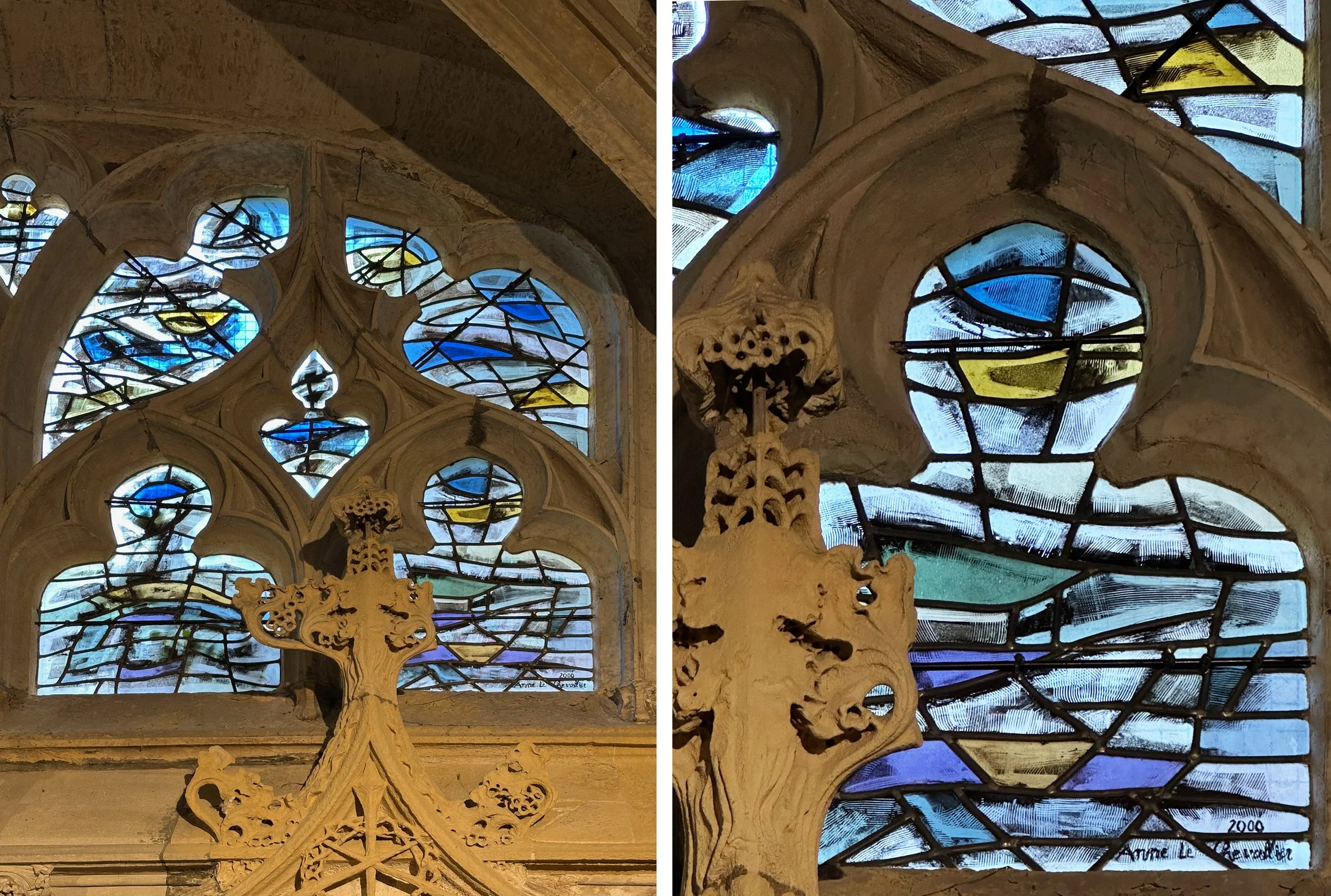
St Jacques Church, Detail of the Chapel of St Sepulcre with stained glass by Anne Le Chevallier 2000.
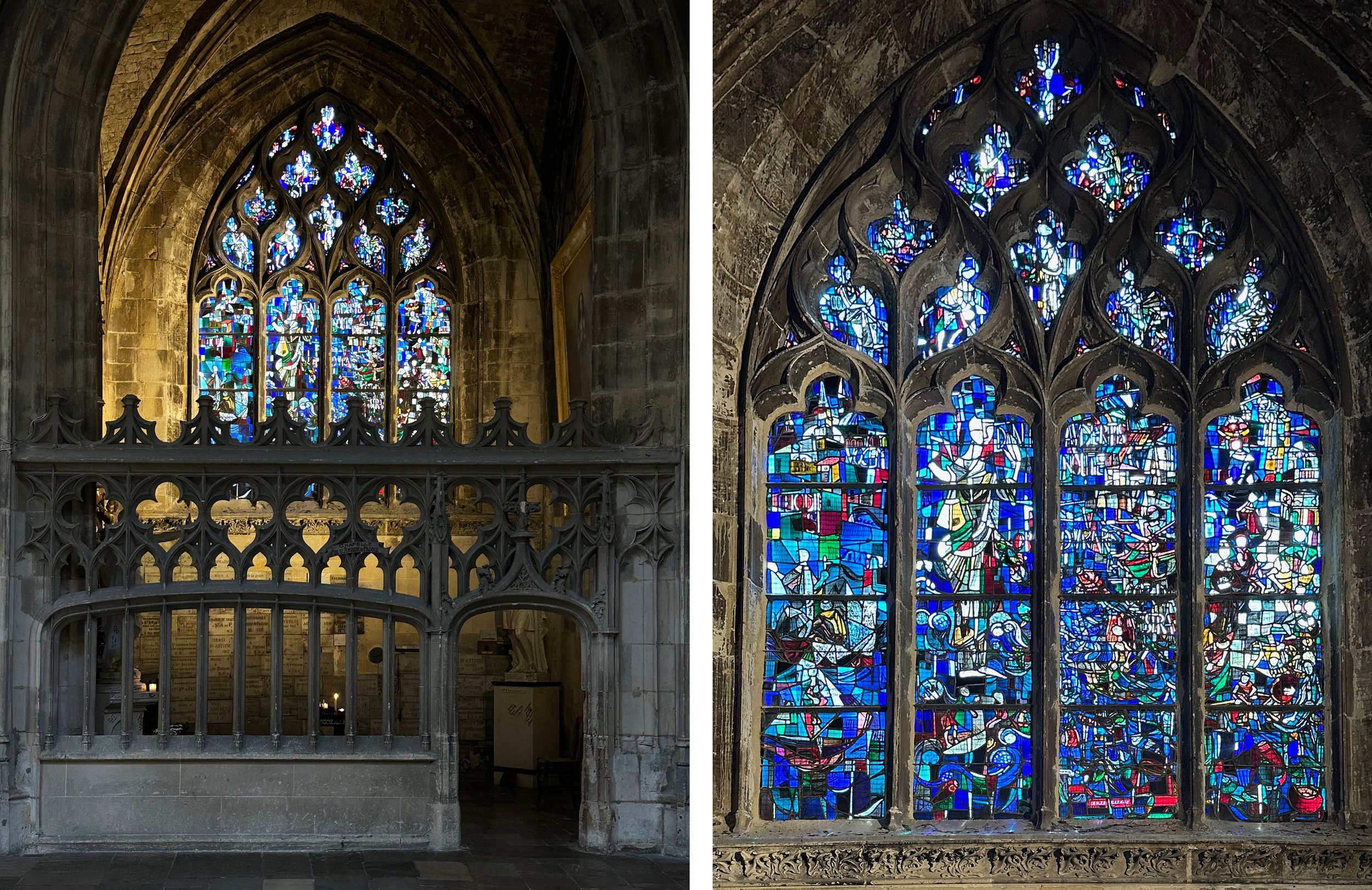
St Jacques Church, The Chapel of St Anthony of Padua.
The next chapel along, dedicated to St Anthony of Padua, contains a window that is a riot of colour, imagery and lettering with a strong blue background. In a different way this glass also perfectly complements the dark, gothic stonework. In it I can see boats, buildings and figures, but I’ve never seen anything similar to this obviously twentieth century work and the only information I can find about it is written on the bottom of the third opening - OFFERT PAR LE CLERGE, then a word on a piece of blue green flashed glass hidden by the stonework, then DES VERRIERE.
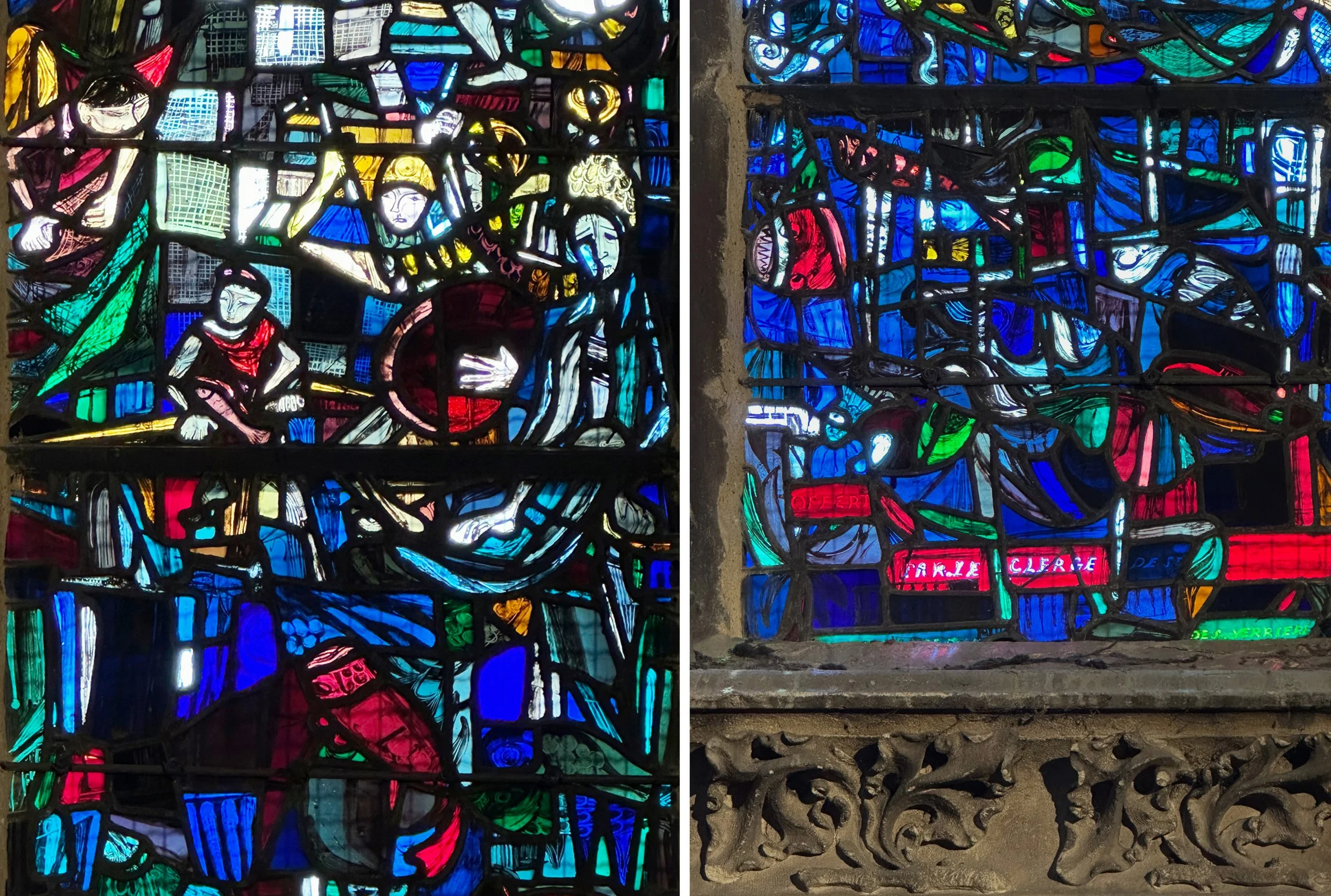
St Jacques Church, Detail of stained glass in The Chapel of St Anthony of Padua.
A more ornate chapel at the far end of the church is dedicated to St Yves. It contains the tomb of local hero and ship owner Jehan Ango (1480-1551), also a twentieth century painting and three windows which are attributed on the brief information board to Jacques Gruber (1870 - 1936). These are beautiful, delicate creations, with loose geometry and symbols in pastel colours surrounded by rich spiky borders that depict sea life. Quite unlike the stained glass that Gruber made for mansions and public buildings, they don’t fit in to either the art nouveau aesthetic or the post war revival of church stained glass.
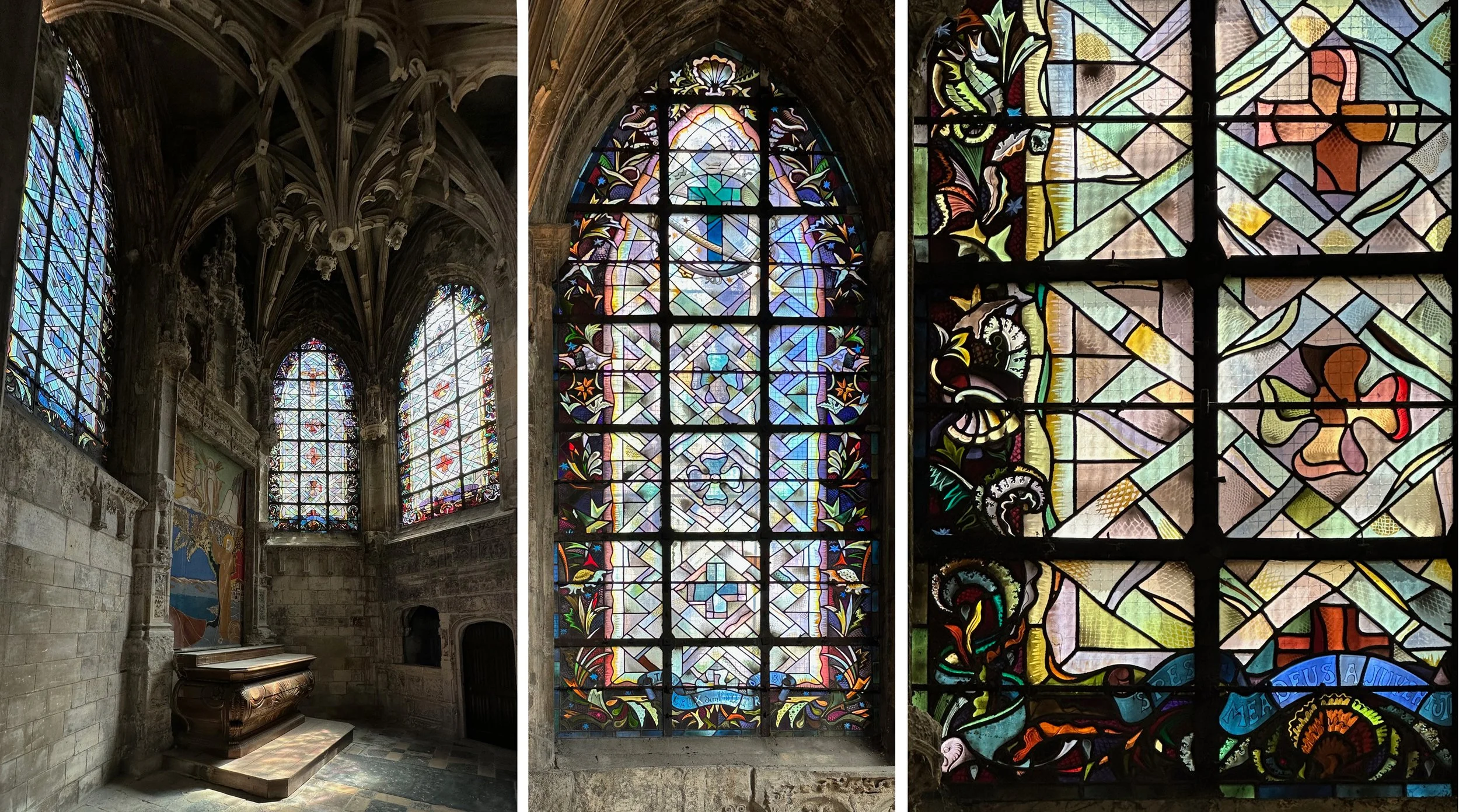
St Jacques Church, The Chapel of St Yves with stained glass by Jacques Gruber.
Finally, my first visit to see some French hospital art - six windows that were moved from the hospital chapel when it was demolished and reinstalled in the new reception area in 2007. They were designed in 1949 by the artist Pierre Le Trividic, a painter from the school of nearby Rouen, and commissioned to replace ones destroyed during World War II when thousands of Canadians died during the unsuccessful Allied raid on Dieppe. Stained glass was a new medium for Le Trividic, and his windows are a mixture of huge figures, crests and landscapes as he tells the story of the connections between Dieppe and Canada. It’s a cafe, but its carefully designed to show off the stained glass which has been given a new lease of life.
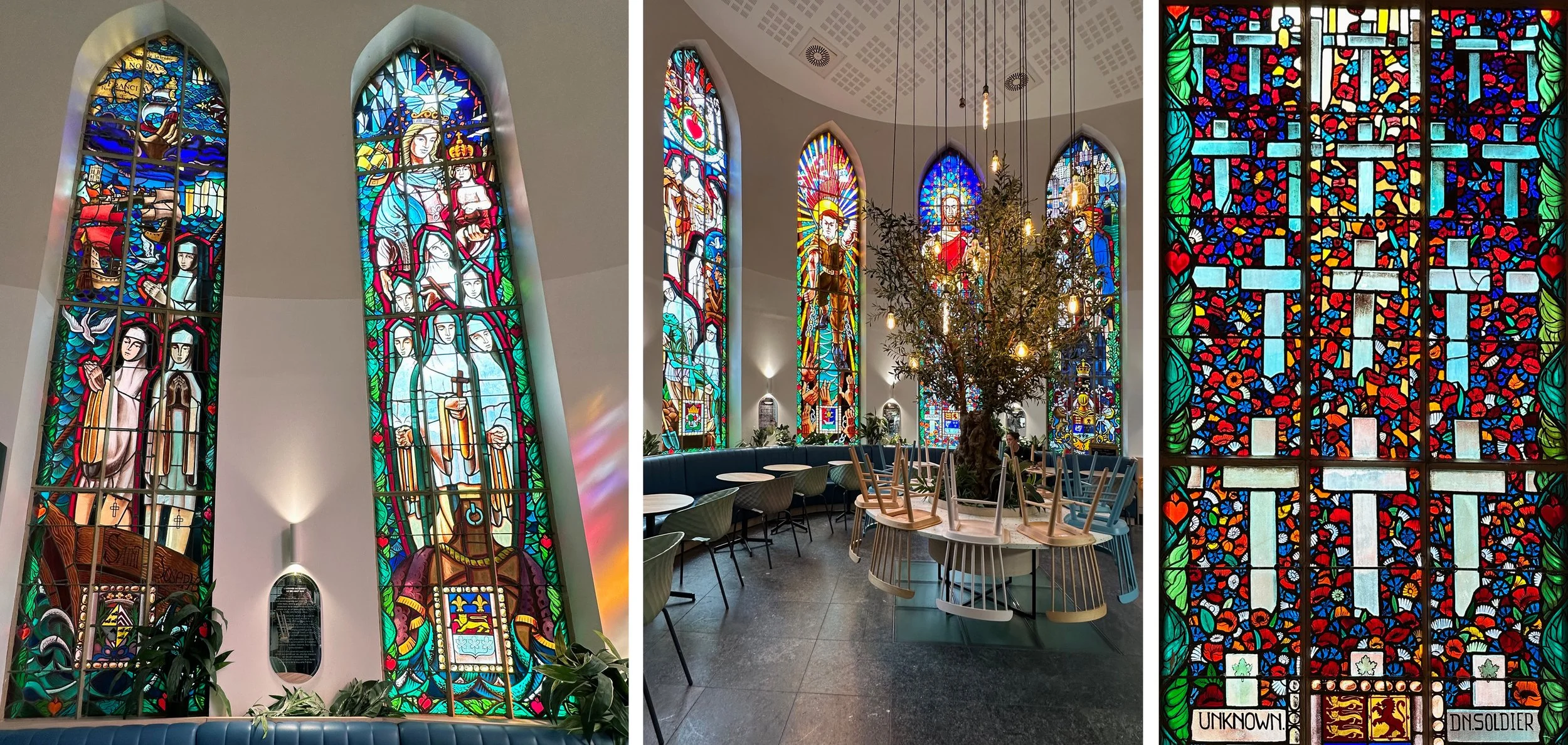
Dieppe Hospital: windows by Pierre Le Trividic 1949.