William Morris' bed curtains by Sasha Ward

The bed: My drawing of a caterpillar embroidered on the bedcover: One of the curtains.

The bed: My drawing of a caterpillar embroidered on the bedcover: One of the curtains.

I have been skirting around WM's imposing bed with the beautiful curtains and cover, placed provocatively between my favourite DGR drawing and Jane's embroidered version of it (see my earlier blog post). I have also admired the embroidered details on the cover by May and Jane of the river and of local flora and fauna in an observational style.

The design of the curtains is linked to WM's trellis wallpaper, but their style has always reminded me of the 17th century crewel work curtains by Abigail Pett in the V&A Museum. In a time when most of our art book illustrations were in black & white, I used to go to the V&A for children's Saturday sessions. I have never forgotten the name of Abigail Pett - a rare non anonymous woman. I have also continued to find inspiration in textiles, carpets, printed sources and all manner of decorative arts, as William Morris did. My first glass commission for a public building (Lansdowne Hospital in Cardiff, still in the black & white era), shows the same influences I think - the birds were drawn from my stamp collection.

Above: Abigail Pett's curtains in the V&A. Below left: A favourite book. Below right: My first public commission.
Above: Abigail Pett's curtains in the V&A. Below left: A favourite book. Below right: My first public commission.


Airbrushing by Sasha Ward

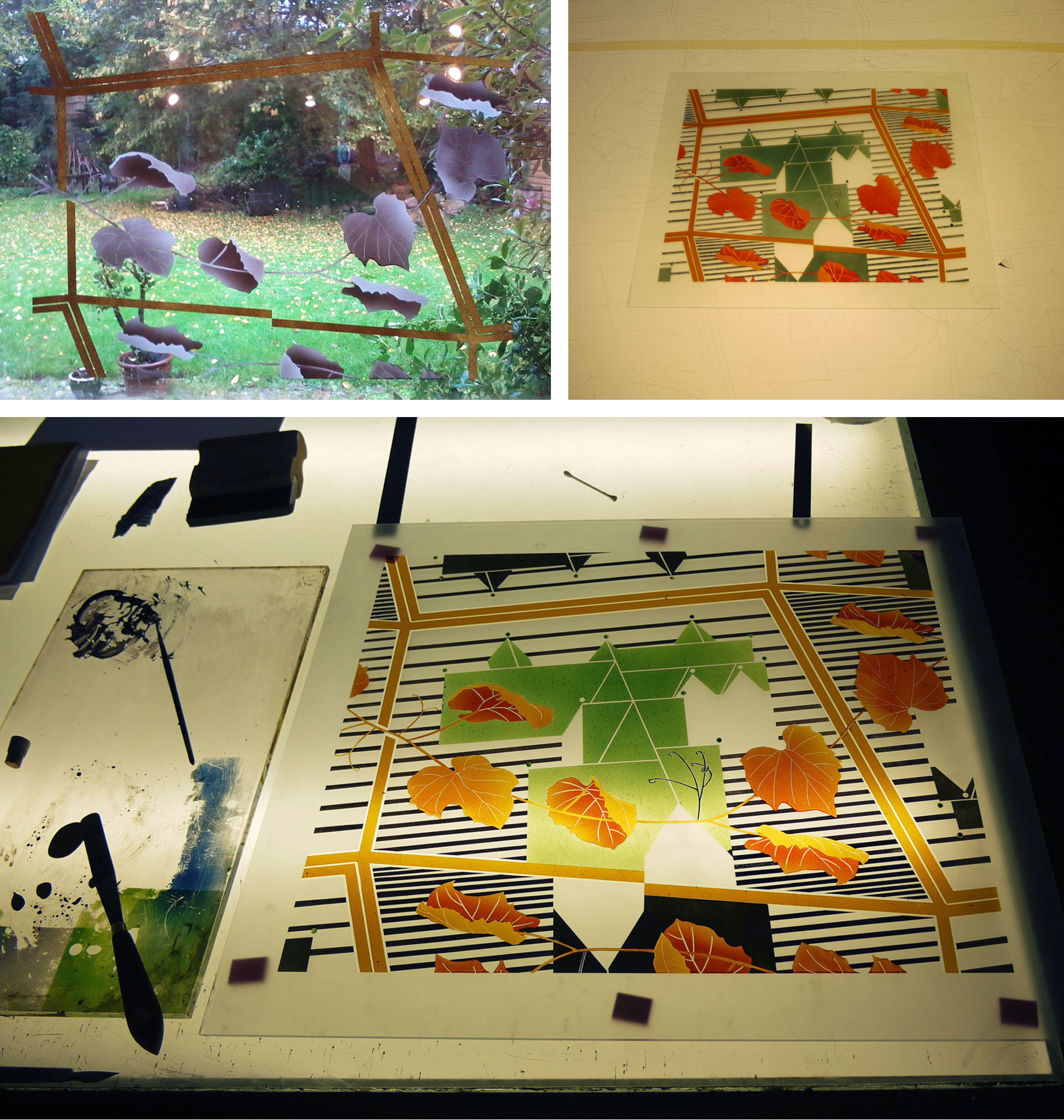
The glass version of Kelmscott Design Number Two has taken a long time to finish, but here it is in my studio in Marlborough. Top left: first enamel layer before firing. Top right: completed and laid out on a tracing of the wallpaper version. Below: backlit and ready to be fired. This design is also a repeat, it's an irregular quadrilateral that rotates.

leaves 2.jpg

My renewed interest in airbrushing - and possibly also in the brown and yellow combination mentioned previously - comes from last year's project for Airbus in Bristol. This was the restoration of a magnificent window made in 1936 by Jan Juta for the headquarters of The Bristol Airplane Company. Working with Creative Glass in Bristol, we remade seven broken panels, including the huge one with the propellor and the one with the compass, both shown below. The blocks of colour and the thin strips of clear and etched glass in combination with small areas of airbrushed detail have crept into my new work subconsciously.

The chestnut tree by Sasha Ward

The southern boundary of Kelmscott Manor is bounded by water, the Radcot Cut, not the River Thames as some visitors presume - see map above to clear up any confusion. The Cut provides a lot of excitement; in April a champagne bottle was dredged from the mud and dated to the 1860s-70s, and in August a huge horse chestnut tree fell with a crash in to the water.

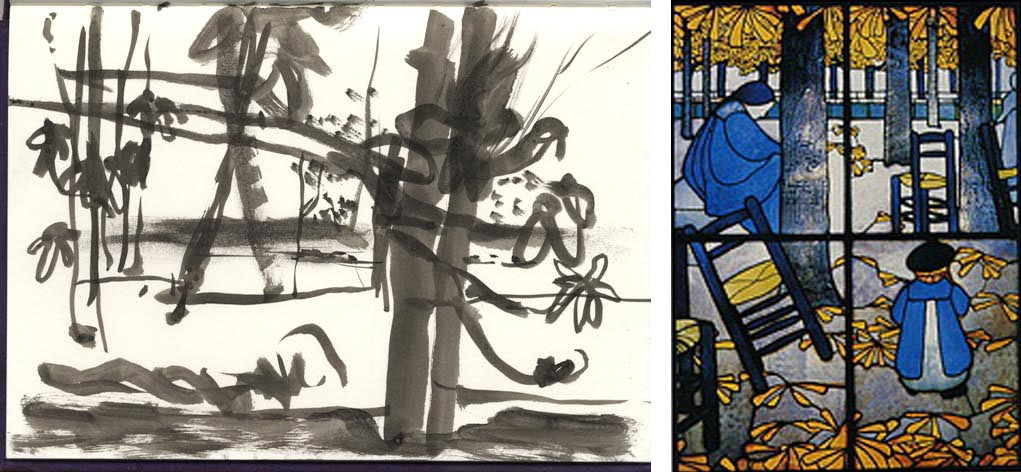
Now the living half of the tree is flowering in the water and circled by the rooks who live in it, the dead part will be taken away soon. The view through the chestnut trees to the field, the river and the woods beyond is a favourite spot and has been reminding me of a stained glass panel by Kerr-Xavier Roussel, below right. This is from a series of 13 panels designed by French artists and made by Louis Comfort Tiffany; Vuillard's design also featured chestnut trees but his stained glass panel is now lost.

Left: one of my drawings from the cut. Right: Garden by Roussel, 1894.

Left: one of my drawings from the cut. Right: Garden by Roussel, 1894.

Peepholes by Sasha Ward

Temporarily installed in the small window in the Brewhouse is a wallpaper and glass version of my Kelmscott design 1 (above). You can see how this links to my playhouse project below: a  house in the courtyard before decoration, and a view of the interior with block printed paper and acetate windows (below). The houses are supposed to look rough on the outside and full of pattern and colour when you are inside.

Although the point of my residency is not to have fun, the playhouses are the fun part. I have spent some time rearranging the window panels to get some sense of order, we need more striped designs as these work best with the wallpaper strips. Kizzy Jones (below left) sensibly brought her sketchbook full of designs to work from and her friend Eden Oakley-Shaw (below right) did the gorgeous window on the far right below. Incidentally not all these works are by children.

Coln Valley trip by Sasha Ward

The River Coln In Fairford, in a Fairford field, Bibury appreciates WM in return.

The River Coln In Fairford, in a Fairford field, Bibury appreciates WM in return.

In a letter to Kate Faulkner written in August 1890, William Morris described a trip up the valley of the River Coln from Fairford to the Roman Villa at Chedworth.  Today I followed his path through Quenington, Coln St. Aldwyns, Bibury, Ablington, Winson, Colne Roger, Colne St. Dennis and Fosse Bridge. I had remembered the enticing descriptions in his letter:

"Bibury is surely the most beautiful village in England".

"The whole valley is a mass of lime-stone, and looks indeed as if it had been made for people 4 ft. high; but small as the scale is, it is most lovely".

His day ended with "Dinner of cold scran at Fosse Bridge", as Lord Eldon would not let them in to see the mosaics pavements at Chedworth.

My trip also ended at Fosse Bridge as I ran out of time after visiting churches along the route. Three very different windows, fantastic in the autumn sunshine at St. Mary's Bibury. 

Inside St. Mary's, Bibury: window by Karl Parsons 1927, C13th grisaille glass, windows added to church in C15th.

Inside St. Mary's, Bibury: window by Karl Parsons 1927, C13th grisaille glass, windows added to church in C15th.