Peepholes by Sasha Ward

Temporarily installed in the small window in the Brewhouse is a wallpaper and glass version of my Kelmscott design 1 (above). You can see how this links to my playhouse project below: a  house in the courtyard before decoration, and a view of the interior with block printed paper and acetate windows (below). The houses are supposed to look rough on the outside and full of pattern and colour when you are inside.

Although the point of my residency is not to have fun, the playhouses are the fun part. I have spent some time rearranging the window panels to get some sense of order, we need more striped designs as these work best with the wallpaper strips. Kizzy Jones (below left) sensibly brought her sketchbook full of designs to work from and her friend Eden Oakley-Shaw (below right) did the gorgeous window on the far right below. Incidentally not all these works are by children.

Coln Valley trip by Sasha Ward

The River Coln In Fairford, in a Fairford field, Bibury appreciates WM in return.

The River Coln In Fairford, in a Fairford field, Bibury appreciates WM in return.

In a letter to Kate Faulkner written in August 1890, William Morris described a trip up the valley of the River Coln from Fairford to the Roman Villa at Chedworth.  Today I followed his path through Quenington, Coln St. Aldwyns, Bibury, Ablington, Winson, Colne Roger, Colne St. Dennis and Fosse Bridge. I had remembered the enticing descriptions in his letter:

"Bibury is surely the most beautiful village in England".

"The whole valley is a mass of lime-stone, and looks indeed as if it had been made for people 4 ft. high; but small as the scale is, it is most lovely".

His day ended with "Dinner of cold scran at Fosse Bridge", as Lord Eldon would not let them in to see the mosaics pavements at Chedworth.

My trip also ended at Fosse Bridge as I ran out of time after visiting churches along the route. Three very different windows, fantastic in the autumn sunshine at St. Mary's Bibury. 

Inside St. Mary's, Bibury: window by Karl Parsons 1927, C13th grisaille glass, windows added to church in C15th.

Inside St. Mary's, Bibury: window by Karl Parsons 1927, C13th grisaille glass, windows added to church in C15th.

Should signatures be legible ? by Sasha Ward

The pale colours of the completed signatures panel look beautiful in front of the restricted light in the Brewhouse window, but it is difficult to see the lettering - incised with a diamond stylus then blackened with grate polish. Also, some people's signatures are not legible, maybe that's the point of them.

Above is a list of the names that I can read (without any of the additional comments, dates etc.) arranged in the blocks as they are in the panel. Illegibility is represented by ……… , and below are photographs, mostly in reflected light,  showing the dotted sections. If you signed, you should be able to find your name, click on any of the pictures to enlarge it.

The clump by Sasha Ward

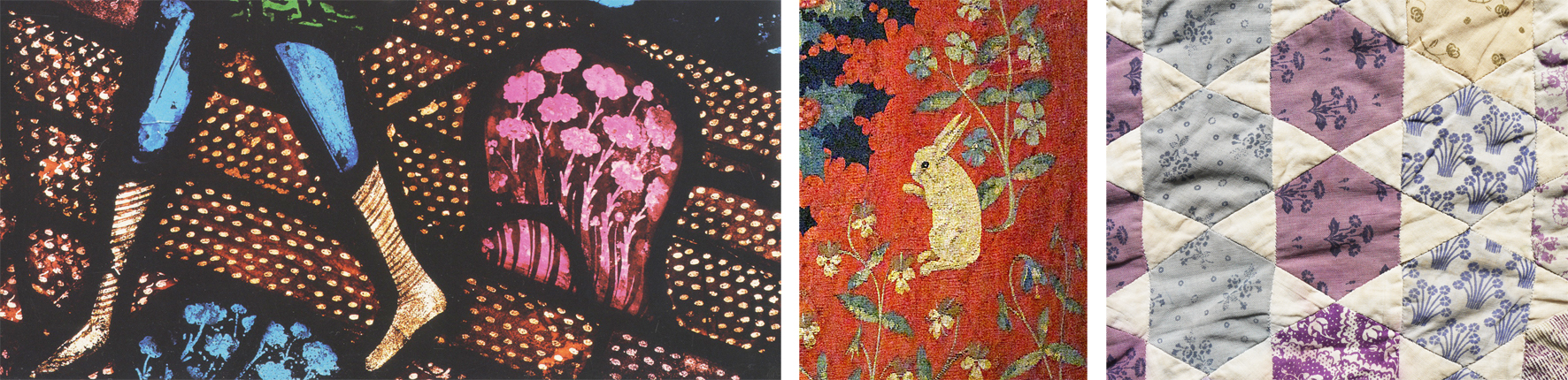
Details from: The Sower, Canterbury Cathedral, C12th: Lady & The Unicorn Tapestry, Flanders C16th: my Laura Ashley patchwork quilt, 1975.

Details from: The Sower, Canterbury Cathedral, C12th: Lady & The Unicorn Tapestry, Flanders C16th: my Laura Ashley patchwork quilt, 1975.

The clump of flowers motif is found in many of my "favourite" items: the weeds, spots and stripes in the stained glass at Canterbury Cathedral, the background to the tapestries in The Cluny Museum in Paris and the Laura Ashley scraps that I made my patchwork quilts from. 

But the best example has got to be on the serge curtains stitched by William & Jane Morris in 1860 and hanging in the hall at Kelmscott Manor. The stitches are huge and the colours dramatic, each clump (below right) is about 300 mm. tall.

Above is my first drawing inside the Manor, drawn with great excitement in front of the serge curtains, with a  glimpse of the treasures beyond. These are a 1925 tapestry by JH Dearle (Art Director for Morris & Co. from 1896) hanging next to a black & white and a coloured design for the piece. 

JH Dearle tapestry: detail of tapestry: my copy of two clumps from Dearle's black & white design.

JH Dearle tapestry: detail of tapestry: my copy of two clumps from Dearle's black & white design.

This "millefleurs" tapestry uses the clumps not as background filling or a border around figures - as in many Morris tapestry and stained glass designs - but as an overall small scale pattern (clumps about 120 mm. tall). There are about twelve different types of flower closely packed together with just a dark narrow border around the edge. Close study of the clumps reinforces a fact I particularly like, that these plants were not necessarily drawn from nature.

Glass collection by Sasha Ward

Enamelled glass vessels in the V&A: by Karel Vanura 1959, Francois Eugene Rousseau 1878, Ludwig Sutterlin 1904.

Enamelled glass vessels in the V&A: by Karel Vanura 1959, Francois Eugene Rousseau 1878, Ludwig Sutterlin 1904.

Where could I go for tips on painted glass vessels but the glass gallery at the V&A ? I liked the flower goblets for the shape of the painting, the fish vase for the fine detail, and everything about the vessel on the left by the Czech artist Karel Vanura.

At home I have my own glass gallery, including a set of beakers, below right. From the sets I find in charity shops I keep one on the shelf and use the others - I prefer the feel of the small thin ones in my hand. I'm just at the stage of experimenting with enamels on old jars, bottles and beakers for a range of glassware that will use my Kelmscott shapes with inspiration from Karel Vanura.

Some of the first tests and part of my collection of beakers.

Some of the first tests and part of my collection of beakers.