Eaton Hastings by Sasha Ward

WM commented on the church of St. Michael and All Angels at Eaton Hastings as being a companion in size and layout to those at Buscot and Kelmscott. Looking across the river from Kelmscott Manor, you can see the clump of trees surrounding the church, but it's a winding walk away because of the bridges over the Thames.

Inside are interesting windows, and a tasteful interior as the cushions and kneelers are in the same jade green as the glass borders. I like the white/green and green/white reversal in the first two windows above, and I love the little piece of C18th painted glass above right.

Below are the windows from Morris & Co in the church. Left to right; Christ from a design by EBJ (1877), St. Matthew from a design by EBJ (1872-4), St. Michael by FMB surrounded by angels and Saints Raphael and Gabriel designed by WM but not made until 1935.

eh1b.jpg

Early stained glass by Sasha Ward

My 1977 sketchbook                              Four versions of "Kelmscott: design 1"

My 1977 sketchbook                              Four versions of "Kelmscott: design 1"

When I put my four new glass panels (all versions of Kelmscott: design 1) on the mantlepiece in The Brewhouse yesterday, I was reminded of the first stained glass panel I ever made. I had seen the design for it in my old school sketchbook, on a page after the one about Giotto who was my favourite artist at the time and what I call a real Pre-Raphaelite.

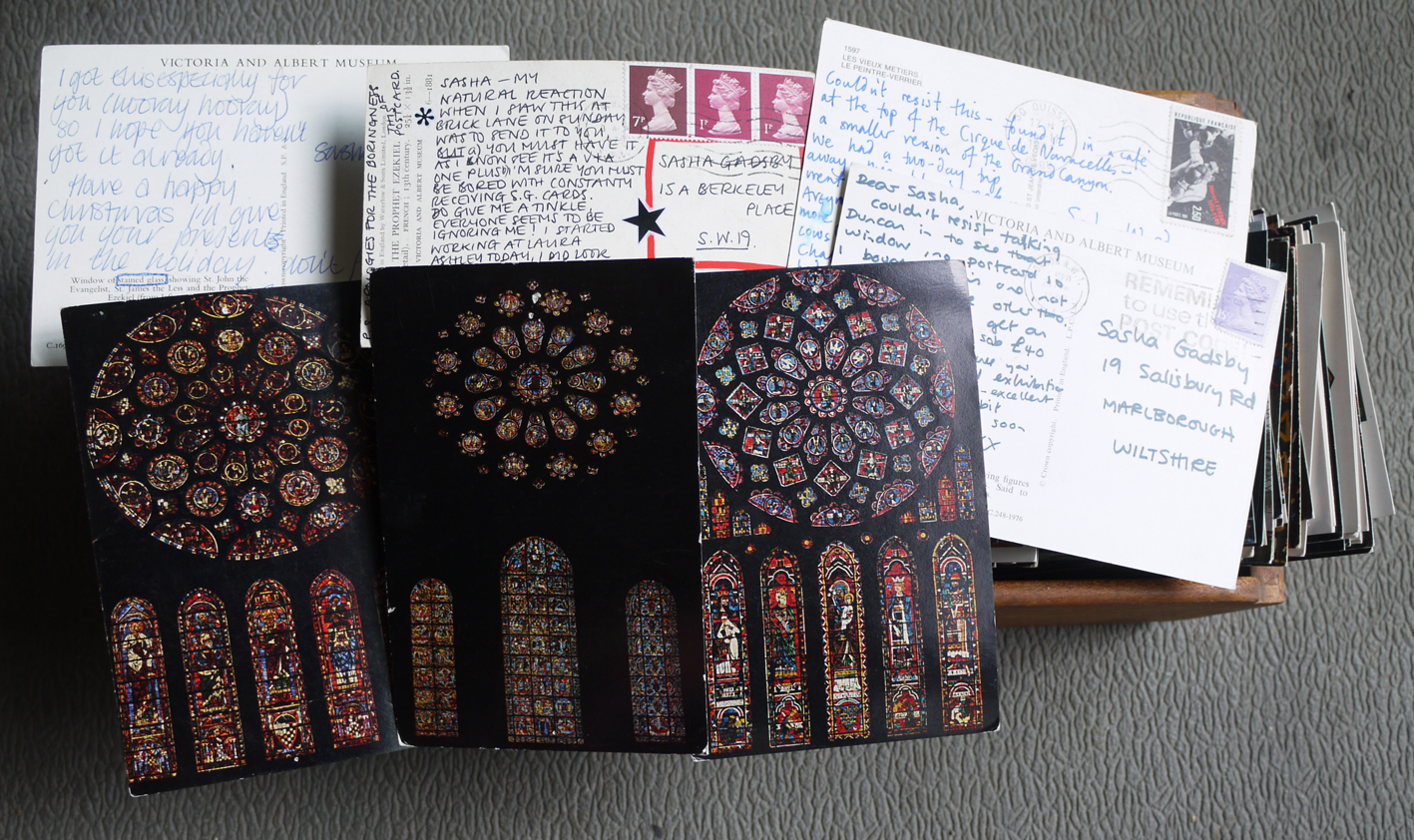
Another frequently asked question from my visitors is "What triggered my interest in stained glass?" I know this was the three postcards of windows in Chartres Cathedral that started off my stained glass postcard collection, shown below. The bits I like best now are the messages on the back from my oldest friends.

P.S. I would love to receive more, address still as on the right in the photo, postcode SN8 4AD.

Frequently asked questions by Sasha Ward

On The Brewhouse wall I have written a list of answers to frequently asked questions; this is not because I am too grumpy to speak to people, but sometimes I am out. The technical questions are quite straightforward, the very frequent one that I am still struggling to answer is "What is an artist in residence ?"

I can describe - in this blog - what I have been doing at Kelmscott Manor, and emphasise that I am not actually living here, but I don't think that's the right answer. I do have a quote from the will of May Morris, bequeathing the Manor to Oxford University in 1926 with certain conditions.

"The condition of the bequest is that the house should be used by the university not to be let for profit, but as a rest-house for artists, men of letters, scholars and men of science, whether for shorter or longer periods". 

As you know, I am very anxious to please May, the quote is going on the wall and I'm hoping that will do the trick (despite the unfortunate "men of...." wording). 

Peacocks by Sasha Ward

One of WM's peacocks                                                         Drawing by Millie, aged 5

One of WM's peacocks                                                         Drawing by Millie, aged 5

I have been asking people to draw something they like in the Manor and William Morris' pair of peacocks keeps coming up. Millie's superb drawing (above) is from observation, the other three are from memory and, in my view, all great in their own way.

Drawings by Mabel (5), Lara (5), Steff (8)

Drawings by Mabel (5), Lara (5), Steff (8)

The blocks made during our wallpaper printing workshop last Saturday featured two separate peacock designs. You can see them inside the playhouse we made, in orange on the right and in blue on the left, below.

playhouses.jpg

Old sketchbooks again by Sasha Ward

Three drawings of WM on his deathbed by CFM, dated 3rd, 3rd & 4th October 1896.

Three drawings of WM on his deathbed by CFM, dated 3rd, 3rd & 4th October 1896.

In William Morris' bedroom at Kelmscott Manor there is a pencil drawing of him by Charles Fairfax Murray who was there when he died in 1896. Looking at pages from my 1995 sketchbook below, you can probably see why it reminded my brother of the drawings I did at our father's deathbed in St. George's Hospital, Tooting. It's not the facial features that are similar, it's the pose or something more profound. As my fourth drawing in particular shows, I was fascinated by the "life support" and monitoring apparatus.