Hayle

Bathroom Window by Sasha Ward

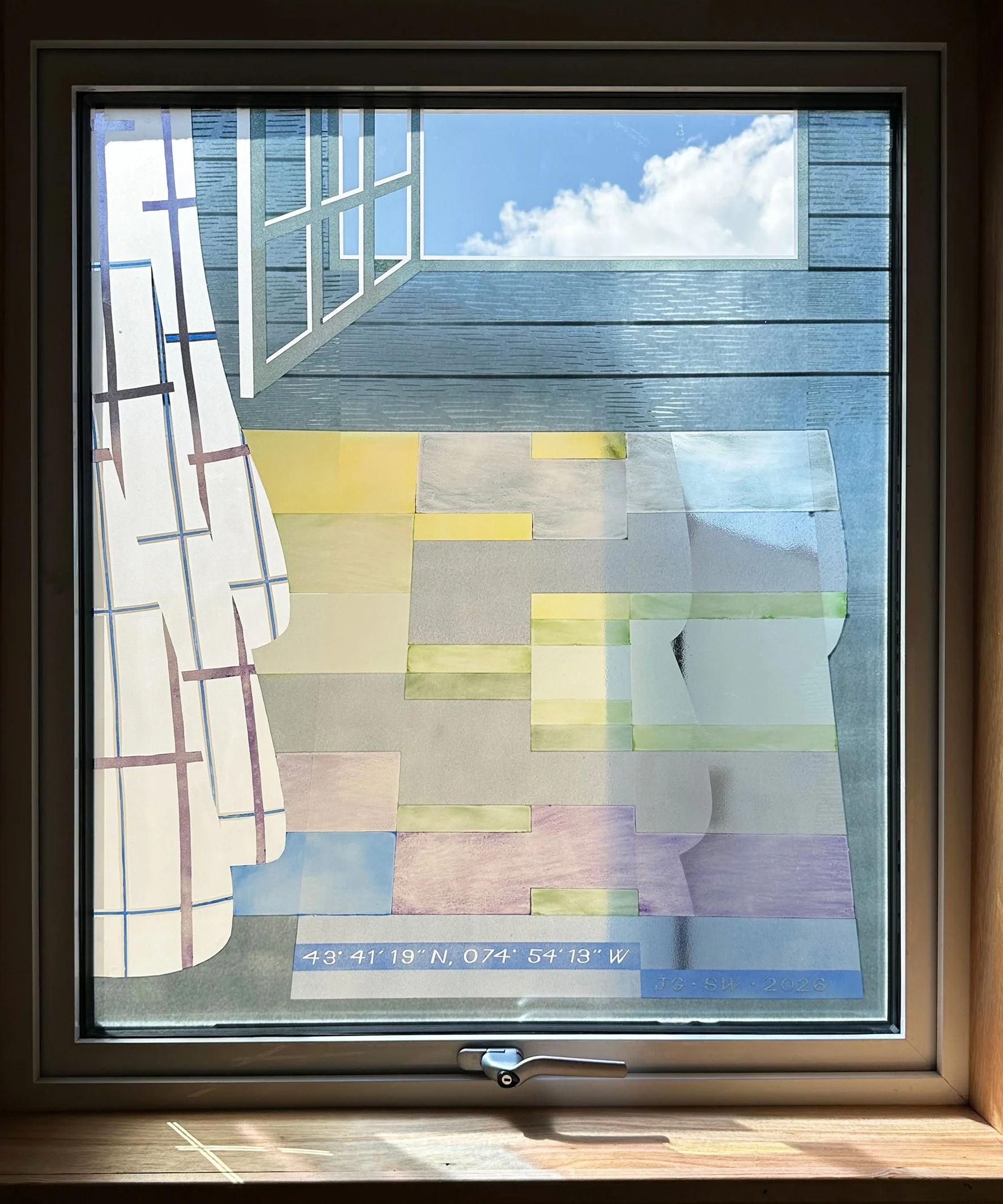
Bathroom window, 881 × 786 mm. The grid reference at the bottom is for a wooden cabin in the Adirondacks.

A bathroom window is the perfect spot for a glass commission. Usually you need to block the view for passers-by outside but with this solution you also get to see some of the outside world, here it’s the quickly changing sky as it passes over the sand dunes and estuary in Hayle, Cornwall. Because of the damp air in a bathroom, the enamelled surface of the glass has to be sealed inside the double glazed unit and because I was wary of making the room too dark I used only pale, watered down colours with opacity coming from sandblasted areas of glass.
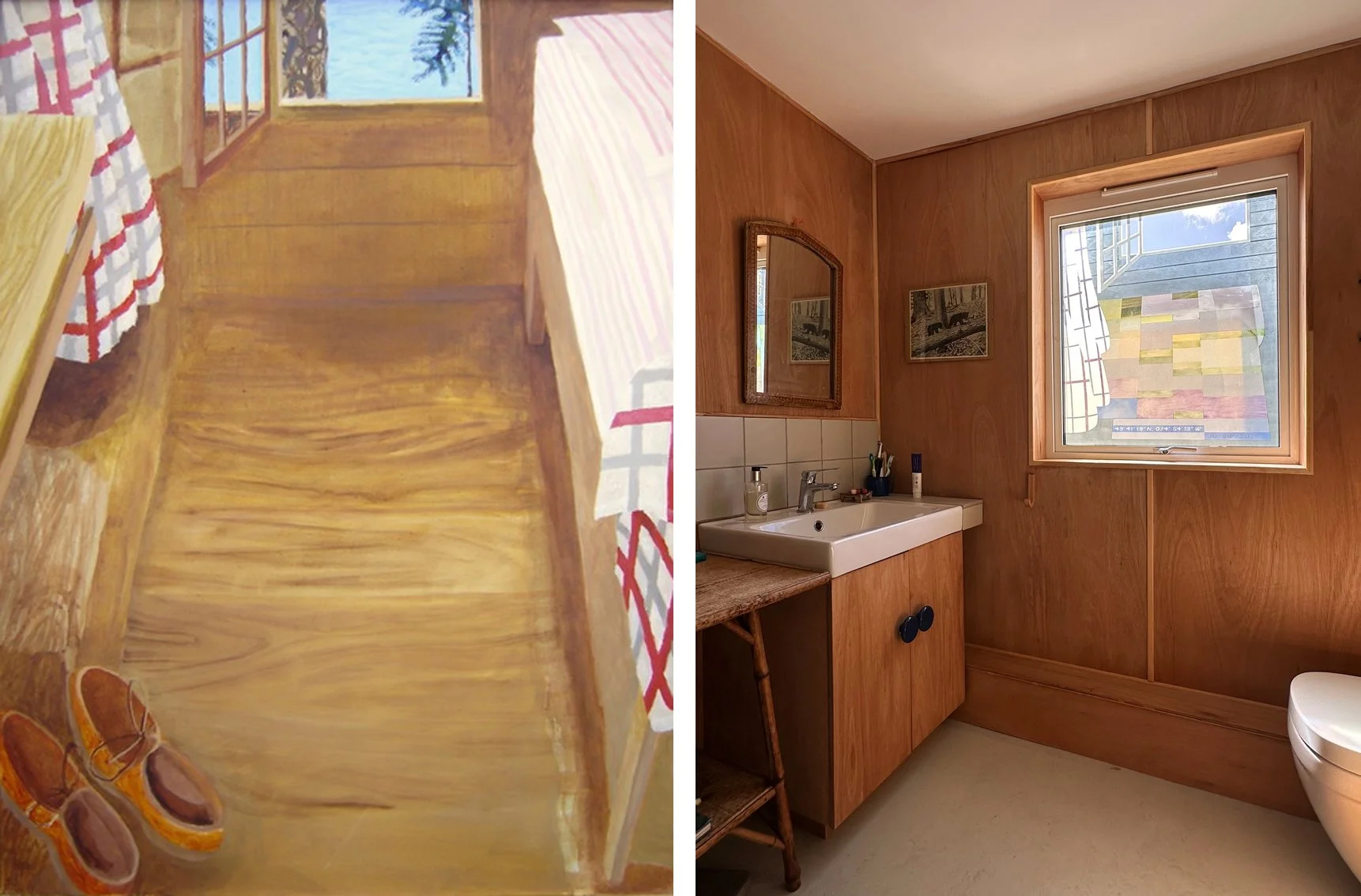
Left: Painting of the cabin in the Adirondacks by Juliet Goodden, 1982. Right: Bathroom in Hayle.

Two months ago in a blog post called Postcard from the Past I described my struggles with the concept for this commission, which was based on a painting by Juliet Goodden of her family’s wooden cabin in the Adirondacks, New York State (above left). The interior of her new bathroom (above right) is also based on memories of the cabin, so my final design is not a copy of the painting (it’s proportions are different for a start) but is one that takes the billowing curtain then adds in a grid of colours as if they’re streaming through the open window.
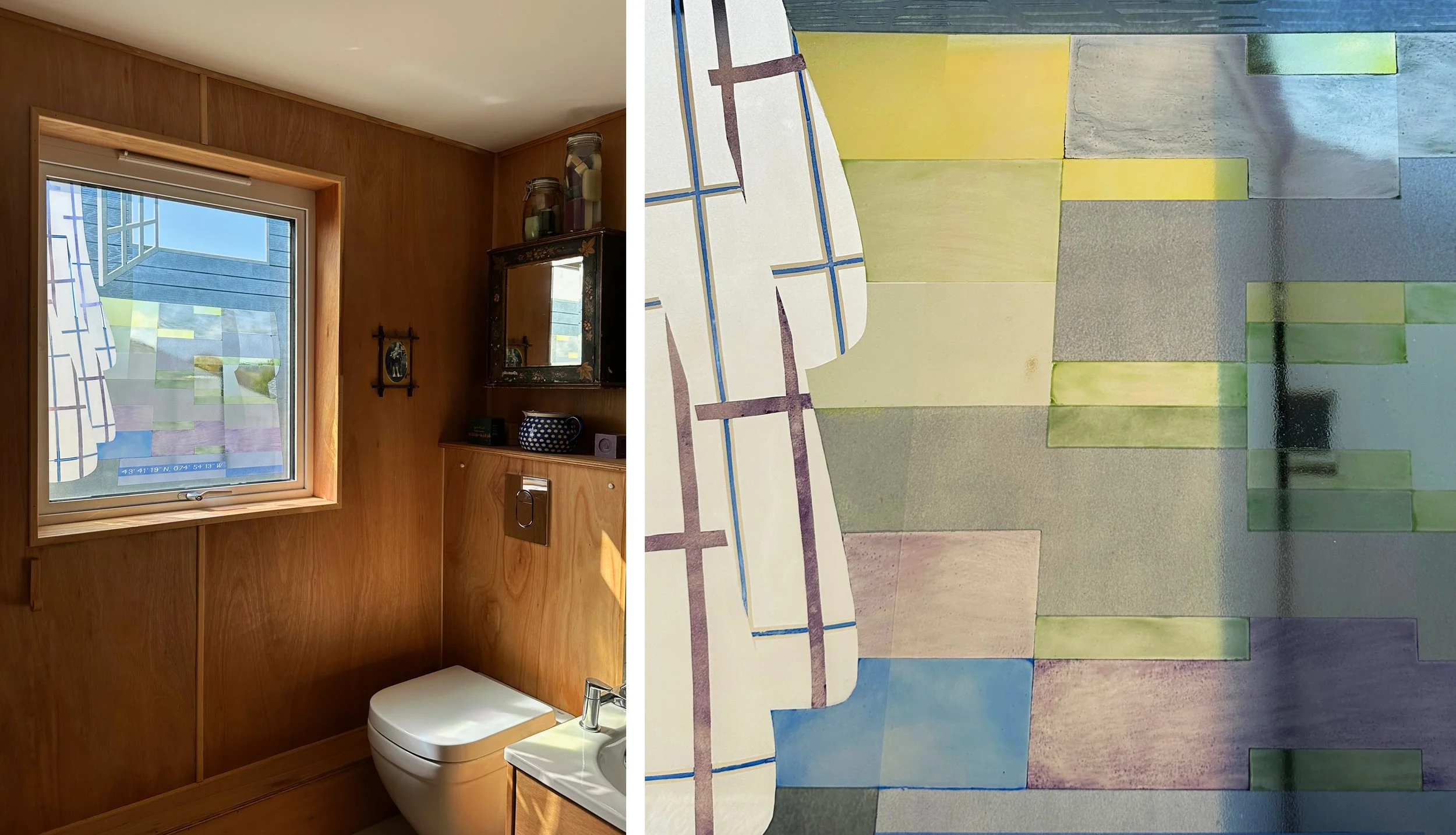
Left: View of the bathroom. Right: detail of curtains and enamel colours.

Grey was the best colour to complement this range of colour washes against the brown of the wooden walls. I have three different grey enamels and I love them all, although the pot of my favourite discontinued soft grey is nearly empty. I particularly like the photo of the open window (below left) that looks as if it’s floating away, but wonder why the modern window is not a thing of beauty in itself. From the outside, high up and facing west, you catch a glimpse of colour and the white lines of the sandblasted window and curtains.
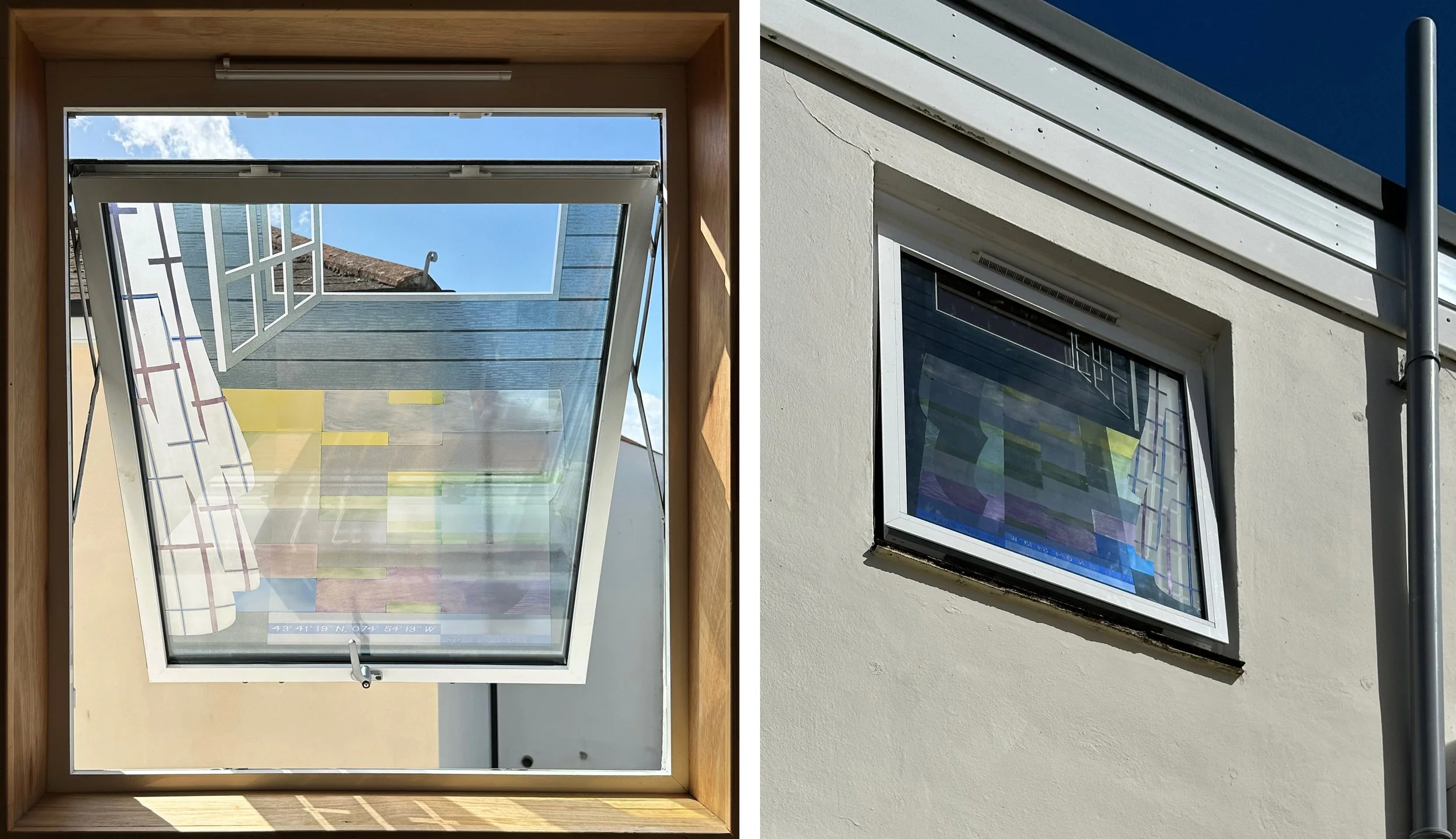
Left: Window open. Right: Bathroom window from the outside.

Cornwall in Cornish Stained glass by Sasha Ward

St Winwaloe, Gunwalloe, view through the beach facing window and from the porch.

St Winwaloe in Gunwalloe is the sort of church I hope to see when on holiday in Cornwall. There has been a church here, practically on the beach, from the fifth century with several stages of rebuilding since. It remains a small, stoney structure at the foot of the sand dunes with a view of the sea through the pale colours of the simple windows and from the porch (above).

St Uny, Lelant, view of the church and Trencrom hill from Hayle, view of Hayle from the church.

St Uny in Lelant, between St Ives and Hayle, is also a three hall church dedicated to a distinctively Cornish saint and with a view of the river estuary from its windows (above). The central stained glass window is a fine twentieth century one designed and made by Michael Farrar-Bell of Clayton and Bell in 1973. It succeeds in complementing the decorative glass on either side, maintaining a twentieth century style (obvious even from the outside) and packing in Cornish references, which is something that local people and holiday makers love to see.

The three east facing windows of St Uny with 1973 stained glass by Michael Farrar-Bell in the centre.

East window donated by Col. Giffard Loftus Tyringham, formerly of Trevethoe House, Lelant, in memory of his parents, wife and son. At the bottom of the window Tyringham House, Bucks, is on the left and Trevethoe House is on the right, where you can also find a portrait of R.W.G. Tyringham out shooting with his dog.

The saints depicted are St Uny, St Erth, St Anta, St Ia, St Gwinear and, thrillingly, St Winwaloe holding the church on the beach that I’d just visited. In the centre is the Cornish cross, above are recognisable birds - chough, woodcock, puffin and gulls - and below are nicely painted details that either relate to the history of the donor family or show the local landscape.

The Tyringham coat of arms on Trencrom Hill.

This is the coastline of St Ives that I’d been looking at from Hayle beach and in the foreground the rocky hill fort of Trencrom Hill that has a view of the Hayle Estuary and also over to St Michael’s Mount. How satisfying to see actual details of the region, crisply painted against a patterned sea and sky.

The coastline of St Ives with R.W.G. Tyringham’s yacht.

The Bolitho war memorial window at St Pol de Léon Parish Church, Paul, Robert Anning Bell 1917-18.

For comparison, here is another celebrated twentieth century window in the region that has a Cornish sea at the bottom. Although this could be interpreted as the view of the west coast of the Lizard as seen from the churchyard at Paul, it looks to me more like a decorative pattern with repeated cliff motifs rising above curling waves. The window was given in memory of Lieutenant William Torquill Macleod Bolitho who died in 1915 at the second battle of Ypres, at the top of the five lights are scenes from the battlefield and the first world war trenches.

For another comparison, we have Alfred Fisher’s 1987 window in Penzance that shows St Mary as Our Lady, Star of the Seas. Here the sea is shown in wavy bands engulfing a tower and reminding me of the sea sickness I felt on the Scillonian ferry.

I would have found this window, designed at the time I was starting out on my own career in architectural glass, difficult to date just by looking at it. I remember the 1980s as a time of experimentation with technologies, materials and a mix of artistic styles which included a return to figurative imagery in painting. Perhaps the period of commissioning abstract (non representational) stained glass for English churches was mostly over by the 1980s as artists like Alfred Fisher, who had previously experimented with new techniques for making windows, returned to the old ways.

St Mary, Penzance, Alfred Fisher 1987. St Mary in front of the Scillonian ferry, a fishing lugger, nets and lobster pots.