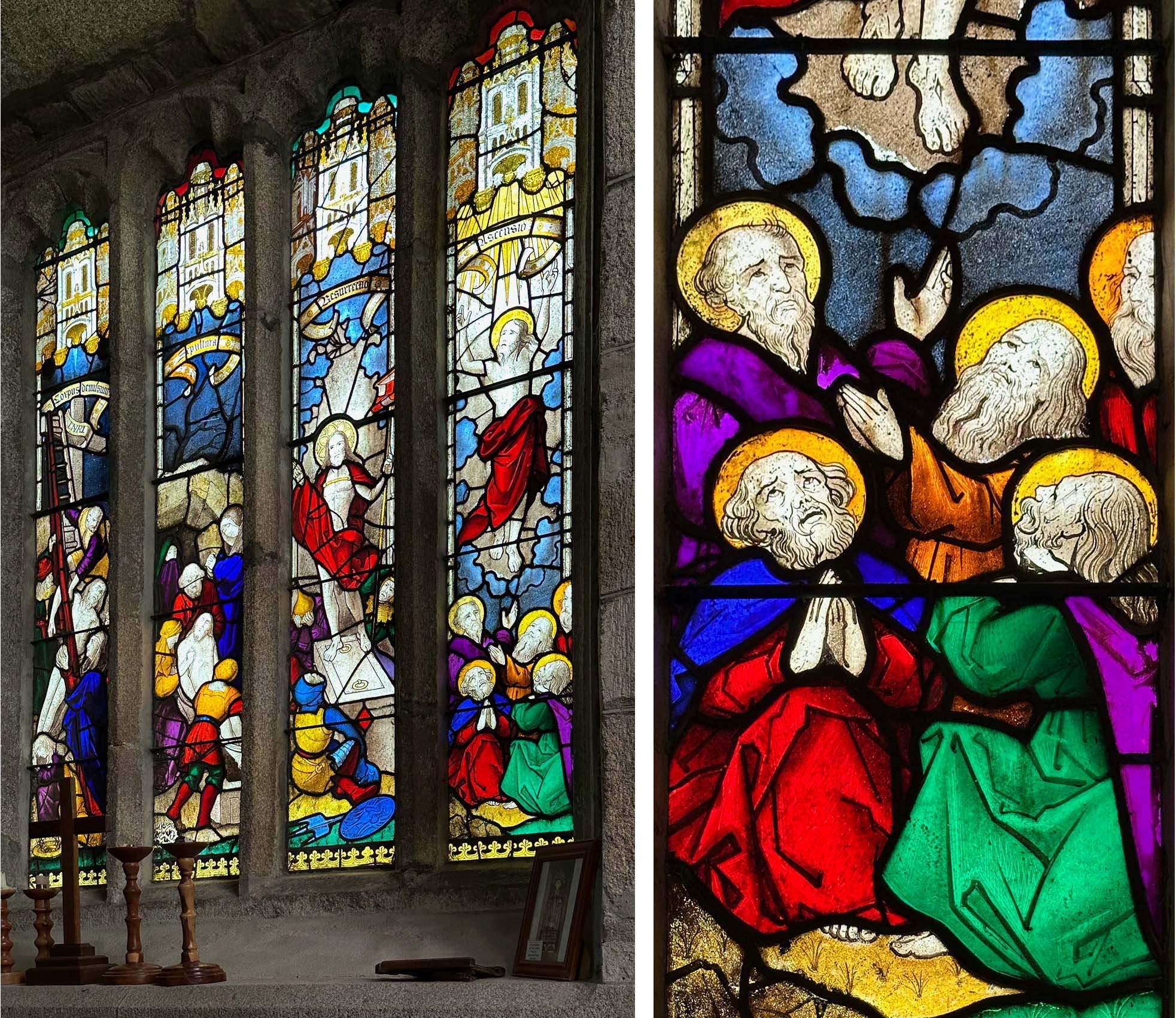
medieval stained glass

From Burghclere to Bramley by Sasha Ward

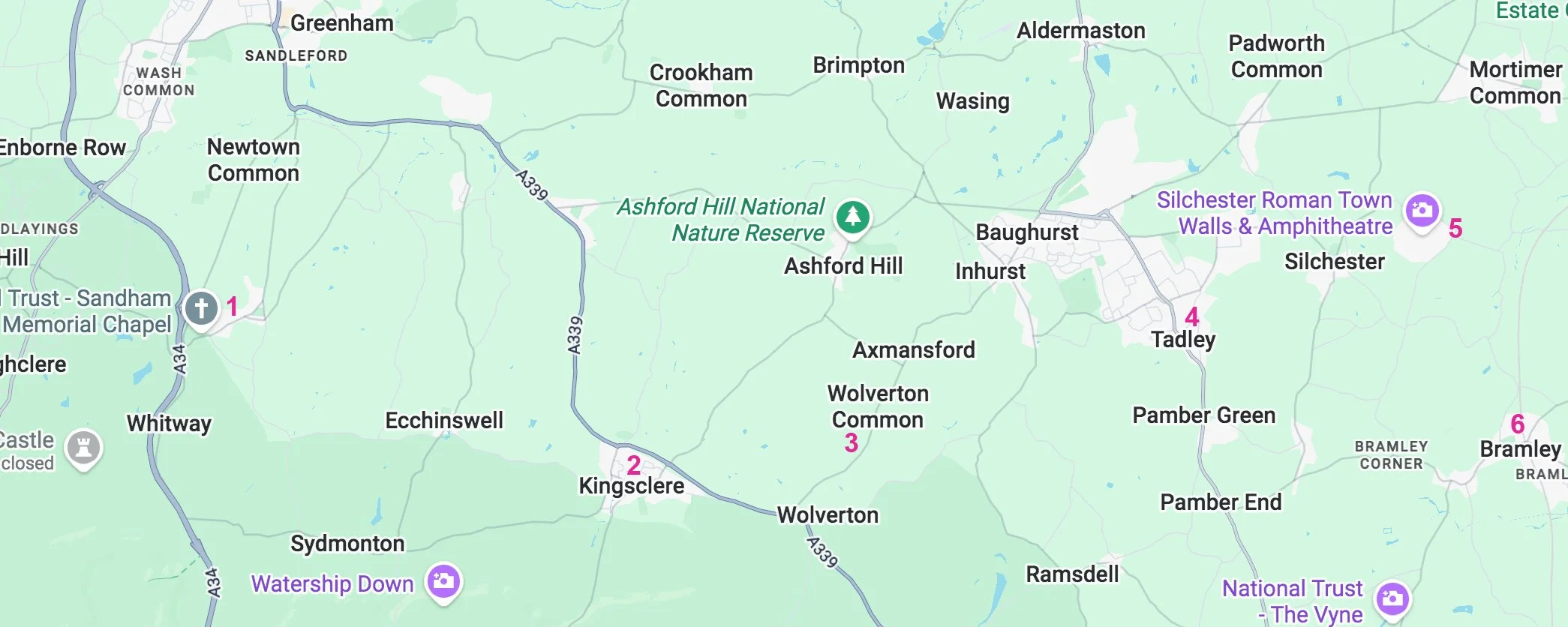
Route map - between Newbury, Berkshire and Basingstoke, Hampshire.

I planned a drive to some churches I had read about in the towns and villages south of Newbury and north of Basingstoke, travelling from west to east as shown in the map above. It proved to be a good day trip that also included views of Watership Down, the woods around Tadley - the site of two of my commissions from 1998 - and the Roman town of Silchester.
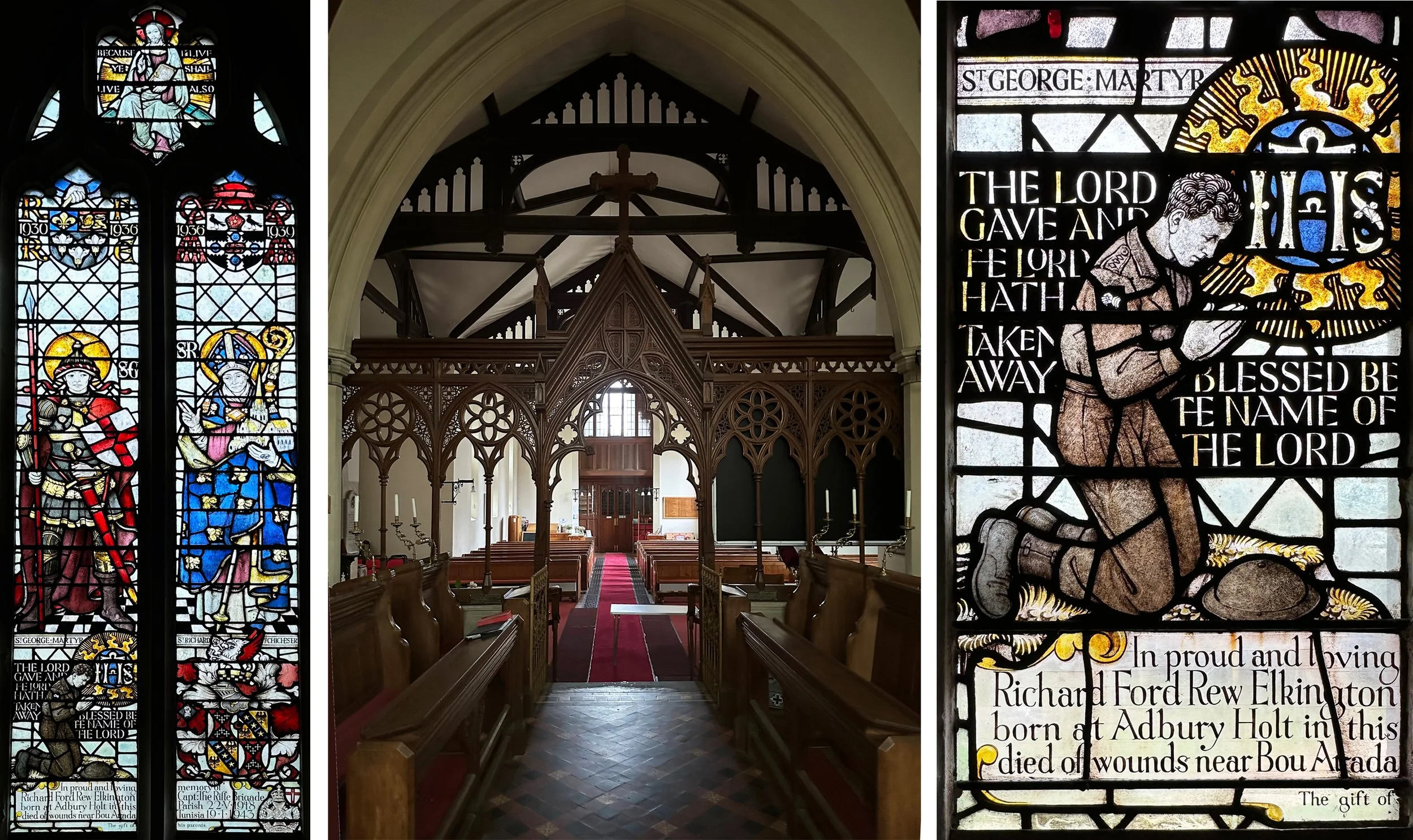
1. Ascension Church, Burghclere. Window by Martin Travers 1943

First stop was Ascension Church, Burghclere, a big flint church with lots of good things inside, for example the wooden rood screen viewed from the chancel in the photo above. As usual I was there for the stained glass and in particular a second world war memorial window by Martin Travers. This window looked to me totally successful; in the depiction of the saints (George and Richard of Chichester) the integration of the arms (Eton College, Christchurch College Oxford, the Elkington family crest, the Rifle Brigade crest, Mailed Fist of the 6th Armoured Division, Crusader’s sword of the First Army) and above all the wonderful hand drawn lettering (above right).
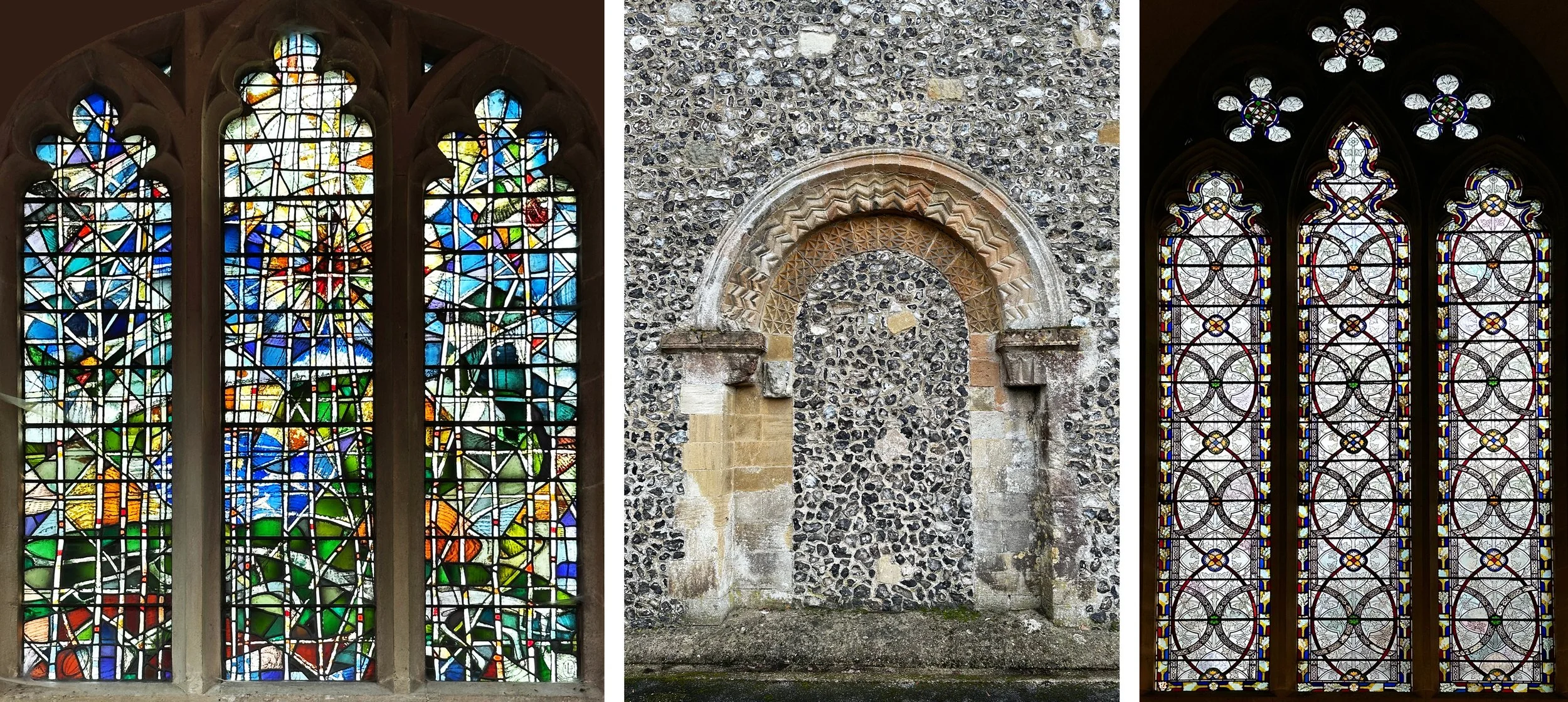
2. St Mary, Kingsclere. Windows by Laurence Lee 1965 (left) and William Wailes 1849 (right).

Next was St Mary’s Kingsclere, an even bigger flint faced church with many styles of stained glass in its windows. The patterned grisaille glass by William Wailes seemed to work best with the architecture of the church, like the east window shown above right. In the south transept is the one I’d come to see (above left) a three light window from 1965 by Martin Traver’s pupil Lawrence Lee. I think of this as essentially a formal design, not abstract as I can see a landscape through the organic white grid, and with two patterns - landscape and grid - working with each other and their surroundings. The church leaflet tells us that the window commemorates the racehorse trainer Captain Peter Hastings-Bass, and that it contains pictures of vaguely suggested celestial creatures, also a sparrow-hawk, a red-legged partridge, a rugby ball, racehorses and the white horse of Uffington stretching across the base.
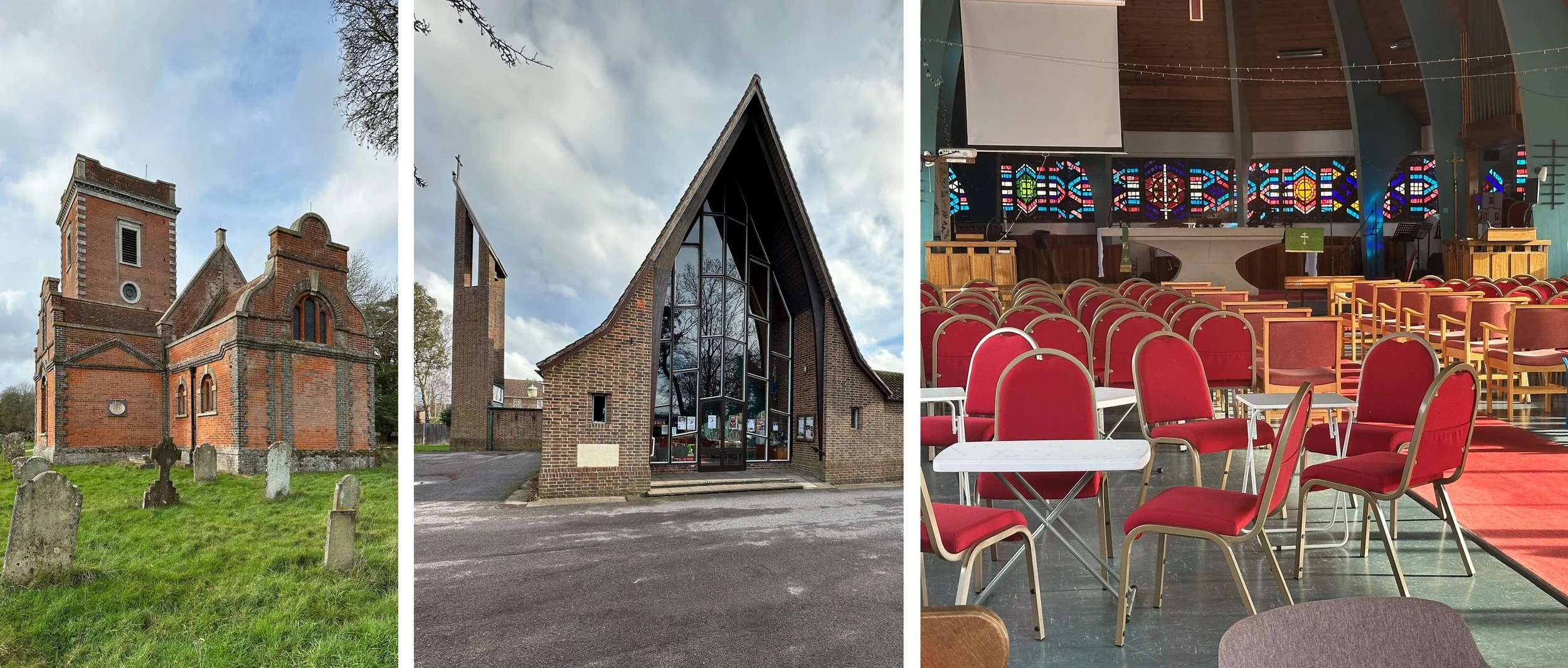
3. St Katherine, Wolverton. 4. St Paul, Tadley.

Next came two churches that were shut, but both with very interesting architectural forms. St Katherine, Wolverton (above left) has at its heart an old flint and wood church that was entirely encased with local hand-made brick in 1717. There is a tall tower, curves at the east end and crow stepped gables on the transepts.

The brick church of St Paul, Tadley built in 1966 (above centre and right) has a separate tower and a dramatic glazed west wall with low key doors in the centre. Through these I could see the beautiful wall of dalle de verre set in concrete stretching around three angled walls at the opposite end of the church. These are the work of Brian Milne who was a pupil of Lawrence Lee at the Royal College of Art from 1959 - 1963. He worked across various media on public art projects in the 1960s and 70s before setting up his stained glass studio in Suffolk which operated from 1983 until his death in 1996.
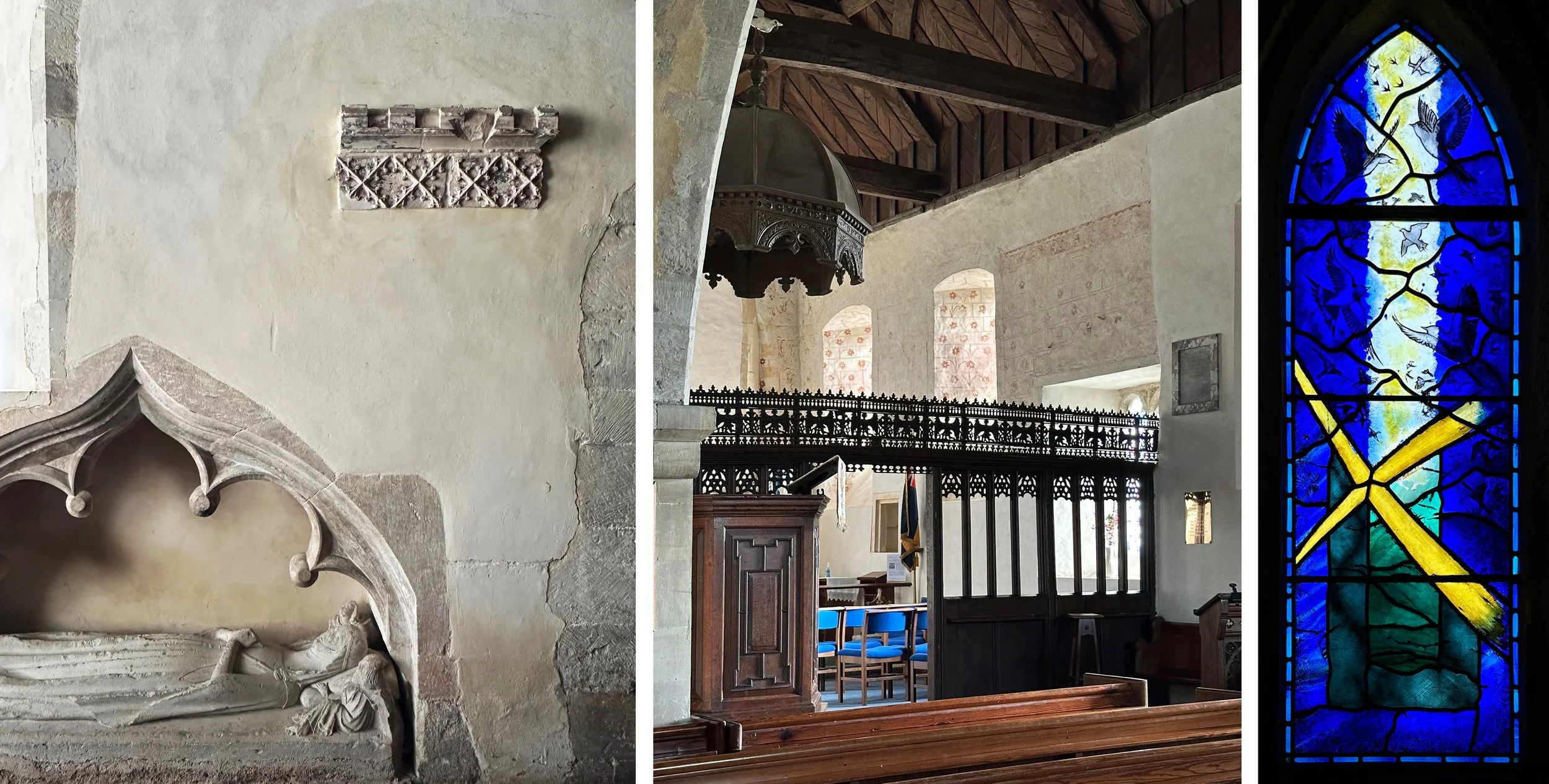
5. St Mary, Silchester. Window by Jon Callan 2005.

Then to St Mary’s, Silchester, a church built on an early sacred site within the Roman walls of Silchester - there is a great walk around the walls that includes the impressive site of an amphitheatre. Inside the church is a delicate wooden screen in front of 13th century wall paintings, recently conserved, and medieval carvings (above centre and left). Behind the font in the north wall is a 2005 window by Jon Callan entitled ‘Carpe Diem’. It’s a memorial window to Andrew Culbert and Sophie Wilsdon, as we learn from a plaque on the wall and a laminated A4 sheet that partly obscures the window and that includes a picture of the window itself. To me this is essentially a contemporary looking landscape with some obvious religious symbolism (cross, column of light) and some birds shoved in. The laminated sheet however tells us, The window is an abstract design intended to encourage people to put their own interpretation upon the spiritual meaning behind it. It then goes on to describe the design in terms of what it represents. I’m finding out that the word ‘abstract’ is beginning to mean the opposite of what it used to, that is something that had no basis in representation.
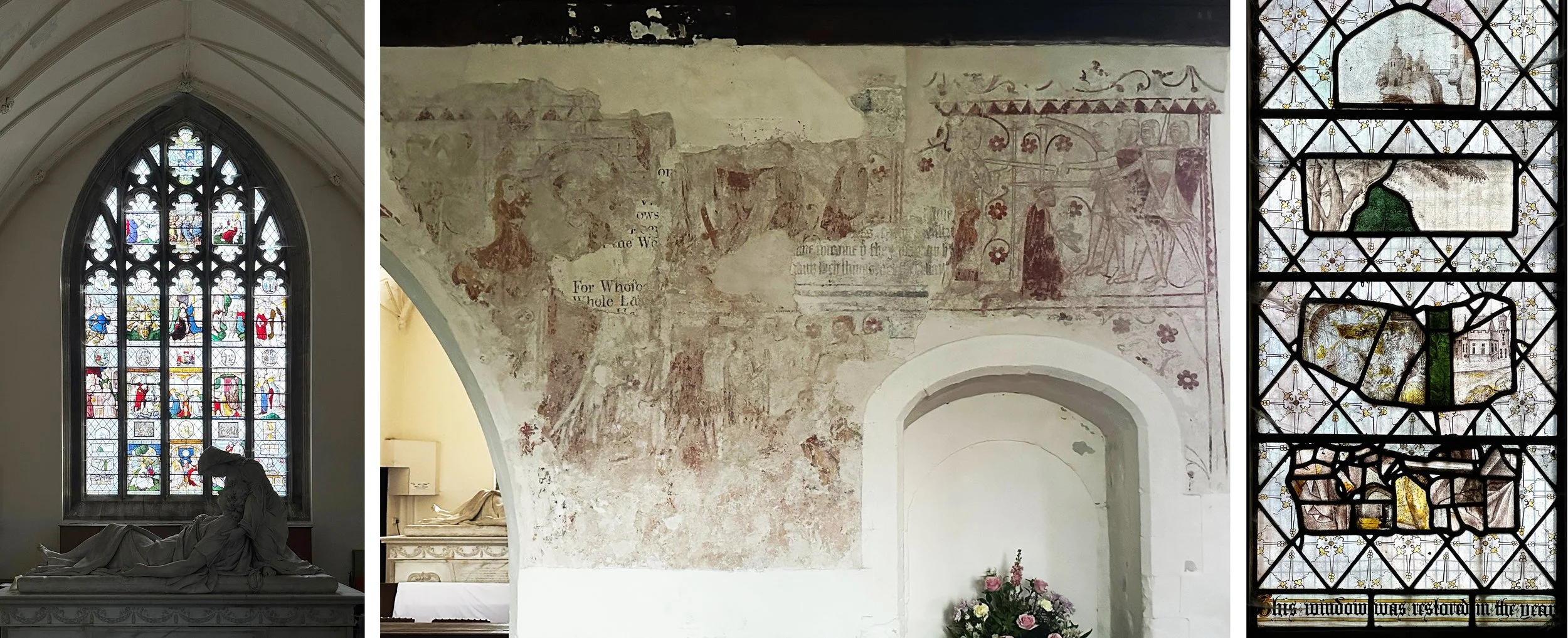
6. St James, Bramley. Window of C16th Flemish glass fragments. C12th wall painting of the murder of Thomas Becket.

The last church, St James, Bramley, contained the best things of the day. It is an interesting building with additions from many periods, it has a screen, monuments, wall plaques, medieval wall paintings and lots of medieval stained glass. In the Brocas chapel, added to the church by John Soane in 1802, is a large window that was set in 1889 by Burlison and Grylls with 16th century Flemish fragments, all delicately painted and presented on a subtle patterned background (above left and right). In the north aisle is a window with earlier glass, at the top are radiant suns of the Hose of York, dating from 1461 - 1483, while below are tiny figures of musicians and saints, including Saint Catherine (below right), these are thought to be from the 13th century. Next to the window is a well preserved, because painted over rather than destroyed during the Reformation, mural of St Christopher. The best of the wall paintings is on the opposite wall (above), Thomas Becket’s murder is one of several martyrdoms depicted, with the familiar flourish of red flowers all around.
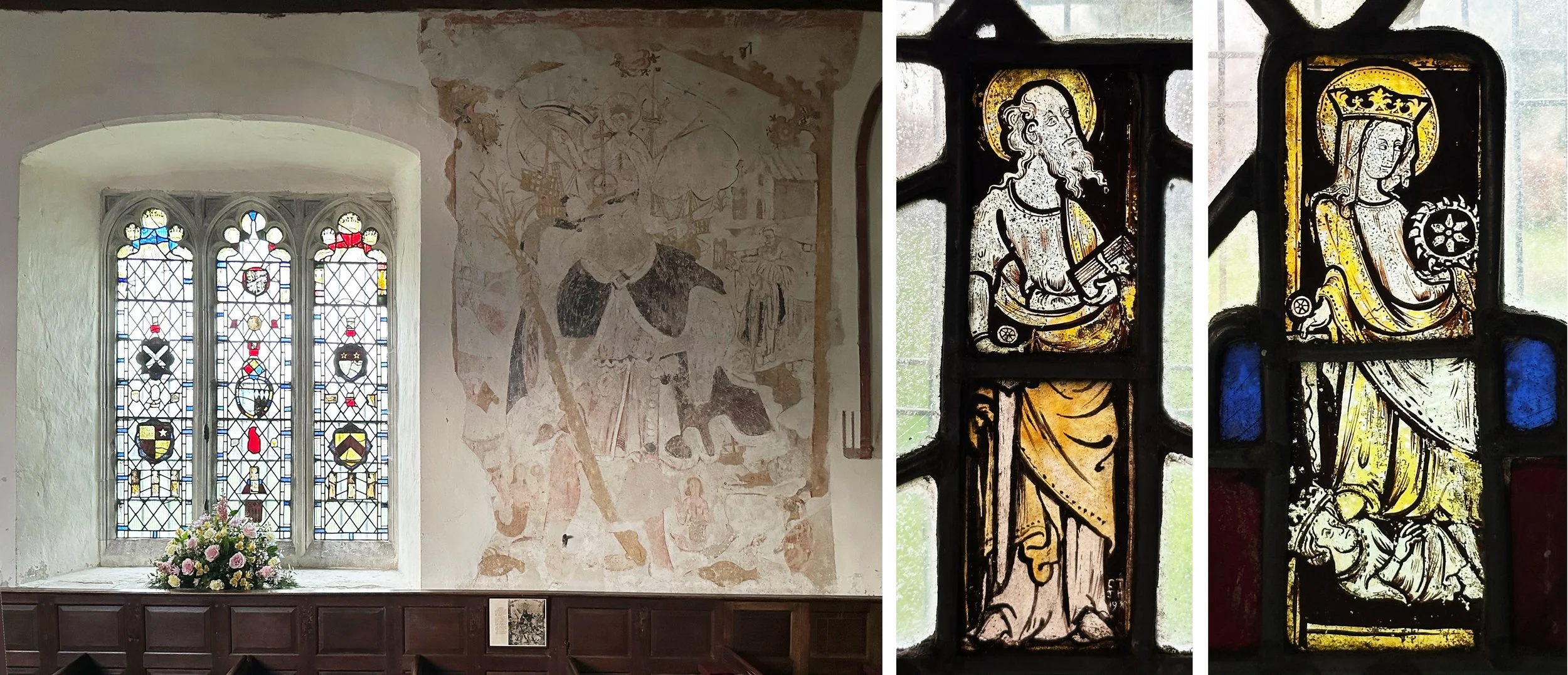
St James, Bramley. Window with C13th-C15th English glass fragments. C16th wall painting of St Christopher.

The Parish Church of St Neot, Cornwall by Sasha Ward

Left: St Neot, south porch. Right: Interior, looking east.

Welcome to our ancient parish church in the village of St Neot, nestling on the southern edge of Bodmin Moor. You have probably come to view our magnificent late medieval stained glass, the most complete set of parish church windows after Fairford in Gloucestershire are the opening words of the church guidebook, which goes on to describe the church as a magnificent example of what can be achieved with intractable granite. Although the visitor is urged to look around at other objects of historical interest, I had eyes only for the glass. Every window is filled with stained glass, not all of it in its original position but all of it heavily restored by John Hedgeland in the 1820s. In my account of the windows I have started in the south east corner with the Creation window then circled clockwise around to Hedgeland’s Last Supper window behind the altar.

Left: South east corner with Creation and Noah windows. Right: Top of Creation window.

Left: Creation window detail, Death of Adam. Right: Bottom of Creation window.

The Creation window retains 95% of its original 1480s glass. In its tracery (above right) is a set of the nine orders of angels, the panels below show the early history of the world from God marking out the sun in the sky with a pair of compasses at top left to God commanding Noah to make the Ark at bottom right. The detail above shows the death of Adam, with his son Seth putting pips from the Tree of Life under his tongue.

It’s obvious that the next window, the story of Noah, has sections by Hedgeland - look at that light blue glass - the tracery lights and most of the scenes in the bottom row are replacements. The Ark, shown in the detail below (c.1480) is a fifteenth century sailing boat with Noah, his wife and pairs of animals inside while the dove and the raven fly away.

Left: Noah window detail, Noah and his wife on the Ark. Right: Noah window.

Row of windows along the south aisle.

It is remarkable that so much of this fifteenth and sixteenth century glass has survived the vandalism that took out a lot of the stained glass in English churches. The suggested reason for this is that most of the windows depict saints chosen by private donors with their families commemorated below, thereby representing local pride and an interest in keeping the windows safe. Those in the south aisle are named for the donor families - Borlase, Martyn, Mutton, Callaway and Tubbe (above). The last two of these windows are not in their original positions, similarly some of the donor panels that would have been on the north side of the church and therefore with the donors facing the altar. A row of these lovely little figures with interesting backgrounds and a request for the saint to pray for them is shown below.

Details of donor panels from the bottom of the south aisle windows.

Left & Centre: details of St George’s window, he is torn with rakes, he is thrown into a cauldron of molten lead. Right: St George’s window.

I’ve missed out a couple of later windows at the west end of the church, before coming to the north west corner with windows depicting the Saints George and Neot in sequences of scenes from their lives. The St George window (above) dated from 1500 to 1510 has episodes in his life not seen elsewhere; in scenes 7 to 11 he is tortured in different ways before being beheaded in the final panel.

Left: North aisle. Right, St Neot window.

Like all the windows in the slightly later north aisle, the St Neot window has a plainer shape with straight tops. The story telling in this glass, dated 1530 and given by the young men of the parish, is wonderfully simple and repetitive, strip cartoon style, with a consistent castellated background. It seems to me the most legible of the windows, with the Hedgeland additions blending in to the colour scheme. The last scene shows St Neot on a visit to Rome being blessed by the Pope, said to be Marinus (882 - 884). There is some confusion about St Neot as the stories about a Cornish hermit and a Saxon saint were mixed together after the Cornish St Neot’s bones were taken to Huntingdonshire following the Saxon conquest of Cornwall, only the right arm remains in the sepulchre in this church.

Lower half of St Neot window. In panels 5 to 8 Neot is lying in bed, his servant Barius cooks fish from the well, then throws them back where they return to life. In panels 9 to 11 a robber steals Neot’s cattle, stags come voluntarily to take their place before the robber repents and returns the stolen oxen.

Row of windows in north aisle.

The next three windows return to the scheme of saints and donors and are named for the donors - Young Women’s, Wives’ and Harry’s. They present a consistent row of ordered proportion and tone, with a series of richly coloured gowns at the bottom of the first two windows and patterned settings for the Harry family in the third.

Details of donor panels from the bottom of the north aisle windows.

Left: Redemption window. Right, detail of Redemption window.

The three last windows in my sequence, Redemption, Acts and the Last Supper were designed by John Hedgeland, the latter based on a German woodcut of 1491 that he found in the British Museum. Redemption and Acts were moved from the south aisle and are now rather hidden behind the organ in the vestry, while the Last Supper window in the chancel has itself been recently restored and includes original glass in the tracery. These are all interesting windows with shapes in the bands of lettering and the canopies and a colour balance that ties them in to the rest of the windows in the church. The painting of the figures is free and lively, the work of the skilled glass painter James Henry Nixon who worked with Benjamin Baillie and John Hedgeland on this complete restoration scheme.

I am indebted to the facsimile copy of a 1937 guide to the windows by G. McN. Rushforth which gives thorough descriptions of each panel and an account of what used to be where that I bought in the church alongside the afore mentioned church guidebook.

Left: North east corner of the church with Acts window. Right: Last Supper window.

Behind the Scenes by Sasha Ward

Left, East Hagbourne, Oxfordshire. Right, Urchfont, Wiltshire.

To see the medieval glass patchworked into a window at St Andrew’s Church, East Hagbourne (above left) I had to poke my head through a screen of heavy curtains that hide the vicar’s desk. To get up close to Rosalind Grimshaw’s window in Urchfont church I had to move piles of chairs and toys (above right). I’ve now started looking out for the children’s corners which, like kitchens in churches, give an indication of how the church is being used.

Left, inviting at North Moreton, Oxfordshire. Right, austere at Potterne, Wiltshire.

Steeple Ashton, Wiltshire.

In the huge church of St Peter and St Paul, Steeple Ashton, everything is clean and neat with fragments of medieval glass in almost all of the windows. The door to the vestry, not a separate room but just a space sectioned off, was open and everything inside was in order (above left). The children’s corner (above right) looked like you might want to spend time there, it seemed to have been arranged by someone who actually cares what the place looks like.

My best behind the scenes photo, above left, is from the corner of another huge church, this one at Madley in Herefordshire. The scene is simply furnished, the atmosphere is timeless. In the east window of the church is a wealth of medieval stained glass (below), but even more unusually there are twenty first century paintings by Edward Kelly installed in the nave and the crypt (above right). The triptych in the crypt is a particularly wonderful sight because paintings, particularly modern ones, are rarely found in English churches.

This from The Rev Simon Lockett, who I like to imagine sitting on that pink cushion. ‘It is a great joy to have the triptych “The Lillies of the Field” here in Madley Crypt. I have lived with these paintings for a long time now and they have helped to bring this beautiful space alive giving the crypt depth as well as a flourish of colour and bold form. They have helped with a contemplative practice as well as a daily reminder not only of the beauty of creation but of the natural cycle of abundance, death and new life’.

Medieval glass in the east window of The Church of the Nativity of the Blessed Virgin Mary, Madley.

Introduction to the French Road Trip by Sasha Ward

Rouen Cathedral with stained glass by Max Ingrand 1956 (below)

The first leg of our road trip consisted of a journey from the north - Calais - to the south - Mazamet - with stops along the way, some for stained glass and some for camping. Our first stop was Rouen and a quick evening visit to Notre Dame Cathedral, famous for its façade painted by Monet, drawn by Ruskin and admired by William Morris and Edward Burne-Jones on their sight seeing visit in 1855. On our trip the heat wave was on and the sun was blazing through tall thin windows filled with excellent examples of stained glass from the 13th to the 16th century. The 1950s windows, most notably by Max Ingrand, replaced the ones that were bombed during the Second World War. They are similar to the cathedral’s medieval and renaissance windows in terms of composition, with colours and imagery that fit in, in an unremarkable way. I loved the patterned windows (top right) in a design of squares and diamonds with painted details that makes the glass look padded, like a quilt.

Stained glass windows in the church of St Ouen, Léry.

Early the next morning we stopped outside a church 15 miles away, and found it open, the interior beautifully kept. It looked, sounded (taped organ music) and smelt in perfect order, with painted walls, tiled floors, wooden sculptures and a complete set of twentieth century windows. The ones in the lower windows (shown above) were all of a similar design in different colour combinations and they became more satisfying the longer we looked at them. Like the patterned windows in Rouen Cathedral, I couldn’t find a name or a date, and like those windows they were in harmony with the architecture. When I was an art student I used to call this sort of stained glass ‘subservient to the architecture’, now I tend to think that’s a positive quality for a stained glass window to have.

Chartres Cathedral: east window, west window and Notre Dame de la Belle Verrière. 12th and 13th century glass.

We spent a day in Chartres, where I hadn’t been since I was a school student. I knew the interior had been controversially cleaned, so the pools of coloured light projected through the glass don’t seem so intense now that the interior is mostly white, rather than mostly black. However the medieval stained glass in its entirety is the best there is; huge and intricate, overwhelming and predominantly cobalt blue. The windows above the west door are beautiful (above centre) and so is the window of Notre Dame de la Belle Verrière (above right) that was always one of my favourites in my stained glass picture books. That’s one of the points of the road trip - to stand in front of your favourite artworks, an experience that is completely different from looking at them in a book or on a screen.

Drayton and Yarnton, Oxfordshire by Sasha Ward

Our cellar

When we decorated our cellar Ray set some of his relief plaster panels, made about twenty years ago, into the walls. It may not be obvious why from the photo above, but I like to think of the link these have to altar pieces, particularly those carved in Nottingham alabaster from the fourteenth to sixteenth centuries. We went to St. Peter’s church in Drayton, Oxfordshire to see a set of particularly fine examples of the genre which had survived because they were buried for safety and rediscovered when a vault was dug out in 1814.

Fifteenth century altar piece in St Peter’s church, Drayton, Oxfordshire

There are six scenes crowded with dynamic figures, heads, animals and angels. The panels, some with missing sections, are about 40 cms. tall with traces of paint visible and are mounted in the wall behind an altar. I was so captivated that I couldn’t really be bothered with the (nineteenth and twentieth century) stained glass in the church, but we did find a guide book that told us about a similar Nottingham alabaster altar piece in St. Bartholomew’s at Yarnton, only 15 miles away - a church I knew by name but couldn’t remember why.

The two end panels of the Drayton altar piece

Fifteenth century altar piece in St Bartholomew’s church, Yarnton, Oxfordshire

This altar piece (above) with two of the six panels missing, proved much less exciting than the Drayton one mainly because of the way that the panels are mounted, surrounded by heavy stone, and lit with a dim yellow light. However, every window in the church is filled with fragments of the most fantastic medieval english and continental stained glass, most of it given by alderman William Fletcher, Mayor of Oxford, in 1813. We stayed for a long time, admiring the details and the style of the figures so in keeping with the altar piece; I was delighted not to have my medieval reverie interrupted by any more modern glass here.

Yarnton church: East window (above the Nottingham alabaster altar piece) mainly English C15th and detail.

Two more depictions of the virgin and child (with other painted fragments) in the north windows of Yarnton church.

Details from the north west window of Yarnton church.

Left, The only C15th pieces that are in their original position in the top tracery, north window. Right, Head and birds in the sanctuary window, Yarnton.

To me, the most exciting windows are the reset angels in deep alcoves, lit by sunshine in the south west corner of the church (below). The windows are small enough for the mainly fifteenth century pieces to make a complete picture in each one, with some pattern, some objects ( a wheel or a surveillance camera, a football or a flower?) some border pieces, some incongruous bird and animal segments, fritillaries and bluebells. The faces that loom out of the bottom of the right hand window (bottom picture) have a particular other worldly quality - there is nothing in the centuries of stained glass painting that I would rather see.

Angel windows in the south wall of Yarnton church.

The two angel windows in Yarnton church.

Details of painted glass in the bottom of the left hand angel window

Detail from the bottom of right hand angel window