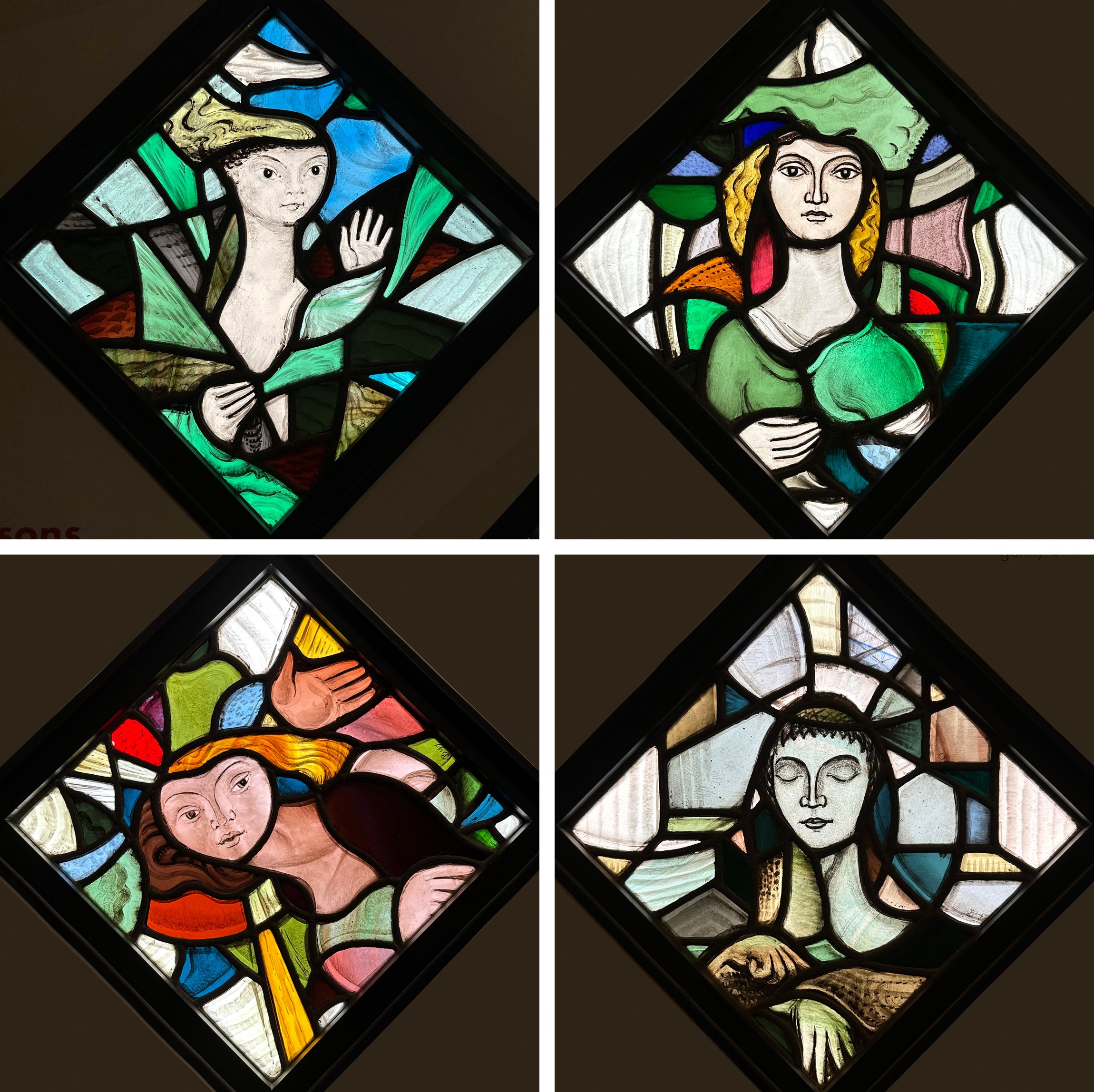
Court Barn Museum. Four Seasons panels by Charles Blakeman
Chipping Campden is a well preserved town in the north Cotswolds with a wealth of connections to the Arts and Crafts movement chiefly because Charles Robert Ashbee moved there with the members of his Guild and School of Handicraft from the East End of London in 1902 looking for a more beautiful place to live. The town’s Court Barn Museum tells the story of some of these artists and others who were from Chipping Campden, like Charles Blakeman. His four seasons panels which were probably for his own house as there is no record of them being commissioned (from the museum’s website) are displayed on a wall on the diagonal (I can’t help thinking that autumn, at bottom left above, would look better if rotated clockwise). Blakeman started his stained glass apprenticeship in 1921 when he was 14 in the local studio of Paul Woodroffe.
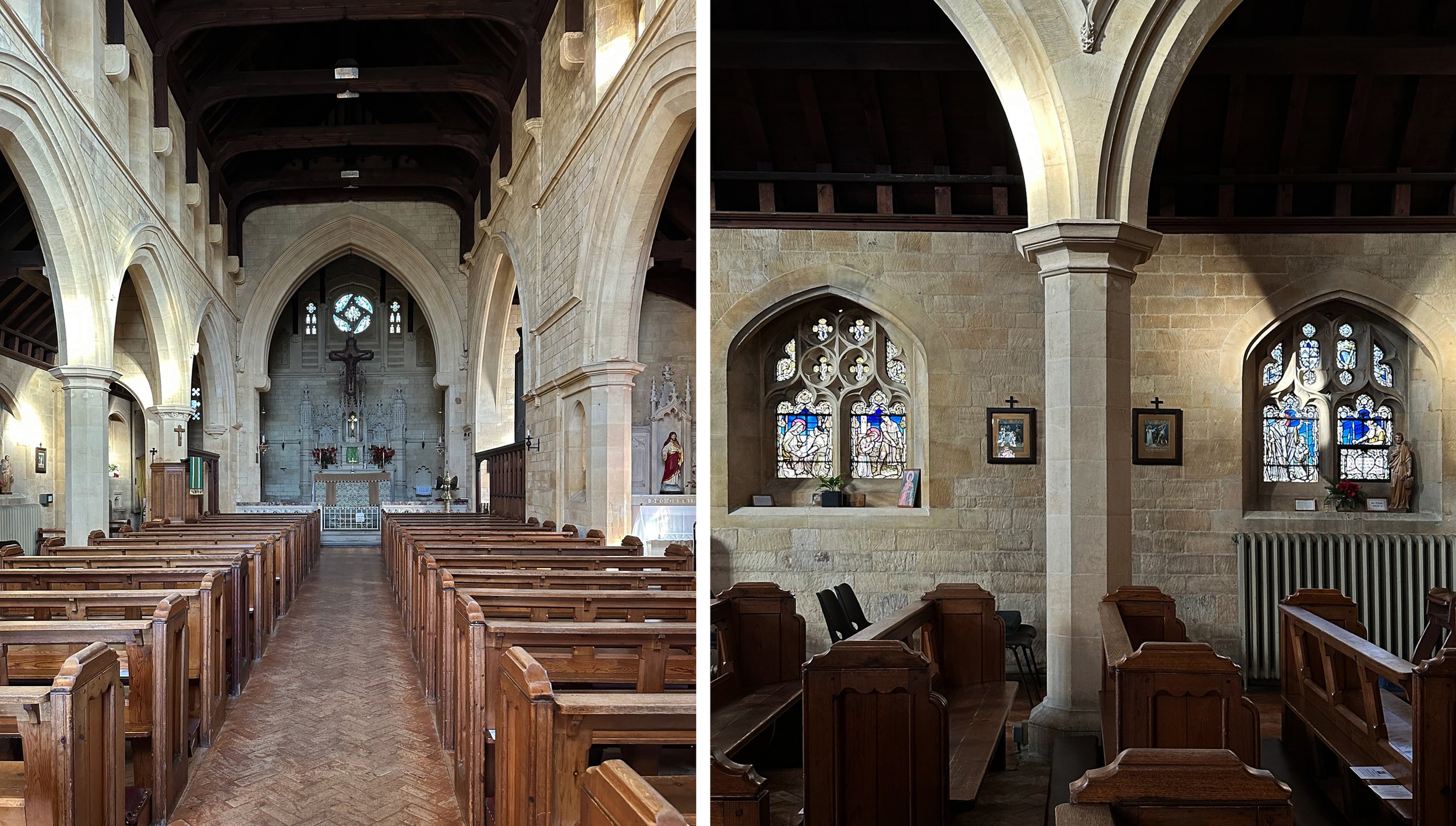
St Catharine’s Church. Left, looking east. Right, two windows in north aisle by Paul Woodroffe 1922.
Woodroffe trained at The Slade School of Art, learnt stained glass from Christopher Whall and moved to Chipping Campden to set up his own studio. He worshipped at the Catholic Church of St Catharine in the town, and made five windows for the church between 1909 and 1930. This is a small, beautiful church designed by W. Lunn, opened in 1891 and fitted with carvings and furnishings by members of the guild during the early twentieth century.
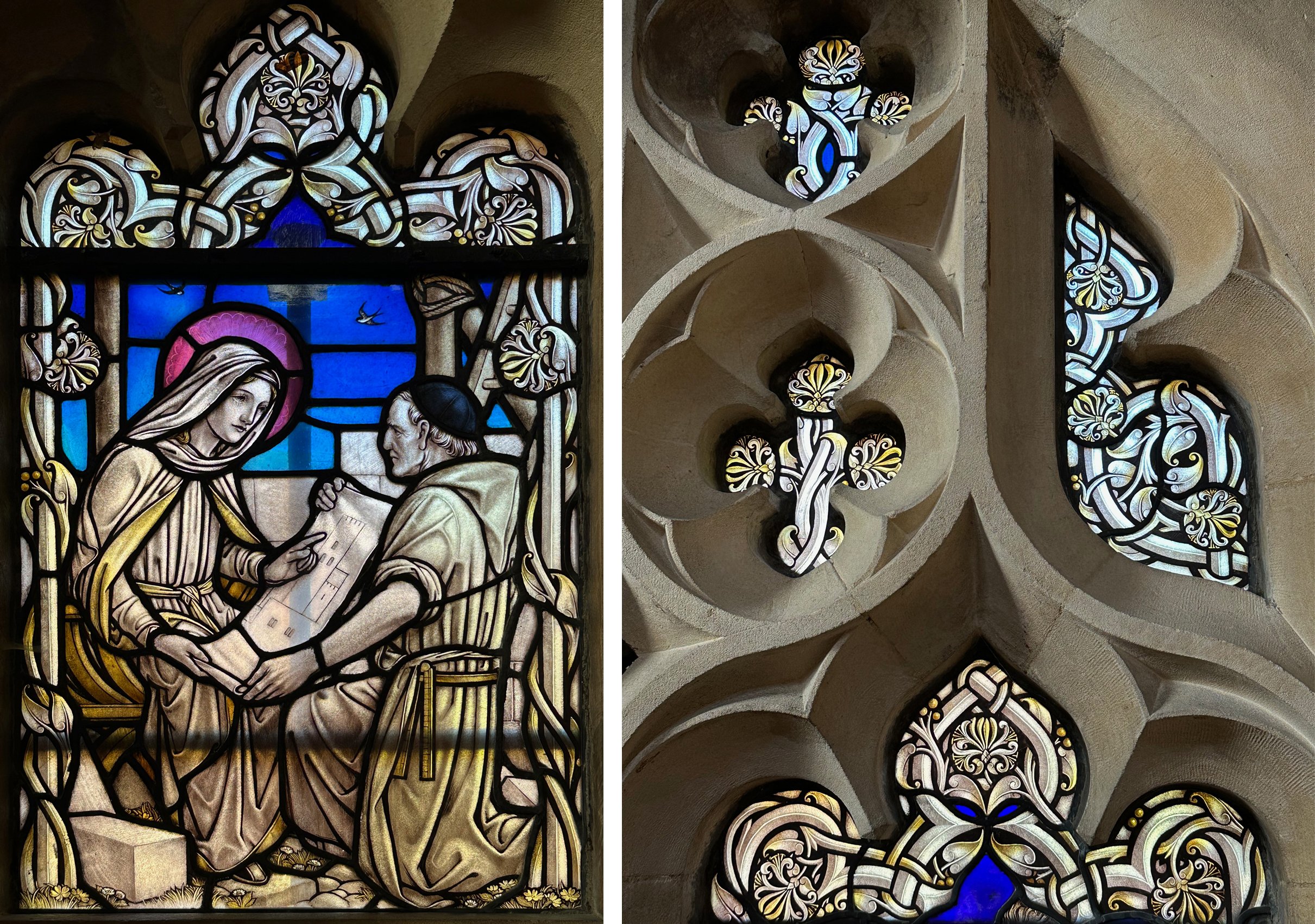
St Catharine’s Church, Details from north aisle window by Paul Woodroffe. St Catharine discusses plans for the church, with a tower that looks nothing like the one here.
Woodroffe’s stained glass is perfect for the church. The two north facing ones (above) particularly so, with a restricted colour range and crisp detail they are constructed so that the leading is barely noticeable. Sunlight streaming through the windows on the south and west sides showed up the stonework rather than the subtlety of the beautiful stained glass designs.
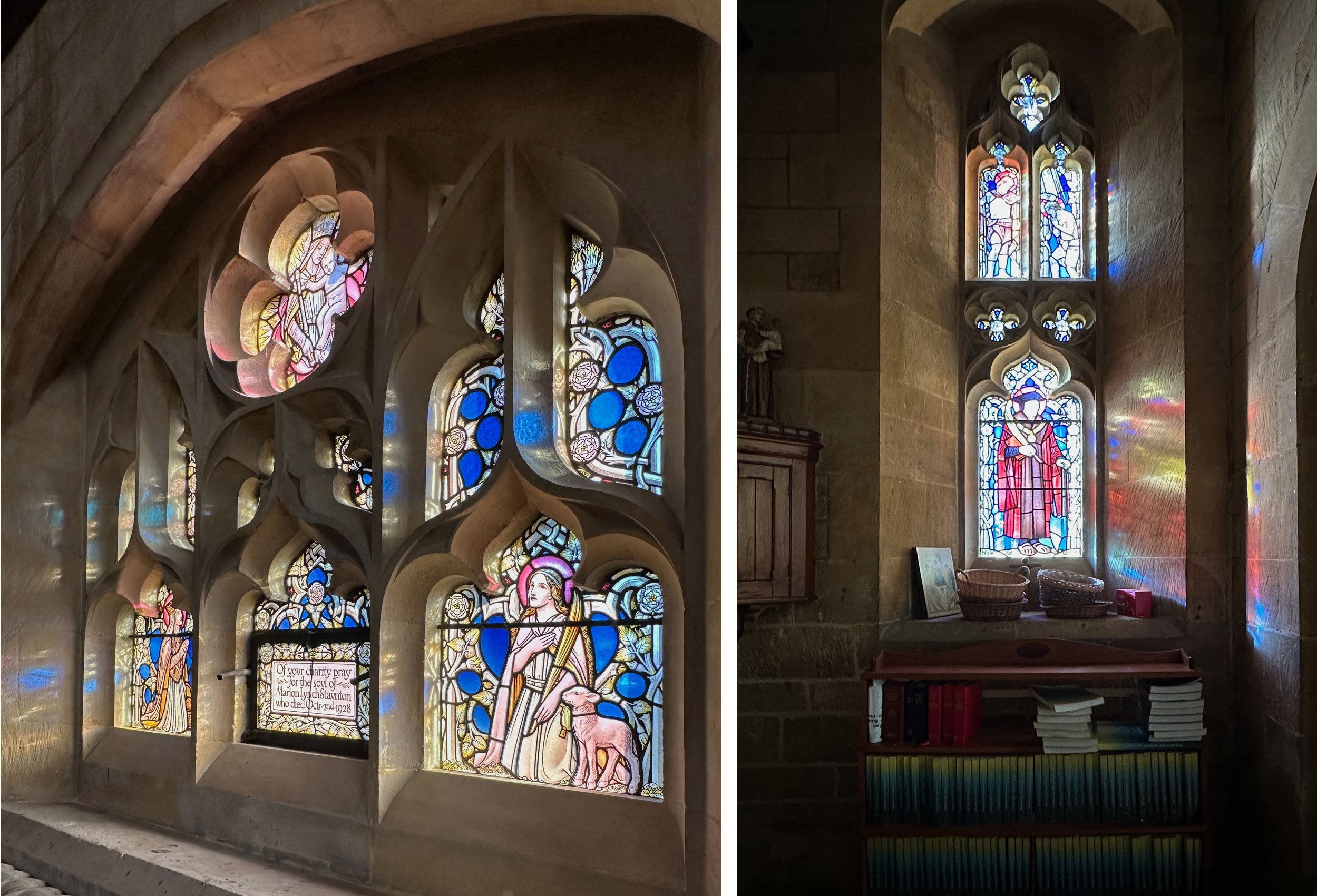
St Catharine’s Church. Left, south facing window 1909. Right, baptism window 1930 (both by Paul Woodroffe).
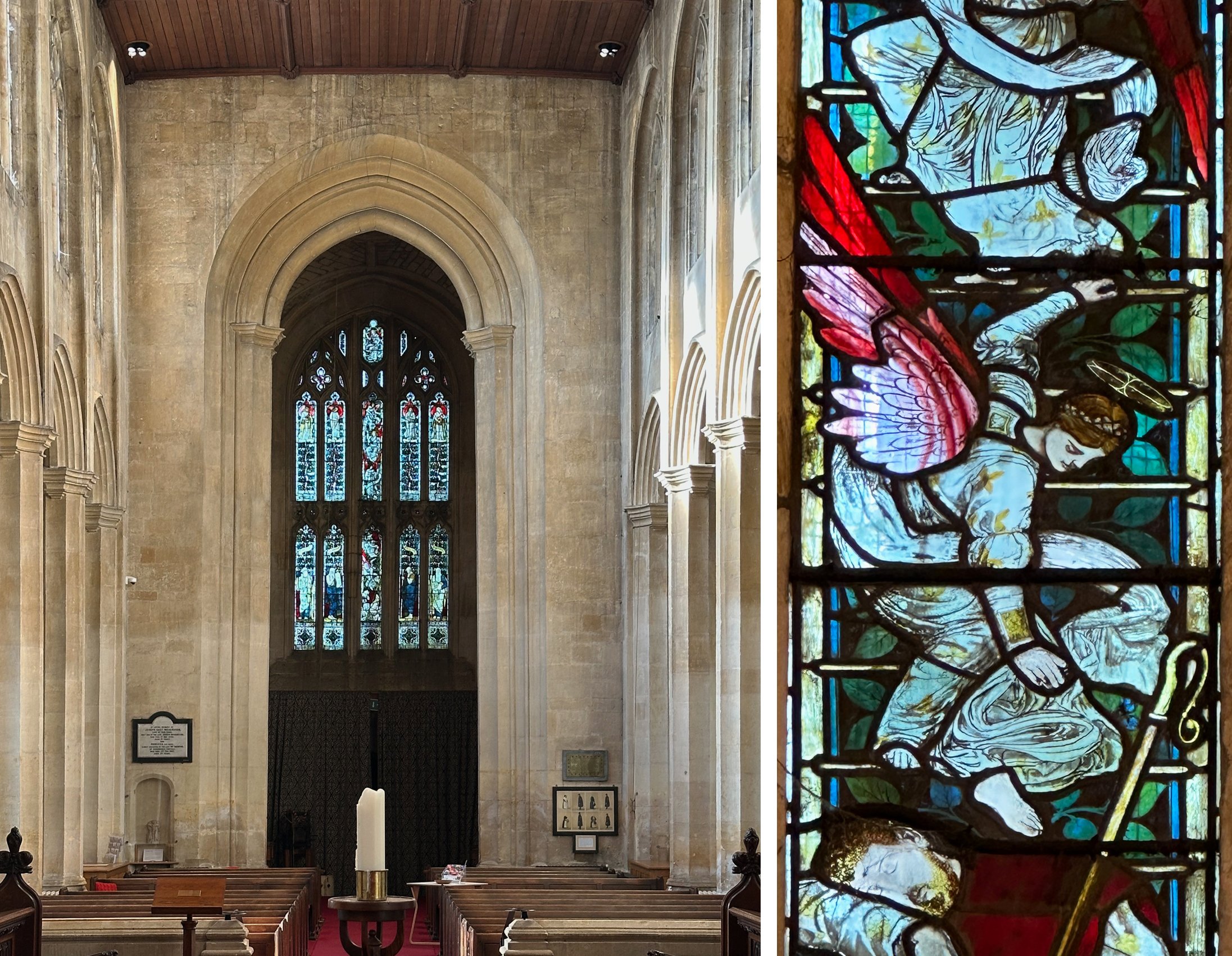
St James Church, looking towards the west window and detail. James Powell & Sons 1877.
At the other end of the high street is the much older and larger church of St James, with a huge ribbed tower built around 1500 that makes this church a significant landmark. There is a whole range of nineteenth and twentieth century stained glass inside, starting with a lovely decorative window of Jacob’s dream under the tower (above). The window’s designer (working for Powells) was Harry Wooldridge, the details of angels and stylised trees are quite pre raphaelite.
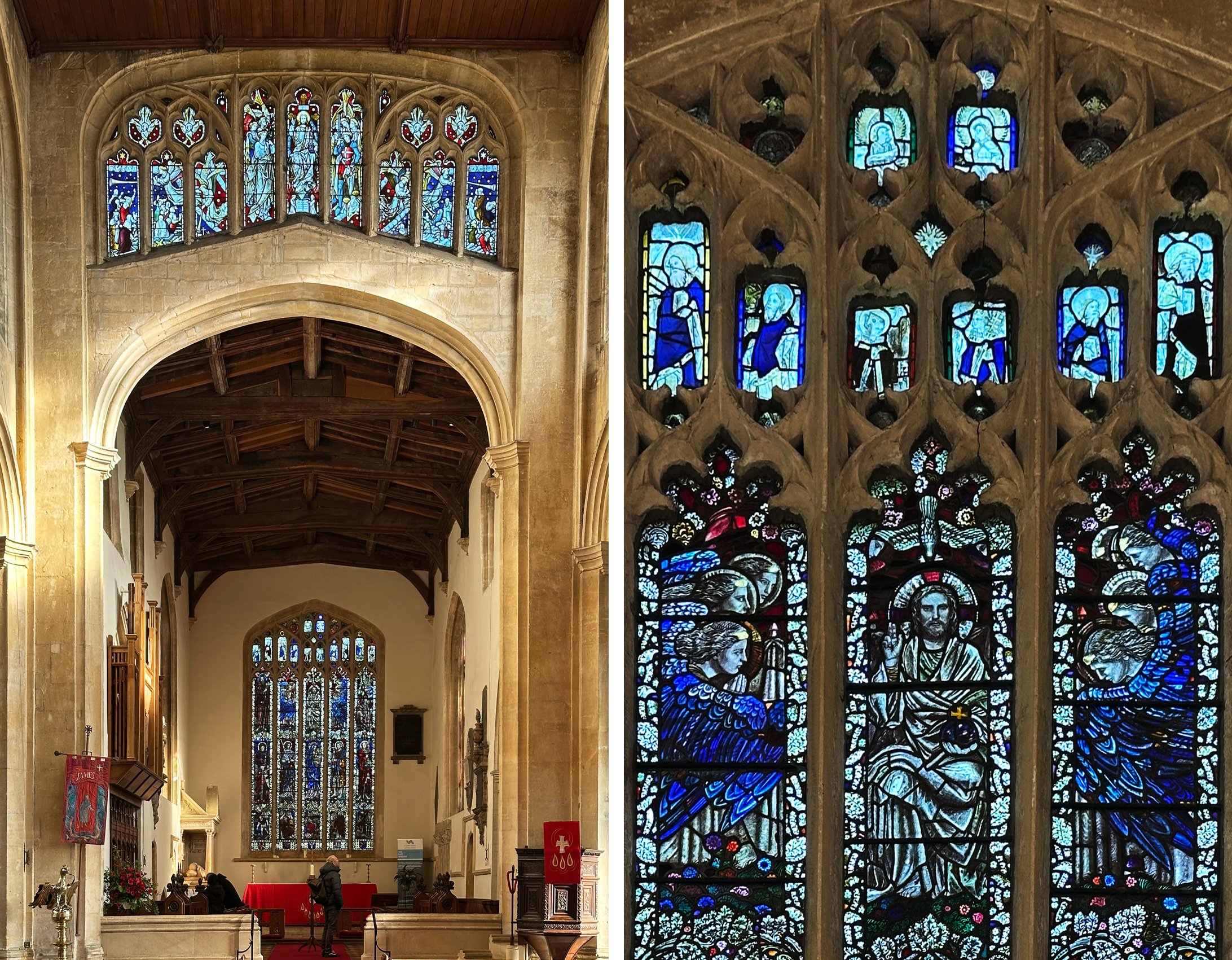
St James Church. Chancel arch window by Hardman 1878, above the east window by Henry Payne 1925,
The artist Henry Payne came to the South Cotswolds from Birmingham, he had also trained with Christopher Whall and was designing stained glass around the same time period as Paul Woodroffe. His window here is fabulously rich with blue patches that link to the medieval figures in the tracery above. The details (below) show the detailed but unfussy ornamentation between the well drawn figures. At the very bottom are a couple of local scenes, one of Payne’s strengths, including that distinctive tower of St James (below right).
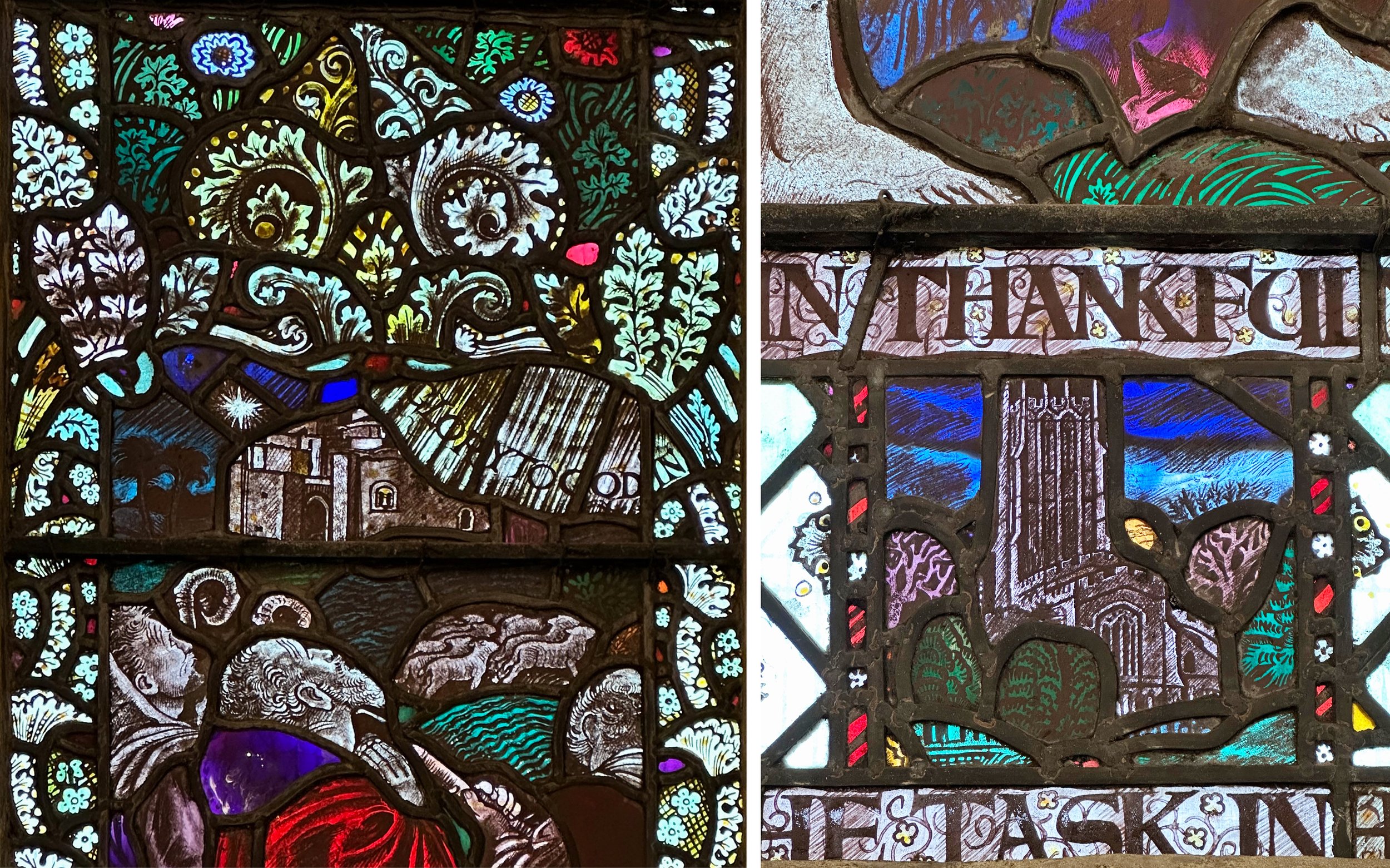
St James Church. Details from Henry Payne’s east window.
In the north chapel is a window with simple oak leaf ornaments and five square details - scenes and crests - by Henry’s son Edward Payne. His version of the church tower (below right) is very similar to his father’s, highlighting to me the difficulty (or maybe the joy) of being in one of those stained glass dynasties.
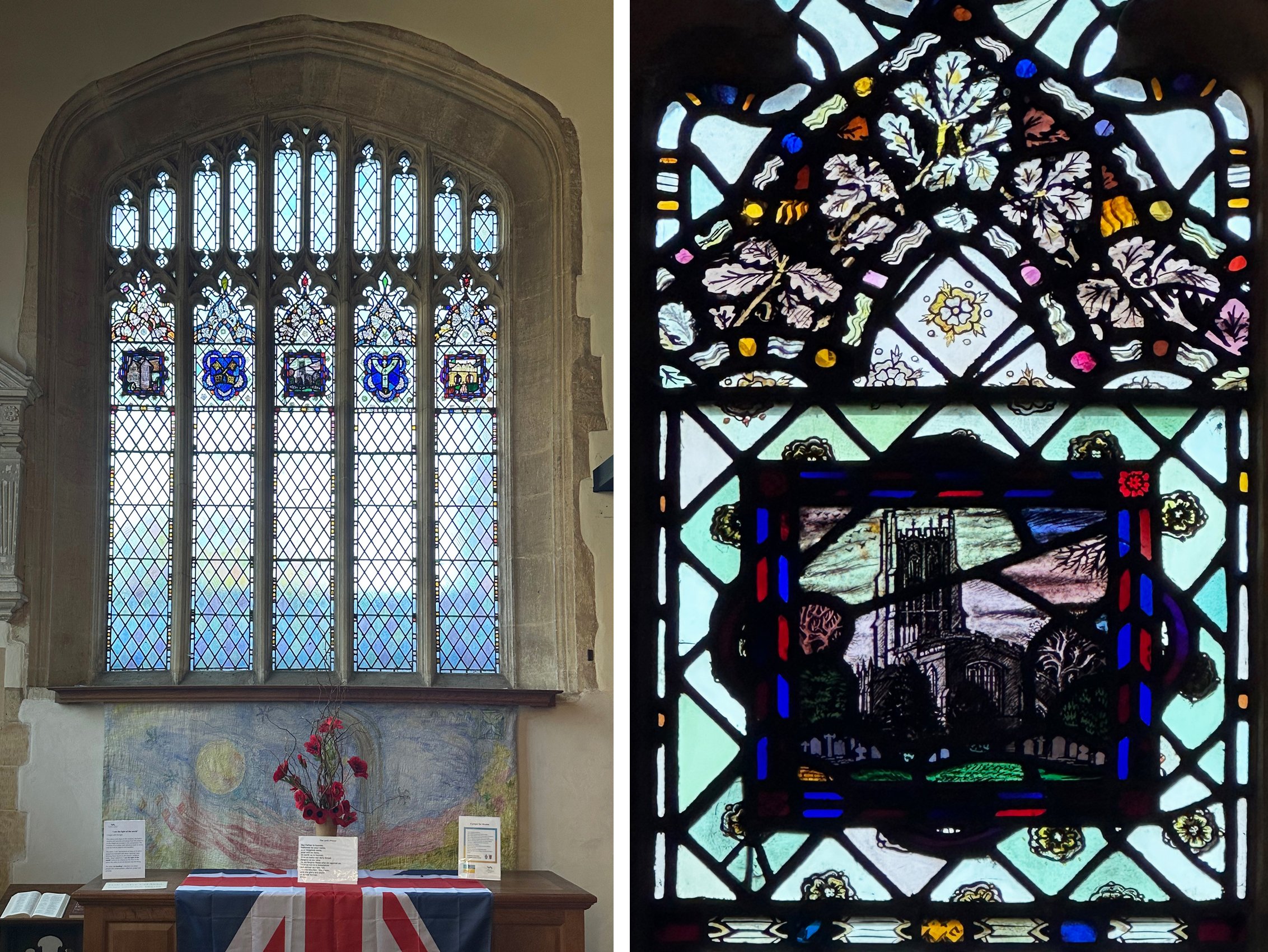
St James Church. North chapel window and detail by Edward Payne 1970.