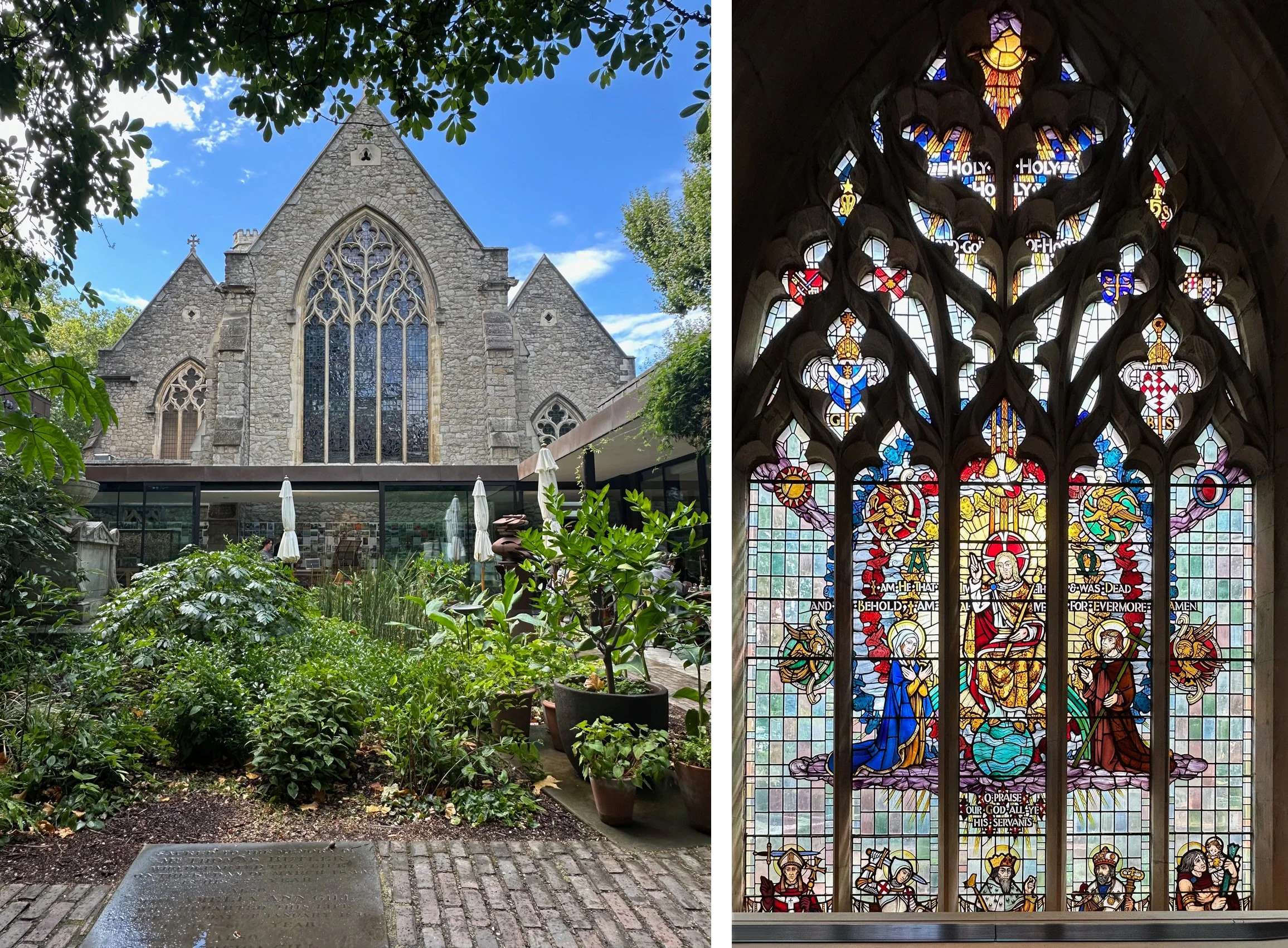
Courtyard of The Garden Museum with view of east window. Interior view of east window with bottom half of the figures obscured by interior wall, glass by Francis Stephens (1953).
The Garden Museum in St Mary’s Church, Lambeth was the world’s first museum dedicated to the history of gardens and gardening. Due to changing population in the area the church was made redundant in 1972 and condemned for demolition, this was only fourteen years after the installation of a series of windows (made from 1953 - 58) by Francis Stephens that replaced the ones destroyed in the blitz.
The churchyard contains the tomb of John Tradescant and his son John who were gardeners, plant collectors and creators of their own public botanical garden in Lambeth in the 1620s. Building on this legacy, Rosemary and John Nicholson saved the building from demolition and established the Tradescant Trust, opening the church as The Museum of Gardening History in 1977. Since then it has undergone a complete transformation inside and outside, with new gardens by Christopher Bradley-Hole and Dan Pearson and an interior remodelled by the architects Dow Jones in 2008 and 2015.
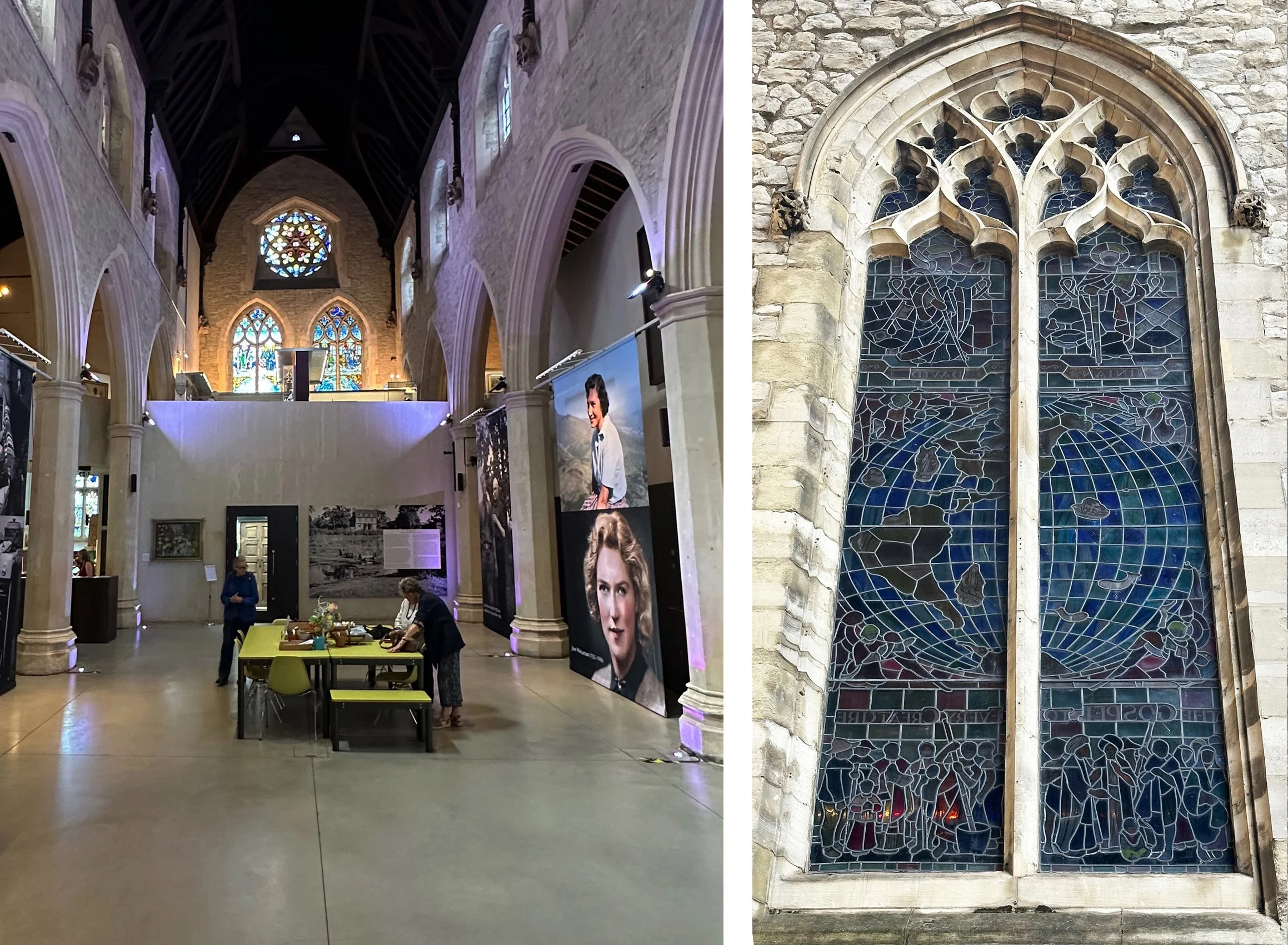
Interior of The Garden Museum looking west. Exterior view of west window by Francis Stephens.
The remodelled interior keeps a central space for events (above left), with a separate exhibition gallery and a display space on a mezzanine level that wraps inside the outer walls without touching them. The clear glass windows are visible to let in daylight, but nearly all the stained glass is partly obscured. I went outside to see Francis Stephen’s west window from 1958 (above right), drawn by the top of two globes just visible above the gallery walls. These illustrate Stephen’s interest in missionary work but also hint at the world wide travels of the Tradescants.
The only stained glass that you can really see is in the baptistry at the museum’s entrance, although a carved stone has been put at its base (below left). Above is a scene showing the apostles at Pentecost, below are rituals of the church across different lands: the detail shows a confirmation and a baptism scene with the people drawn in a style that I remember from picture books of that period depicting ‘children around the world’.
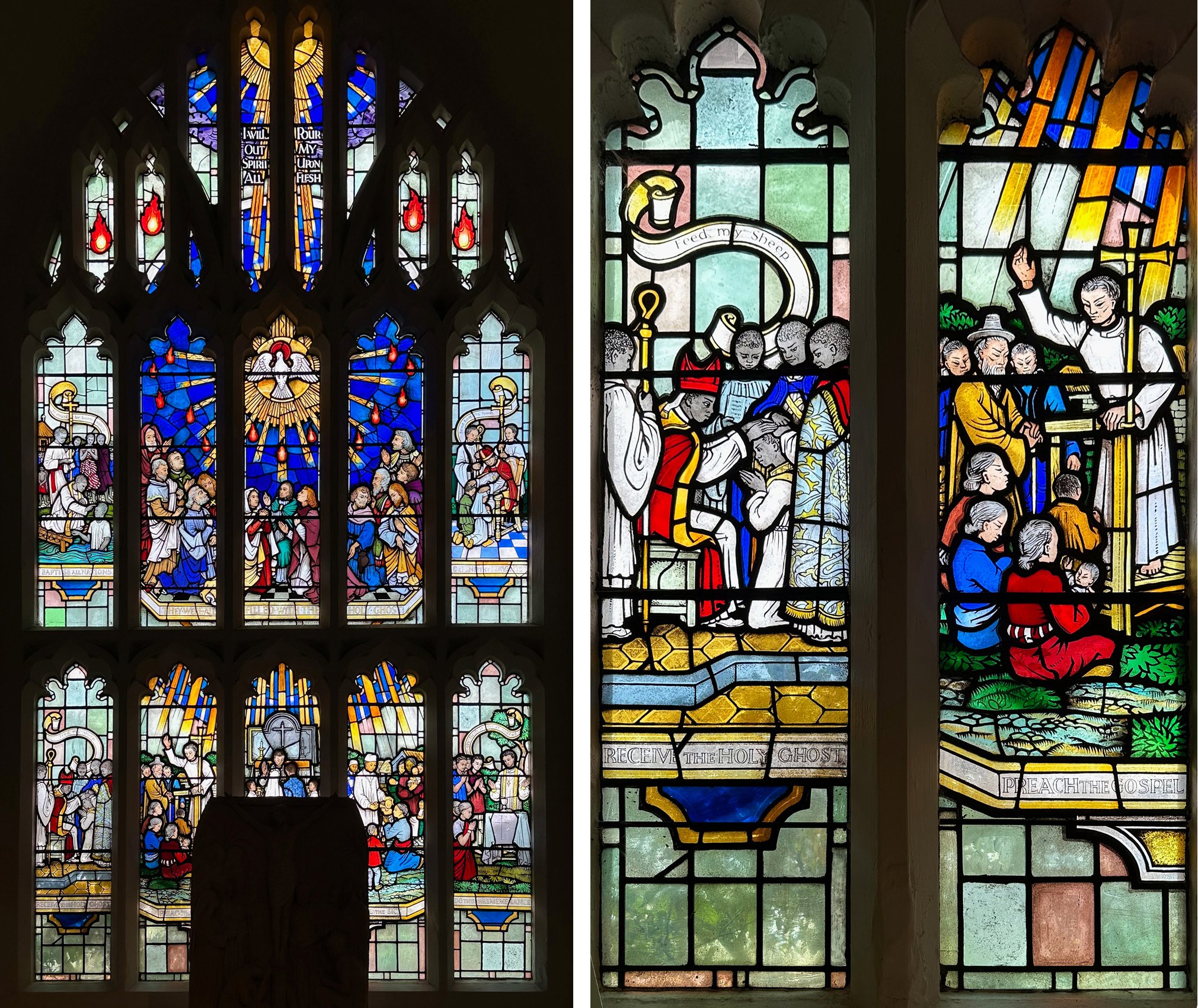
Baptistry window by Francis Stephens (1957) and detail.
Stained glass windows often get blocked off or moved, particularly as tastes change or the subject matter is irrelevant to the new use of a building - so fair enough with the treatment of these 1950s Francis Stephens windows. But there was a window commissioned by Rosemary Nicholson in 1981 for the new museum - The Tradescant Window by the great stained glass artist Lawrence Lee - that nobody thought was worth highlighting in the latest remodelling of the Garden Museum. It is behind the wall of the exhibition gallery in the north west corner of the church, so when you get up on the mezzanine level you can look at the top tracery and down the length of the window - a hopeless view as you can see in the photo below left. There’s not even a sign acknowledging the window or its maker.
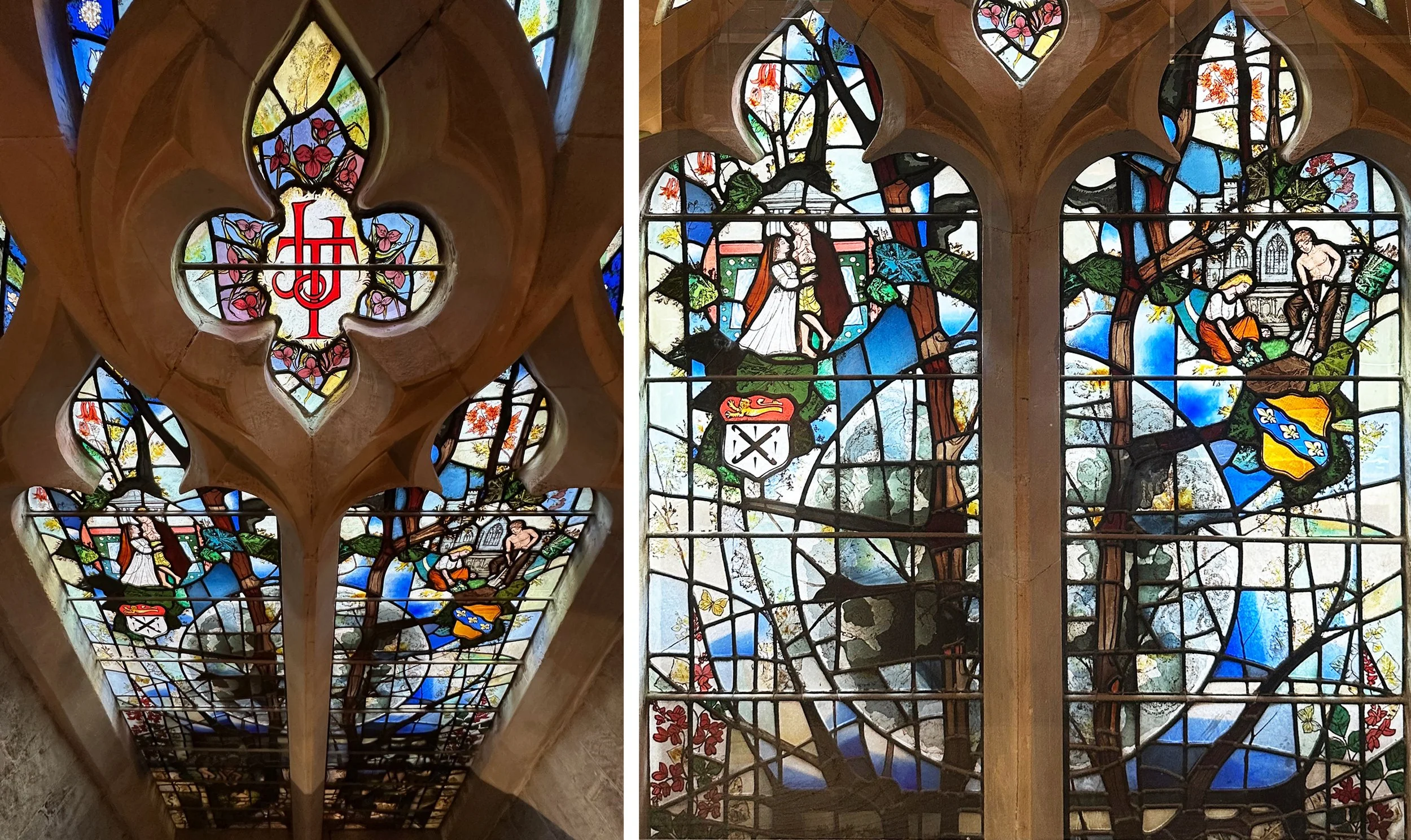
The Tradescant window by Lawrence Lee (1981). Left: looking down. Right: kneeling down in front of a display case and looking through a glass balustrade to the centre of the window.
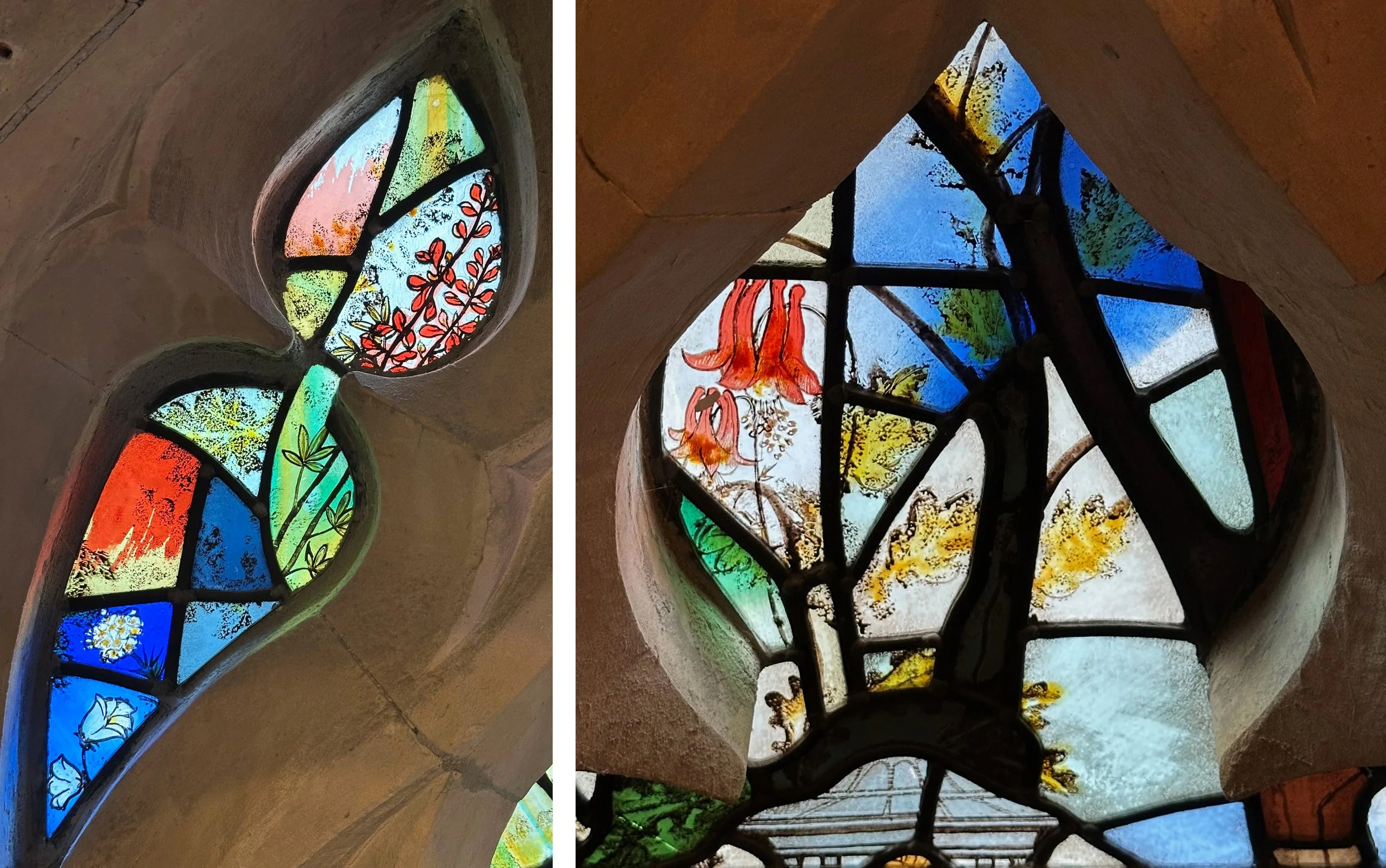
I read that it was one of Lee’s favourite windows - it does look wonderful and it’s a treat to get up to the top tracery and see the plants close up including a red columbine (bottom right) and the three petalled flowers of the plant tradescantia around the initials JJT for father and son. Lee wrote about the window: The central circle is the world as seen from outer space – a symbol of a world-wide interest in plants promoted by the Tradescants …. The square area below is a symbol of order and may also be thought of as an enclosed garden …. Though these elements are the main subject matter of the window, the spectator should first see it as an evocation of nature through colour and design, and not be too concerned with literal explanations. This is something I always like to hear!
I was particularly interested in the way that Lee used the central mullion as a part of the design, with the tree stems growing alongside it, and the branches higher up organically crossing the tracery shapes. I’m amazed that this window wasn’t used as a centre piece of the museum, but it’s still there and I hope that the walls around it will come down one day.
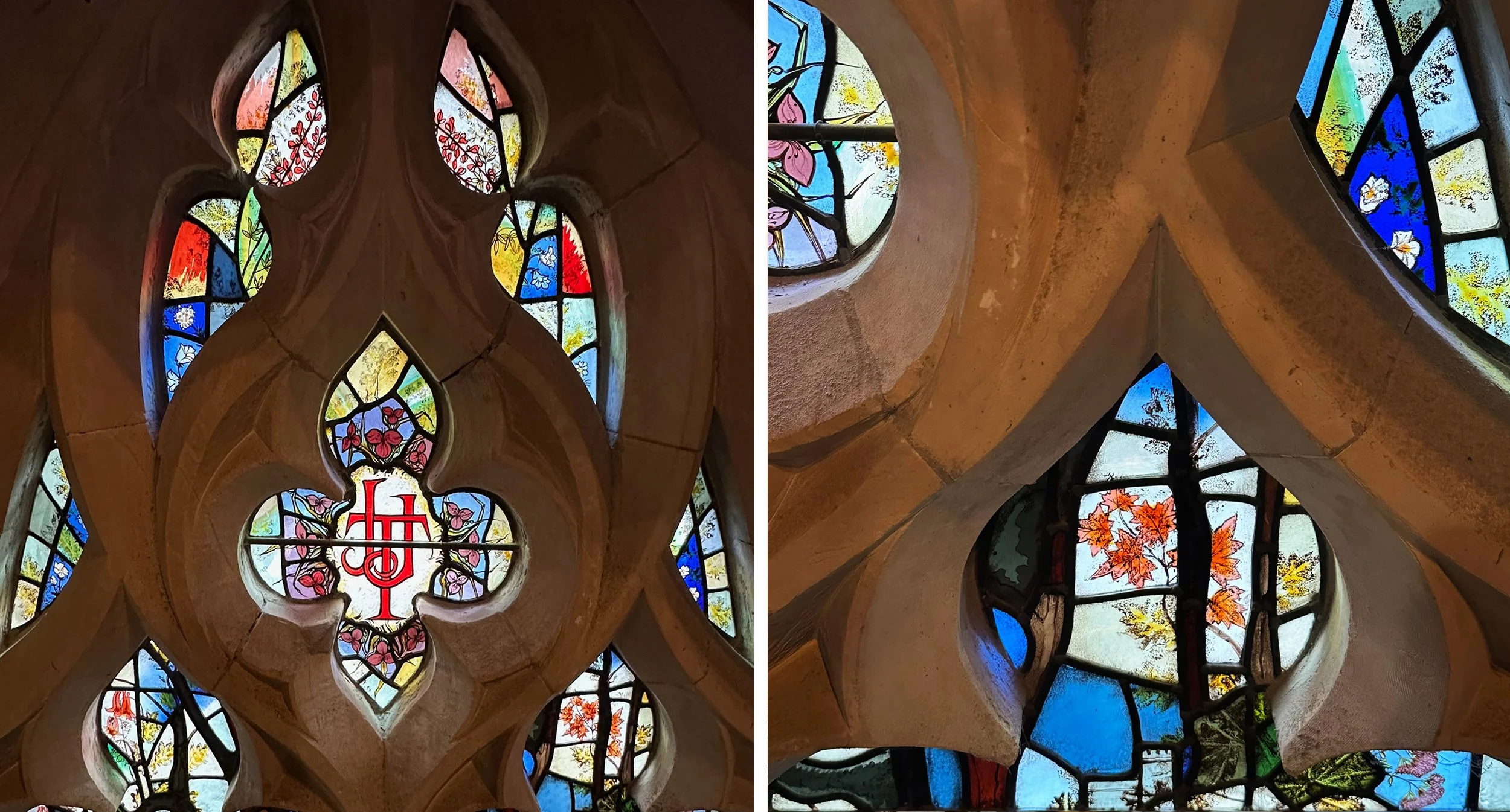
Above and below: details in the tracery from The Tradescant window.